Sign in to save

Bookmark this page so you can find it later.

Sign in to save

Bookmark this page so you can find it later.

Fossils & Ancient Environments Explorer

Discover what Earth looked like millions of years ago by exploring real fossils. Match fossils to ancient habitats and learn how scientists read clues from rocks.

Reference Guide

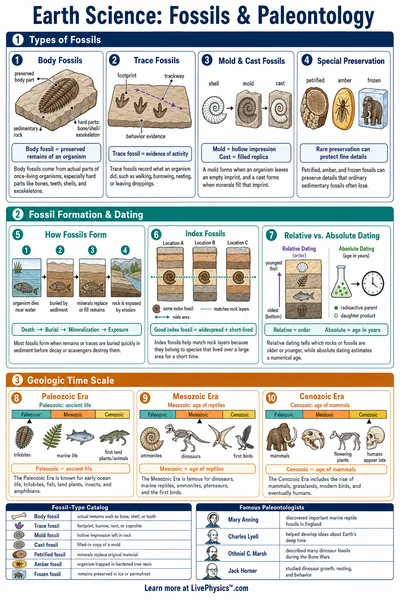
What Are Fossils?

Fossils are the preserved remains or traces of plants and animals that lived long ago. They form when organisms get buried in mud, sand, or ash and slowly turn to stone over millions of years.

Scientists who study fossils are called paleontologists. They use fossils like puzzle pieces to figure out what ancient life and environments were like.

Rock Layers Tell a Story

Rocks form in layers called strata. The bottom layers are older and the top layers are newer. Each layer is like a page in Earth's history book.

Different fossils in different layers tell us how the environment changed over time. Seashells in a mountaintop rock mean that spot was once under the ocean!

Fossils as Environment Clues

Each fossil tells us about the environment where the organism lived. Seashells and trilobites mean ancient oceans. Fern leaves mean warm, wet forests. Petrified wood points to swampy wetlands.

When scientists find several fossils together, they can paint a picture of what that place looked like long ago.

How Environments Change

Earth's surface has changed dramatically over billions of years. Continents move, sea levels rise and fall, and climates shift from tropical to icy and back again.

By comparing fossils from different rock layers, scientists can track these changes. A desert today might have been an ocean 300 million years ago!
Related Content

Related Tools

Earthquake Magnitude Calculator
Four modes: magnitude scales (Richter Mₗ, moment magnitude M𝑤, energy), energy comparison (each step = 31.6× more energy, logarithmic bar chart), Modified Mercalli Intensity I-XII with descriptions, and Richter magnitude from seismograph amplitude. Presets include Minor M3 through Great M8, 1906 San Francisco M7.9, and 2011 Japan M9.1.
Carbon Footprint Calculator
Estimate annual CO₂ emissions from transportation (car miles, fuel type, flights), home energy (electricity, heating, AC), diet (meat consumption, food waste), and lifestyle (shopping, recycling). Pie chart breakdown, country comparison bar chart, trees-to-offset and equivalent-driving metrics. Five presets: Average American, Eco-Conscious, Heavy Commuter, Frequent Flyer, Work from Home.
Star Lifecycle Visualizer
Three modes: interactive HR diagram with 23 real stars (click to see properties), stellar evolution pathway from nebula to end state (white dwarf, neutron star, or black hole based on initial mass), and star properties calculator (luminosity L∝M^3.5, radius, lifetime t∝M^-2.5, apparent magnitude). Six presets: Sun, Red Dwarf (0.3 M☉), Sirius A (2 M☉), Blue Giant (20 M☉), Betelgeuse (15 M☉), Supergiant (50 M☉). Includes spectral class colour strip and SVG star visualization.
H-R Diagram Explorer
Three modes: plot a single star on the Hertzsprung-Russell diagram from temperature, radius, and mass (Stefan-Boltzmann luminosity, spectral class O-M, absolute magnitude, HR region); compare multiple stars side by side; and browse the spectral atlas with typical properties for each class. 23 reference stars plotted, 6 presets from Proxima Centauri to Rigel.