Normal Distribution Lab
Explore the bell curve interactively. Set a mean and standard deviation, move the raw score X, and watch the Z-score, shaded area, and percentile update in real time.
Guided ExperimentNormal Distribution Investigation
Before computing, predict, if X is 1 standard deviation above the mean, approximately what percentile do you expect?
Write your hypothesis in the Lab Report panel, then click Next.
Bell Curve Explorer
Controls
Data Table
(0 rows)| # | X | Mean | Std Dev | Z-score | Percentile % | Interpretation |
|---|
Reference Guide
The Bell Curve
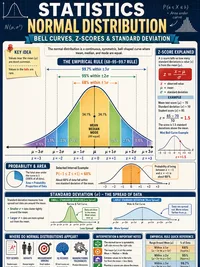
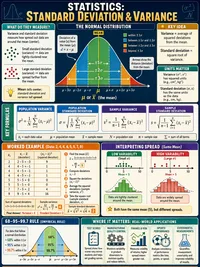
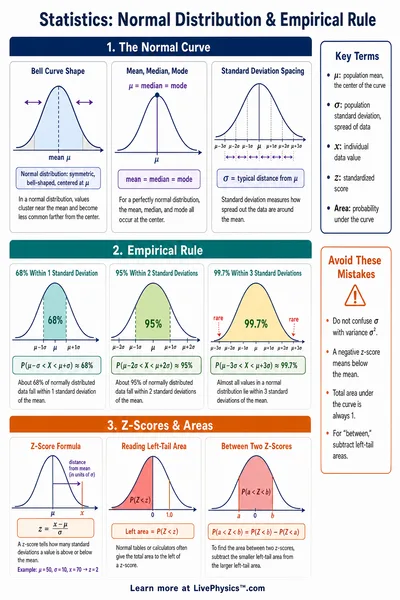
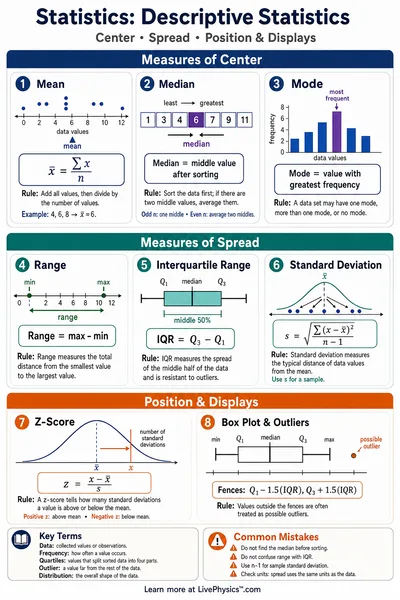
The normal distribution is symmetric and bell-shaped. It is completely defined by two parameters, the mean (μ), which sets the center, and the standard deviation (σ), which controls how spread out the values are.
A narrow bell curve means values cluster tightly around the mean. A wide bell curve means values are more spread out.
Z-Scores
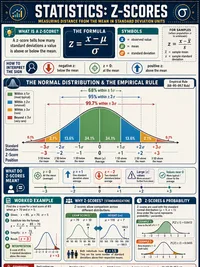
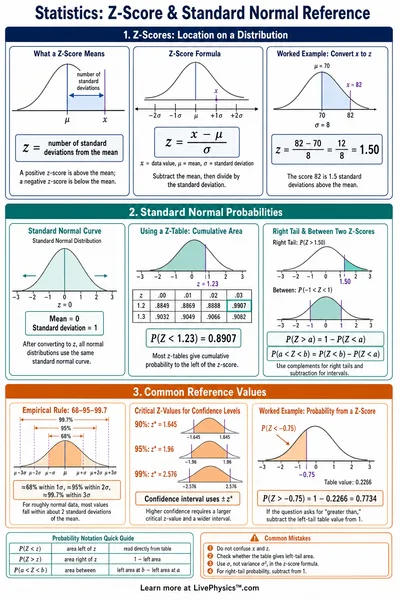
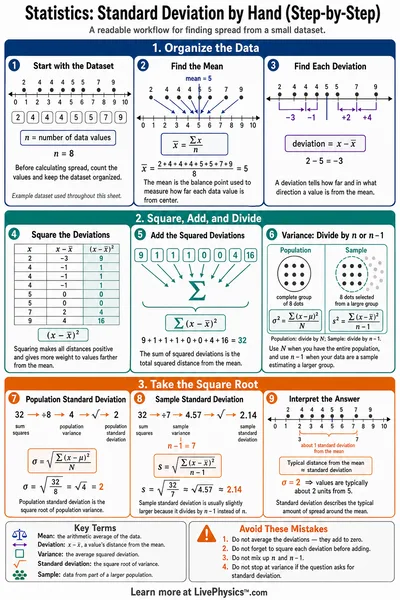
A Z-score tells you how many standard deviations a value X is from the mean. The formula is Z = (X - μ) / σ.
Z = 0 means X is exactly at the mean. Z = 1 means X is one standard deviation above the mean. Z = -1 means X is one standard deviation below.
Percentiles
The percentile is P(X ≤ x) expressed as a percentage. It tells you what fraction of the distribution falls at or below a given value.
Z = 0 corresponds to the 50th percentile. Z = 1 gives the 84th percentile. Z = -1 gives the 16th percentile.
The 68-95-99.7 Rule
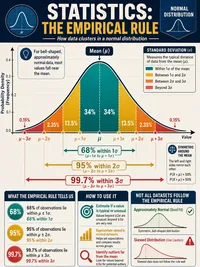
In a normal distribution, approximately 68% of values fall within 1 standard deviation of the mean (between Z = -1 and Z = 1).
About 95% fall within 2 standard deviations, and about 99.7% fall within 3 standard deviations. Values beyond ±3 SD are considered extreme outliers.