Mean, Median & Mode Lab
Enter a dataset to see mean, median, mode, and range computed instantly. Record multiple datasets and compare how each measure changes.
Guided ExperimentMean, Median & Mode Investigation
Before computing, predict, for the default dataset, will the mean be higher or lower than the median? Why?
Write your hypothesis in the Lab Report panel, then click Next.
Enter Your Dataset
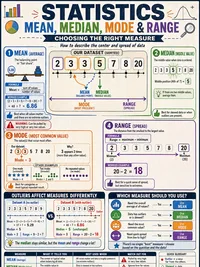
Sorted 1, 2, 4, 4, 4, 6, 7, 9
Controls
Data Table
(0 rows)| # | Dataset | Mean | Median | Mode | Range |
|---|
Reference Guide
Mean
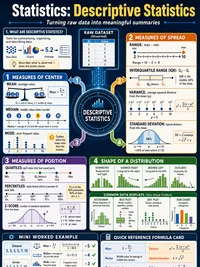
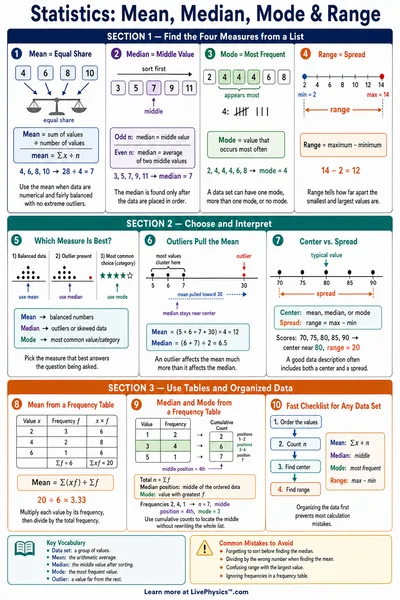
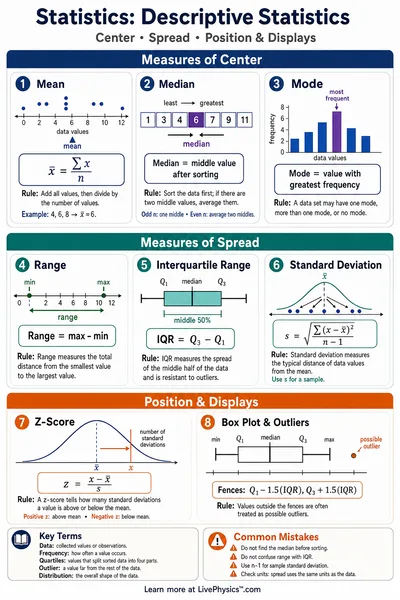
The mean is the sum of all values divided by the count of values. It uses every number in the dataset, which makes it sensitive to outliers.
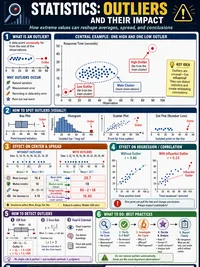
A single very large or very small value can pull the mean far from the center of most of the data. In those situations, the median is often a better summary.
Median
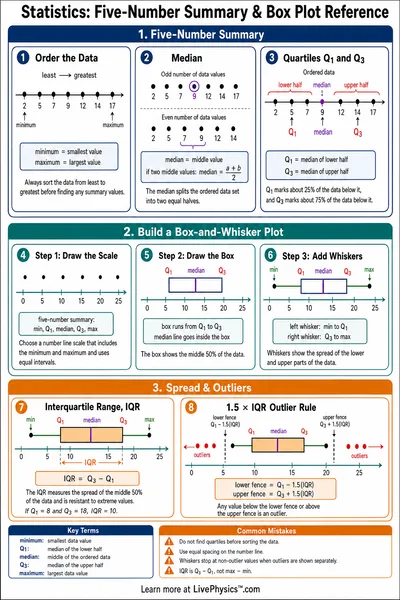
The median is the middle value when all numbers are sorted from smallest to largest. For an even count of values, it is the average of the two middle numbers.
Because the median depends only on rank order and not on exact values, it is robust to outliers. It is commonly used for skewed data such as income or home prices.
Mode
The mode is the most frequently occurring value in a dataset. A dataset can have one mode (unimodal), two modes (bimodal), or more (multimodal).
When every value appears exactly once, the dataset has no mode. The mode is particularly useful for categorical data, such as finding the most common shoe size or test score.
Range
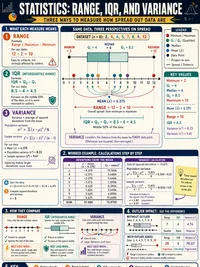
The range is the difference between the maximum and minimum values. It measures the spread of the data rather than its center.
A large range means the data is widely spread out. A range of zero means every value is identical. Like the mean, the range is sensitive to outliers because it depends directly on the extreme values.