Understanding Mixtures Lab
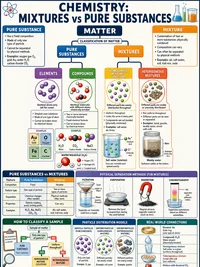
A mixture does not create a new substance. Each material keeps its own properties, even when the particles are too small to see. That idea explains why separation is possible.
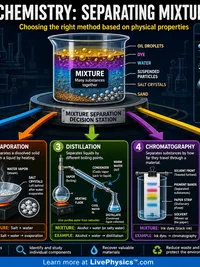
Salt in water still behaves like salt, and water still changes into vapor when heated. A careful observation of particle size, settling, solubility, boiling point, magnetism, and color helps identify a useful method.
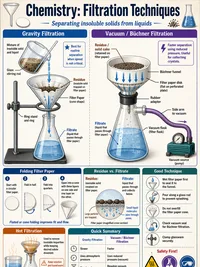
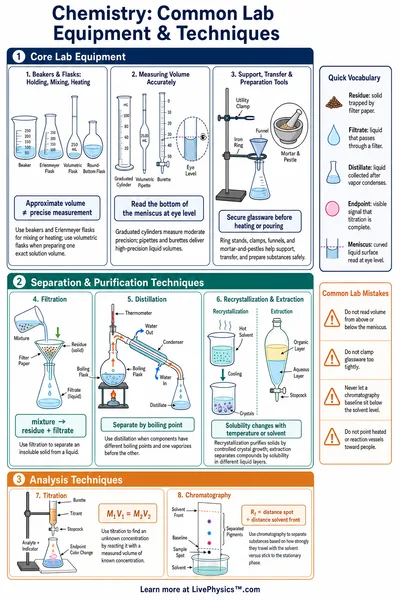
Filtration works when an insoluble solid has particles large enough to be trapped by a barrier. In a sand and water mixture, water passes through filter paper while sand remains as residue.
Dissolved salt cannot be removed this way because its particles pass through with the water. Students should notice the difference between cloudy water, which may contain suspended particles, and clear salt water, which can still contain a dissolved substance.
Decantation uses gravity before pouring. A heavier solid may settle at the bottom, allowing the liquid above it to be poured away gently.
Oil and water form separate layers because they do not mix, so the top layer can be removed with care. This method is quick but rarely perfect, since some liquid or solid can be transferred during pouring.
Heating can separate a solution when one component evaporates more easily than another. Evaporation leaves a dissolved solid behind, which is useful for collecting salt from salt water.
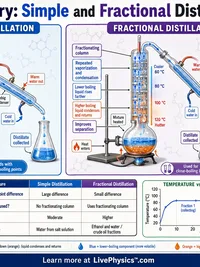
Distillation collects the vapor after it cools back into liquid, so it can recover water rather than lose it to the air. In real water treatment, distillation needs energy, so it is used when very pure water is needed or when other methods are unsuitable.
A magnet separates only substances that are attracted to it, such as iron or some forms of steel. It will not pull out every metal, so knowing the material matters. Chromatography separates dissolved colored substances because they travel through paper at different speeds.
Ink can spread into several pigments, showing that one visible color may contain more than one substance. In the lab, use small samples, label containers clearly, and record what you observe before choosing a method.