Understanding Mixtures vs Compounds Explorer
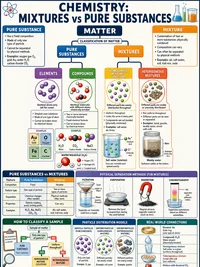
A particle diagram gives clues about what a sample contains. Read the atom labels, identify the groups joined by bonds, and then compare those groups across the whole diagram. The classification depends on the sample as a whole.
Counting circles alone can lead to a mistake. A group containing two oxygen atoms is still made from one element, while a water molecule contains hydrogen and oxygen. The types of atoms matter as well as the connections between them.
A sample of an element contains only one type of atom. Those atoms may occur in bonded groups, as they do in oxygen gas. Bonds in a diagram therefore do not automatically mean the sample is a compound.
In a pure molecular compound, each molecule contains different elements joined in a particular arrangement. Every water molecule has two hydrogen atoms for each oxygen atom. Adding more water molecules increases the amount of water without changing that ratio.
A mixture contains more than one substance. It can contain two elements, two compounds, or an element together with a compound. Finding a compound molecule somewhere in a diagram does not make the entire sample a pure compound.
Air provides a useful example because its oxygen and nitrogen molecules remain separate substances. Each molecule has bonds within it, but the sample contains different kinds of molecules together. A mixture can contain many bonded particles.
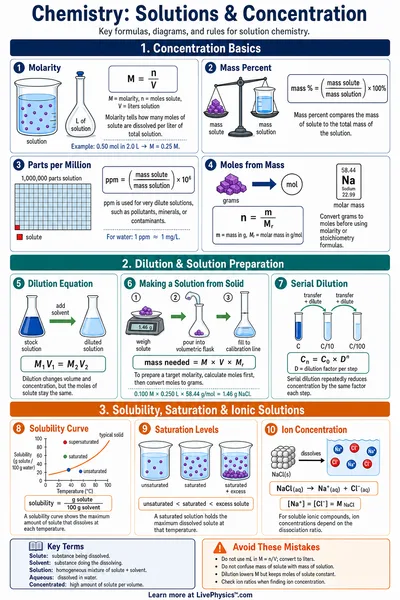
The amounts of substances in a mixture can vary. Adding more salt to water can make a saltier solution, provided the extra salt dissolves. This differs from changing the ratio of atoms within a water molecule, which would change the substance.
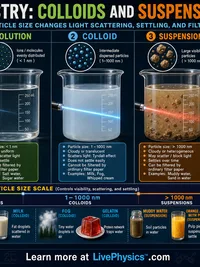
A uniform appearance does not prove that a sample is pure. Saltwater can look the same throughout while containing water and dissolved salt. Sand mixed with water has visibly different parts and may settle into layers.
Particle pictures simplify structures that are too small to see directly. The colors identify elements in the model, rather than showing the actual colors of individual atoms. Diagram spacing and circle sizes should not be treated as precise measurements.
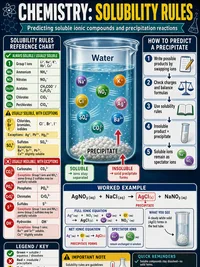
Salt needs an extra distinction when interpreting these simplified pictures. Solid table salt forms an extended arrangement of sodium and chloride ions, rather than separate salt molecules. When it dissolves, those ions spread through the water.
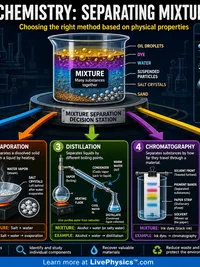
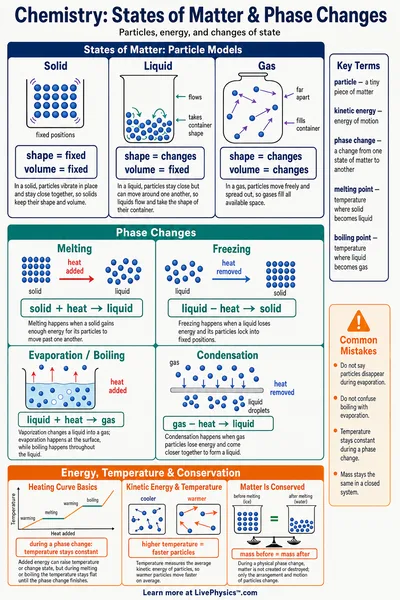
Physical separation uses differences between substances in a mixture. A filter can catch sand while water passes through, and evaporation can leave salt behind. Evaporating pure water changes its state without breaking its molecules into hydrogen and oxygen.
In Learn mode, connect each hint with visible evidence before choosing a zone. In Practice mode, explain your classification using atom types, bonding, and the substances present. After feedback, revisit the evidence so the next choice follows a reason rather than a remembered color.