Understanding Separating Mixtures Lab
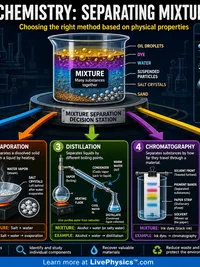
A separation method works only when the substances in a mixture differ in a useful physical property. Useful differences include particle size, magnetism, density, solubility, and boiling point. The substances do not turn into new substances during separation, so their own properties remain available for scientists to use.
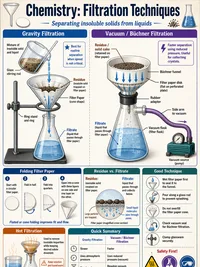
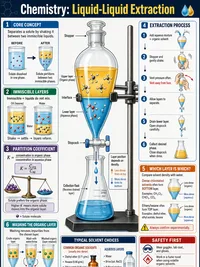
Filtration traps an insoluble solid because its particles are too large to pass through the tiny holes in filter paper. Sand stays on the paper while water moves through, but dissolved salt passes through with the water because salt particles are spread between water particles. Decanting uses settling or separate layers, so it works best when a heavier material sinks or when liquids such as oil and water do not mix.
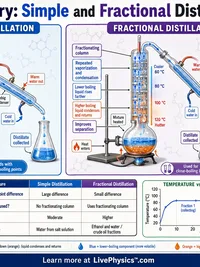
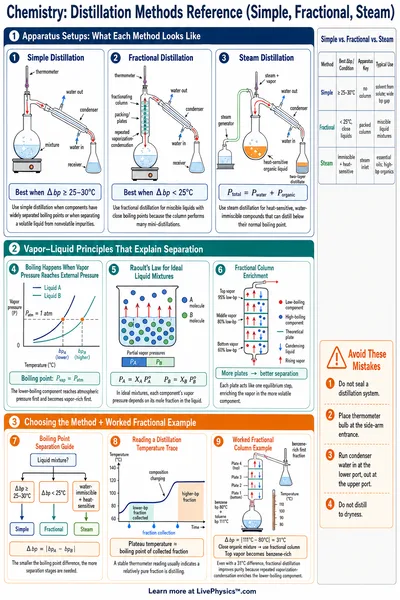
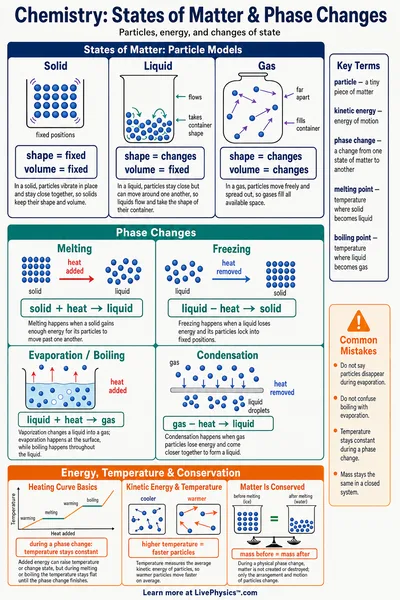
Evaporation removes a liquid by changing it into a gas, leaving behind a dissolved solid that cannot evaporate under the same conditions. This can recover salt from salt water, though the water is lost unless it is collected elsewhere. Distillation solves that problem by heating a liquid mixture, cooling the vapor, then collecting the condensed liquid, which makes it useful when different liquids have different boiling points.
Magnetic separation depends on the material itself, not on how large or heavy the particles are. Iron filings can be pulled from sand because iron is attracted to a magnet, while ordinary sand is not. A method can fail even when it seems sensible, such as filtration for alcohol and water, because both liquids pass through the filter together as one uniform mixture.
These ideas appear outside the lab in water treatment plants, recycling centers, food production, mining, and fuel processing. When studying a mixture, first decide whether you can see separate parts, whether any material settles, whether a solid dissolves, and whether the liquids form layers. Careful observations matter because cloudiness, particle size, temperature, and waiting time can change what you see and can make a correct method appear unsuccessful.