Narrative Writing Lab
Build a story in three guided phases. Plan your characters and plot, draft the story, then revise against a rubric that scores show vs tell, sentence variety, dialogue, and more.
Pick a guided experiment
Guided ExperimentShow vs Tell rewrite
I think showing a feeling through action and sensory detail will pull the reader in more than telling them the feeling directly.
Write your hypothesis in the Lab Report panel, then click Next.
Controls
Current phase 1. Plan
Plan 0 / 12 fields. Draft 0 words. Rubric 6 / 24.
Choose a story prompt
Pick one of the prompts below or write your own. The prompt is the seed for your whole story.
Protagonist
Setting
Plot beats
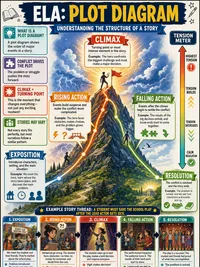
Your plot arc
The diagram updates as you fill in the plot beats. Tension rises into the climax and falls into the resolution.
Inciting incident
Not filled in yet.
Rising 1
Not filled in yet.
Rising 2
Not filled in yet.
Rising 3
Not filled in yet.
Climax
Not filled in yet.
Resolution
Not filled in yet.
Data Table
(0 rows)| # | Trial | Prompt | Word Count | Rubric Score (/24) | Avg Sentence Length |
|---|
Reference Guide
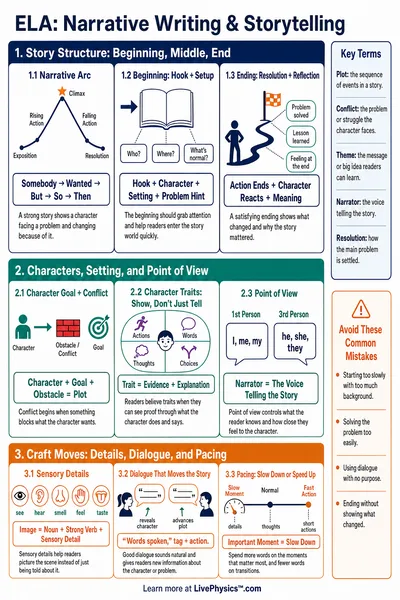
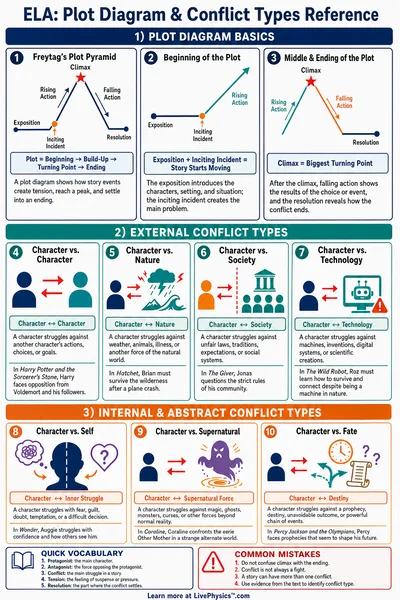
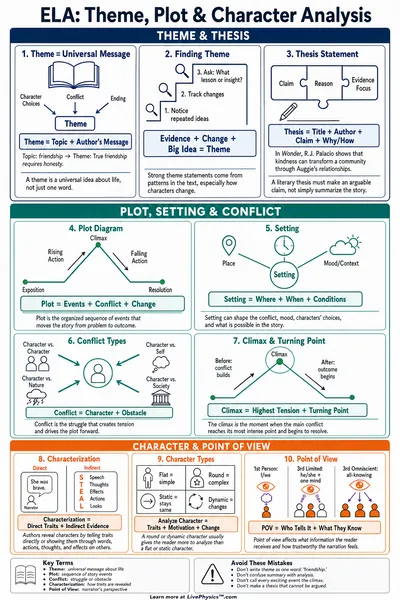
The Plot Arc
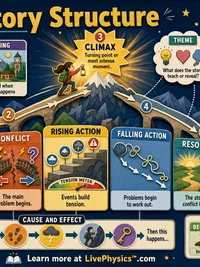
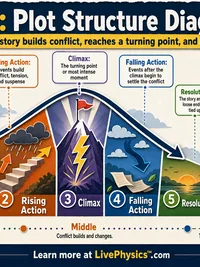
Most short stories follow a simple shape. The narrative rises into a peak of tension, then falls into the new normal.
Exposition. Who is the protagonist, where are we, and what is normal here?
Inciting incident. The single event that pulls the protagonist out of normal life.
Rising action. Three or four events that raise the stakes and deepen the problem.
Climax. The moment of greatest tension. The decision or confrontation that turns the story.
Resolution. Life after the climax. Not always happy, but always changed.
Show vs Tell
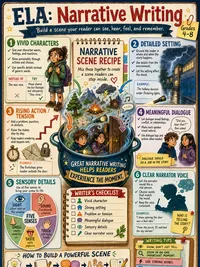
Telling reports a feeling. Showing makes the reader experience it. "She was nervous" tells. "Her hand shook as she lifted the cup" shows.
Strong showing leans on sensory detail (sight, sound, smell, taste, touch), concrete action, and lines of dialogue. The reader gets to feel the emotion, not be told what it is.
A useful test. Cross out every line that names an emotion. If the scene still carries the same feeling, your showing is working.
Strong Story Openings
Open with a moment, not a summary. The strongest first lines drop the reader into a specific scene that is already in motion.
- Action. "The door cracked open before I touched the handle."
- Dialogue. "We have to leave. Now."
- Concrete image. "Frost crept along the kitchen window in tiny ferns."
- Voice. "I have never been good at goodbyes, and yet here we are again."
Avoid weather reports, dictionary definitions, and slow histories. Start where the trouble starts.
Revising Your Draft
Revision is not proofreading. Proofreading fixes typos. Revision reshapes the story so it lands harder.
- Read aloud. Every flat or rambling sentence will jump out.
- Cut. If a paragraph does not raise tension or reveal character, it goes.
- Vary length. Mix short, medium, and long sentences for rhythm.
- Strong verbs. Replace "walked" or "said" when a sharper choice fits.
- Sensory pass. Add one sight, one sound, and one tactile detail per scene.
One round of revision per dimension is enough. Move on before you over-edit.