Paycheck and Taxes Lab
A worker's gross pay is almost never the amount that lands in the bank. Set a gross paycheck, choose simplified tax rates and deductions, and watch each line reduce the check until you reach net take-home pay. Log paychecks to compare how raises, retirement savings, and benefit choices change what you actually keep.
Start From an Example
Set Your Paycheck
Paycheck Breakdown
- Retirement (pre-tax)$0.00
- Health insurance (pre-tax)$0.00
- Federal income tax- $180.00
- State income tax- $60.00
- Social Security (6.2%)- $93.00
- Medicare (1.45%)- $21.75
- Total deductions- $354.75
76.3% of gross pay
Controls
Compare scenarios to see how take-home pay changes.
Adjust gross pay, tax rates, and deductions, then log each paycheck to compare raises and benefit choices side by side.
Data Table
(0 rows)| # | Gross Pay($) | Income Tax($) | FICA($) | Pre-tax($) | Total Deductions($) | Net Pay($) |
|---|
Reference Guide
Gross Pay vs Net Pay
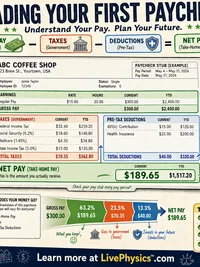
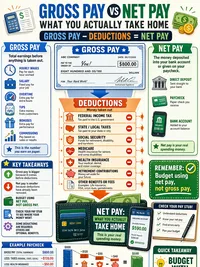
Gross pay is the total amount you earn before anything is taken out. It is the number you usually see in a job offer or an hourly rate times hours worked.
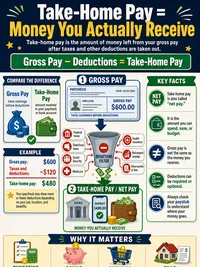
Net pay, also called take-home pay, is what remains after every deduction. It is the amount that actually reaches your bank account.
The difference between the two is the sum of your deductions, income taxes, payroll taxes, and any pre-tax items like retirement savings or health insurance. For many workers, net pay is roughly 70 to 85 percent of gross pay.
Net pay equals gross pay minus total deductions. This lab shows each piece so you can see exactly where the money goes.
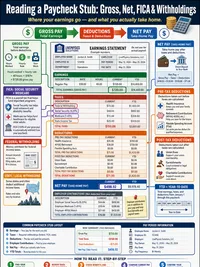
FICA Taxes (Social Security and Medicare)
FICA stands for the Federal Insurance Contributions Act. These payroll taxes fund Social Security and Medicare, programs that support retirees and people with disabilities.
- Social Security. The employee rate is 6.2 percent of gross pay.
- Medicare. The employee rate is 1.45 percent of gross pay.
Together that is 7.65 percent of gross pay. Your employer pays a matching amount that you never see on your check.
FICA is calculated on gross pay and always comes out, even when your income is low enough that you owe no income tax. That is why a zero income-tax paycheck still has deductions.
Income Tax Withholding
Federal income tax is withheld from each paycheck so you pay as you earn rather than all at once in April. State income tax works the same way, though some states have no income tax at all.
Real federal withholding uses progressive tax brackets, where higher portions of income are taxed at higher rates, along with the information on your W-4 form. To keep things clear, this lab uses a single flat teaching rate you choose, applied to your taxable pay.
Taxable pay is your gross pay minus pre-tax deductions like retirement contributions and health premiums. Because those come out before income tax is figured, they lower the tax you owe.
Pre-tax Deductions and What-If Scenarios
Pre-tax deductions are amounts removed from gross pay before income tax is calculated. Common examples are retirement contributions, such as a 401(k), and health insurance premiums.
Because they are pre-tax, a retirement contribution lowers your take-home pay by less than its full dollar amount. Putting aside 100 dollars might reduce your check by only 80 dollars, since you also pay less income tax.
Try a few experiments. Give yourself a raise and see how net pay grows. Add a retirement contribution and watch take-home pay fall by less than expected. Set the state tax rate to zero to compare living in a state with no income tax. Log each paycheck and compare the rows.
These figures are simplified for learning and do not reflect any specific real tax return.