Reading Comprehension Lab
Read a passage, answer six scaffolded questions, and watch your per-skill accuracy build across attempts. Six passages span informational, literary, and historical genres for grades 6 through 10.
Guided ExperimentTrack your inference skill across three passages
Which skill (main idea, detail, inference, vocabulary, author's purpose) do you think will be hardest for you, and why?
Write your hypothesis in the Lab Report panel, then click Next.
Guided experiment
Grade band
Choose a passage
Reading timer
Timed modes auto-advance to questions when the timer hits zero. Untimed mode lets you read at your own pace.
Controls
Ready The Honeybee Hive | Untimed
You will read the passage, then answer six questions.
Data Table
(0 rows)| # | Trial | Passage | Score | Time(s) | Accuracy(%) |
|---|
Reference Guide
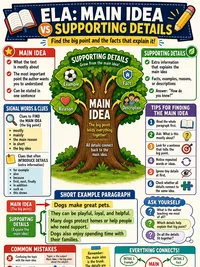
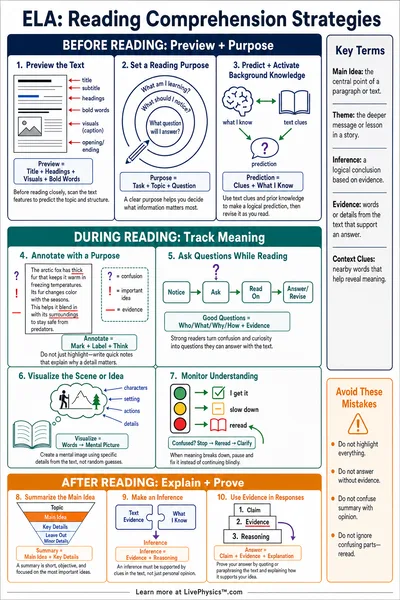
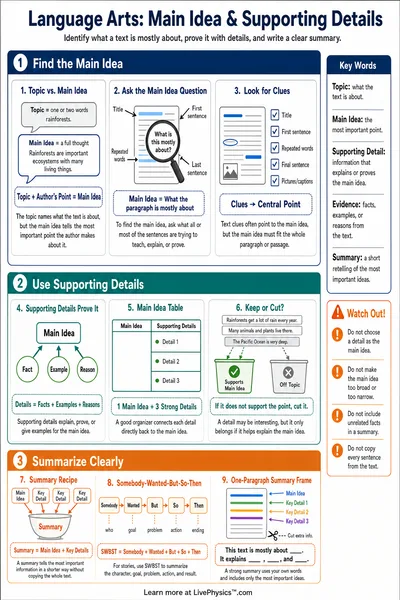
What is a Main Idea?
The main idea is the central point an author wants you to take from a passage. It is broader than any single detail but more specific than the topic. The topic of a passage might be "honeybees," but the main idea is the full claim the author makes about honeybees.
To find the main idea, ask three questions. What is the passage mostly about? What does the author seem to want the reader to understand? Which sentence, if removed, would change the whole point?
In informational texts, the main idea is often stated near the beginning or the end. In literary texts, the main idea is usually a theme that has to be inferred from events and choices.
Tip. Cover the answer choices and try to state the main idea in one sentence of your own. Then look for the choice closest to your sentence.
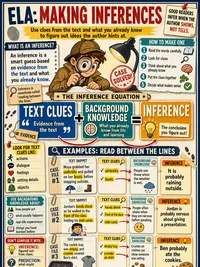
Inference vs Detail
A detail question asks for information stated directly in the text. The answer is on the page. You should be able to point to a single sentence that contains the correct answer.
An inference question asks you to combine information from the text with what you already know. The answer is not stated directly but is strongly implied. A good inference is supported by evidence; a guess is not.
Strategy. For a detail question, reread the sentence and pick the choice that matches almost word for word. For an inference question, find the two or three sentences that point toward the answer, then check whether the choice is logically supported by those sentences.
A wrong inference choice usually does one of three things, it goes too far beyond the text, it contradicts a sentence in the text, or it is true in general but not in this passage.
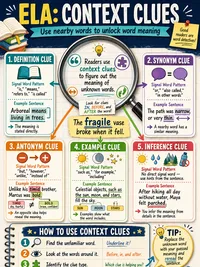
Vocabulary in Context Strategies
When a test asks what a word "most nearly means" in a passage, the answer must fit the sentence, not just the dictionary. The same word can mean very different things in different sentences.
Step one. Reread the sentence with the target word and the sentence before it. Step two. Replace the target word with each answer choice. Step three. Pick the choice that keeps the meaning of the sentence intact.
Watch for signal words. "Like," "such as," and "for example" introduce examples. "Unlike," "but," and "however" introduce contrasts. Both kinds of signals point to the meaning of an unfamiliar word.
Common traps. A choice that uses the most popular definition of the word may still be wrong if it does not fit this sentence.
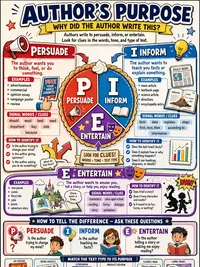
Author's Purpose and Tone
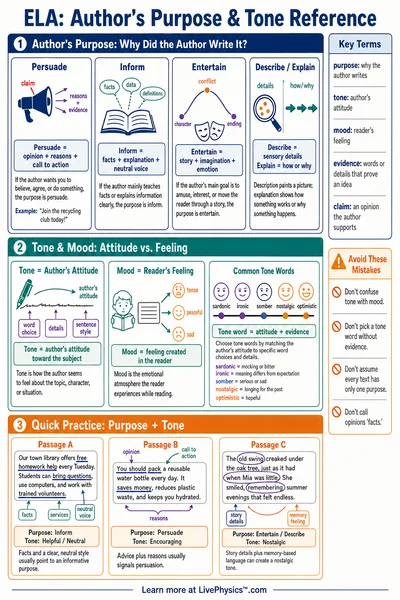
Author's purpose questions ask why an author included a passage, paragraph, or sentence. The four common purposes are to inform, to persuade, to entertain, and to describe. A single passage often mixes more than one.
Tone is the author's attitude toward the subject. Tone is shown through word choice. A passage about a fallen tree can be sad, hopeful, scientific, or affectionate depending on the words used.
Strategy. Ask, "What does the author want me to feel or do after reading this?" If the author wants you to act, the purpose is persuasive. If the author wants you to learn a fact, the purpose is informational. If the author wants you to see a scene or feel an emotion, the purpose is descriptive or literary.
For tone, underline three or four word choices that share a feeling. Those words are usually the tone evidence the test wants.