Why Mountains Have Snow on Top in Summer
High peaks stay cold above warm valleys
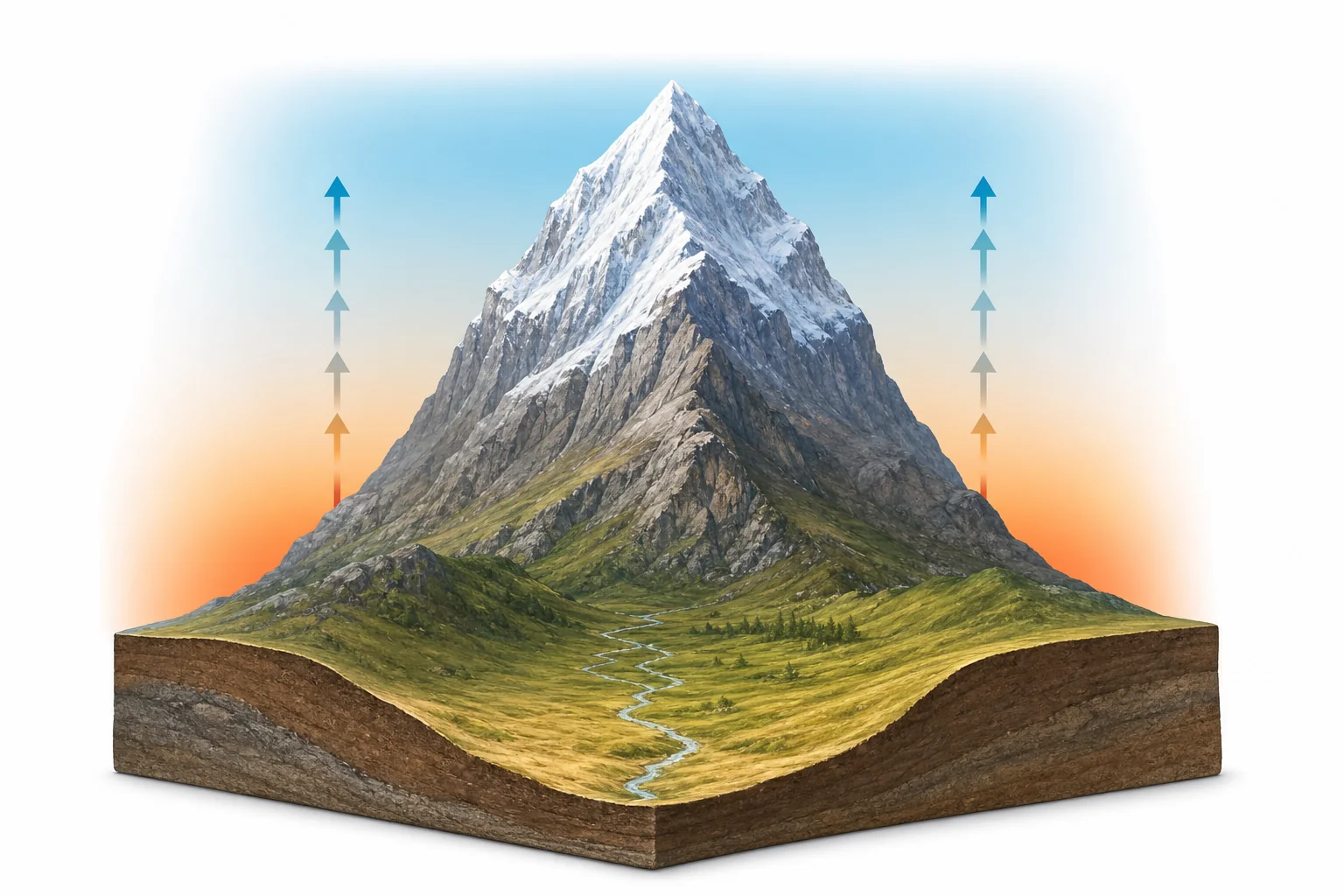
Mountaintops stay snowy in summer because air is colder high above sea level. Snow can fall there even when valleys are warm, and old snow melts slowly. If more snow piles up than melts, a white cap remains.
A mountain can look like it is in two seasons at once. The lower slopes may have flowers, streams, and warm air. The top may still hold snow in July. This happens because temperature changes with height. As air rises up a mountain, it spreads out in lower air pressure. Spreading air cools. In many parts of the lower atmosphere, the temperature drops about $6.5\,^{\circ}\mathrm{C}$ for every $1\,\mathrm{km}$ of height. That pattern is called the atmospheric lapse rate. It is not the same every day, but it is a useful guide. A peak that is several kilometers high can be cold enough for snow while the valley below feels like summer. Snow also reflects sunlight and can stay frozen longer in shaded bowls, north-facing slopes, and places where storms add more snow than summer can melt.
Air gets colder with height
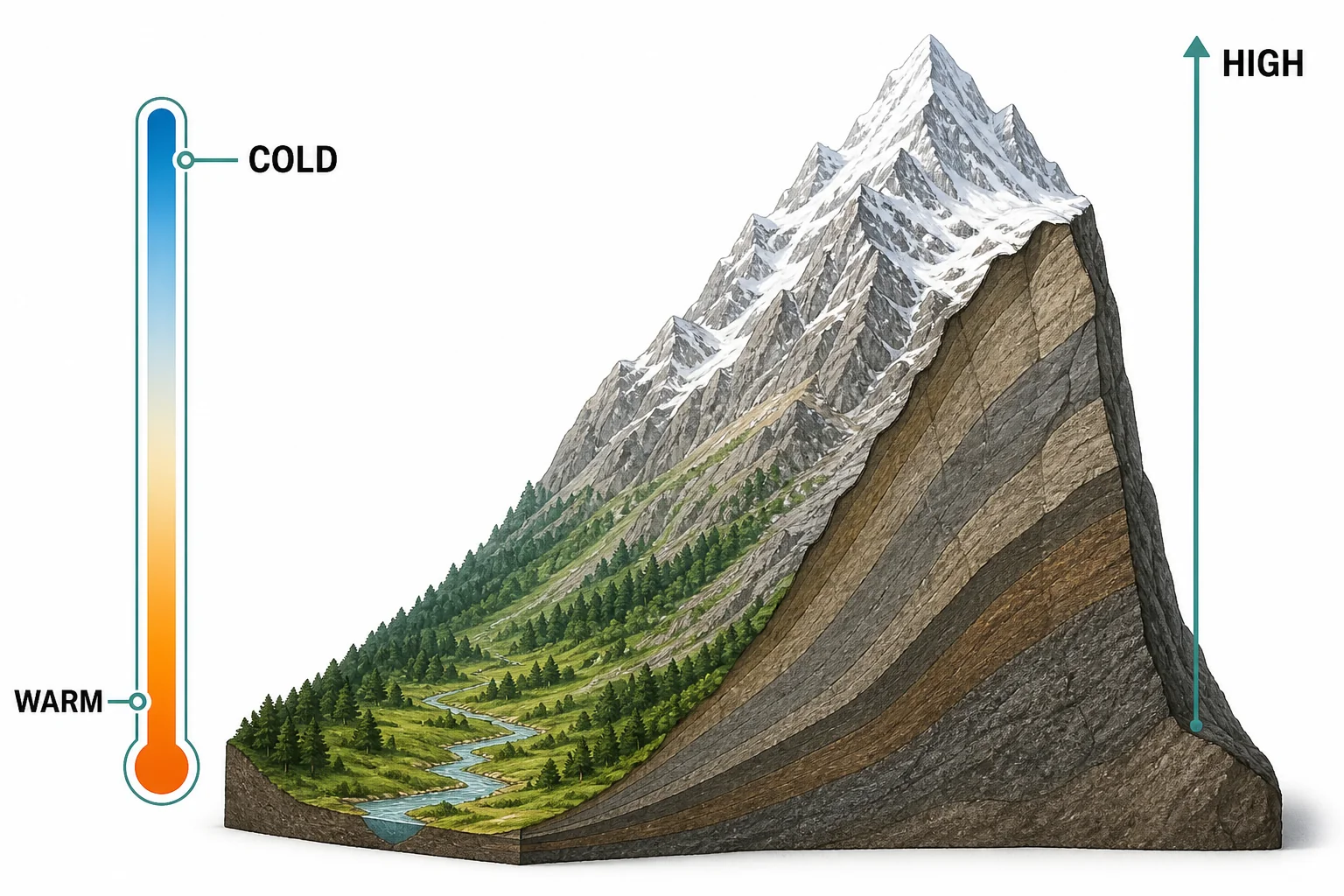
Higher altitude usually means lower temperature.
Pressure helps explain cooling
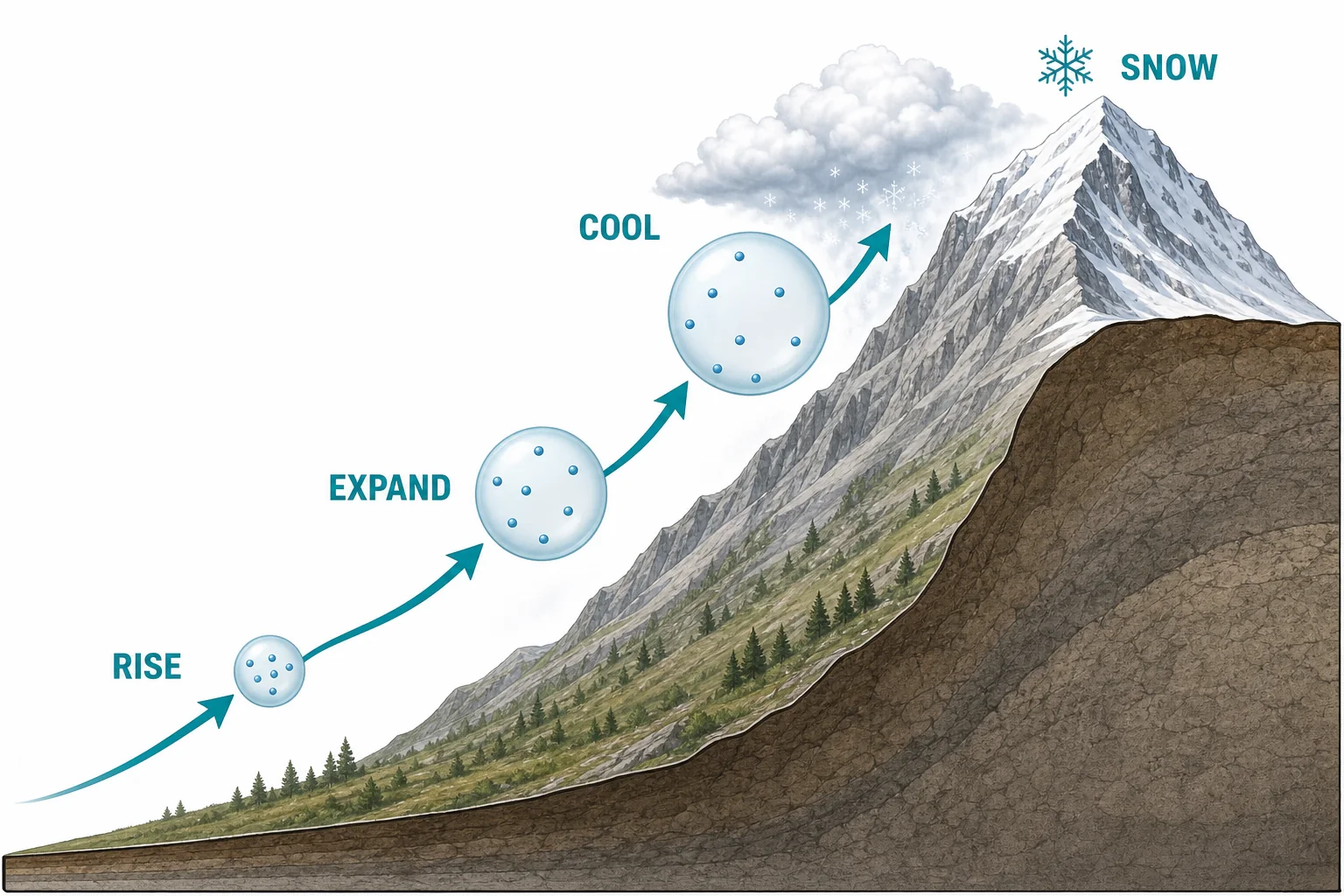
Lower pressure at high altitude lets rising air expand and cool.
Snow falls where air stays below freezing
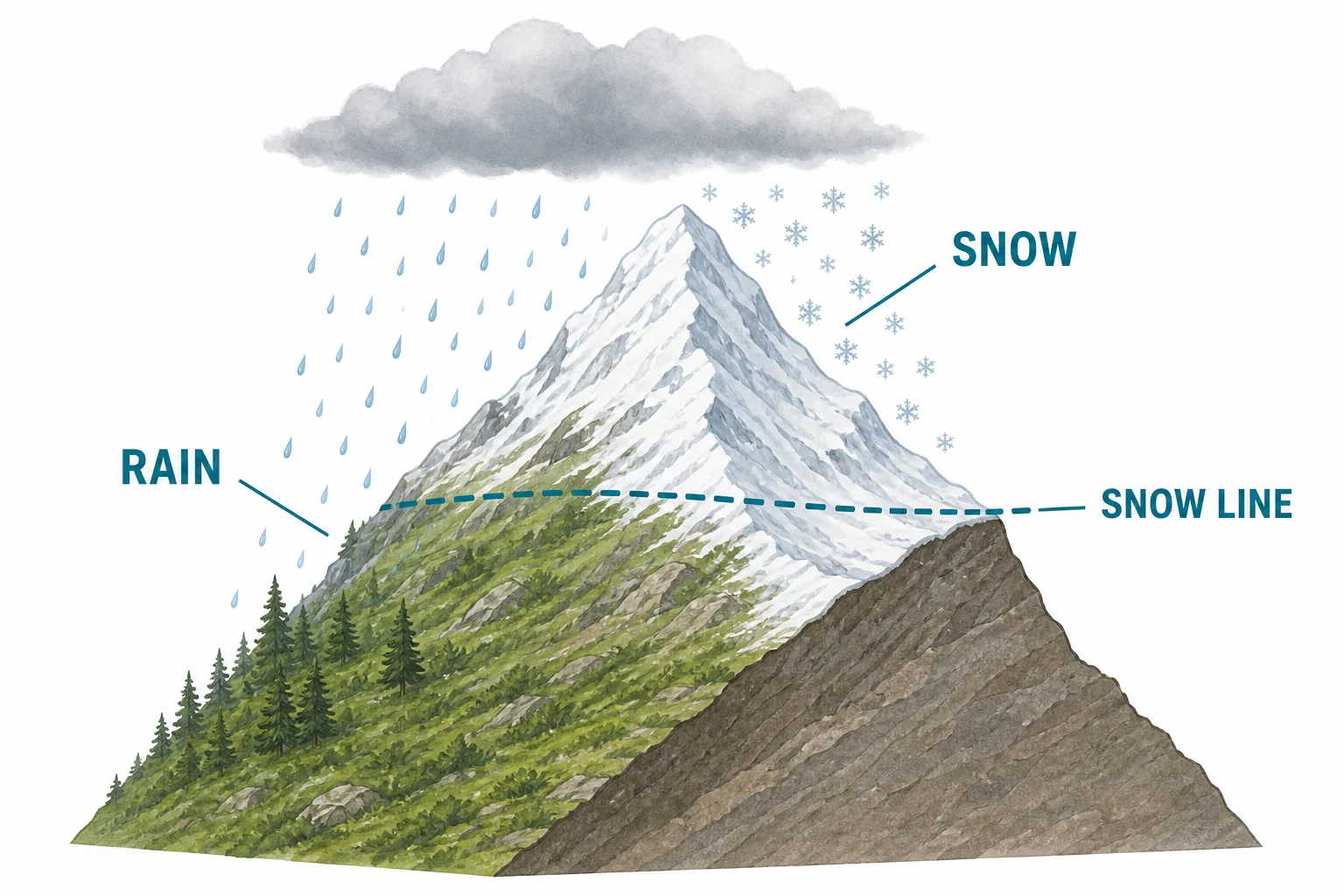
A summit can get snow while nearby lower land gets rain.
Melting is not just about air temperature
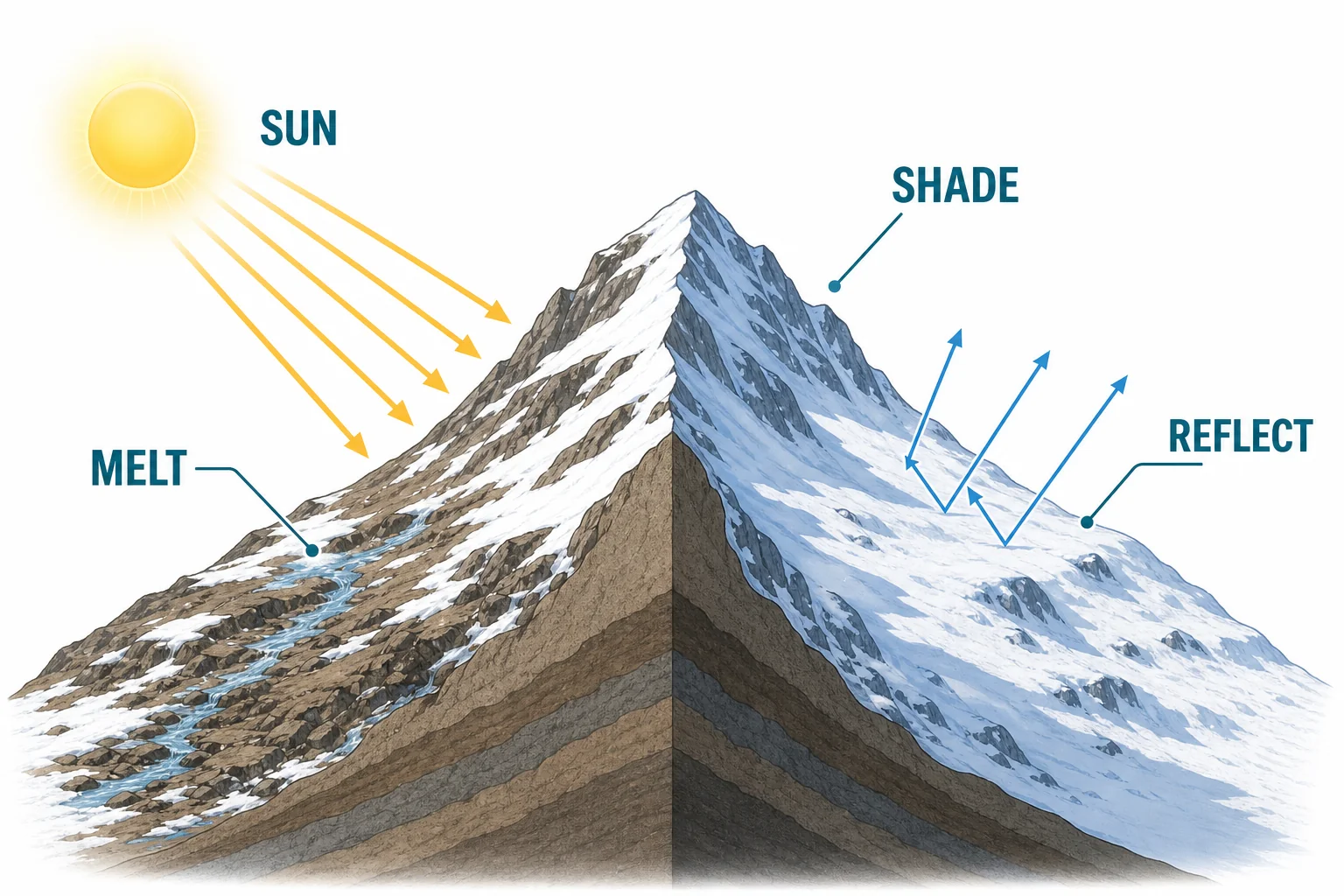
Snow lasts longer where it reflects light or sits in shade.
A snow cap is a balance
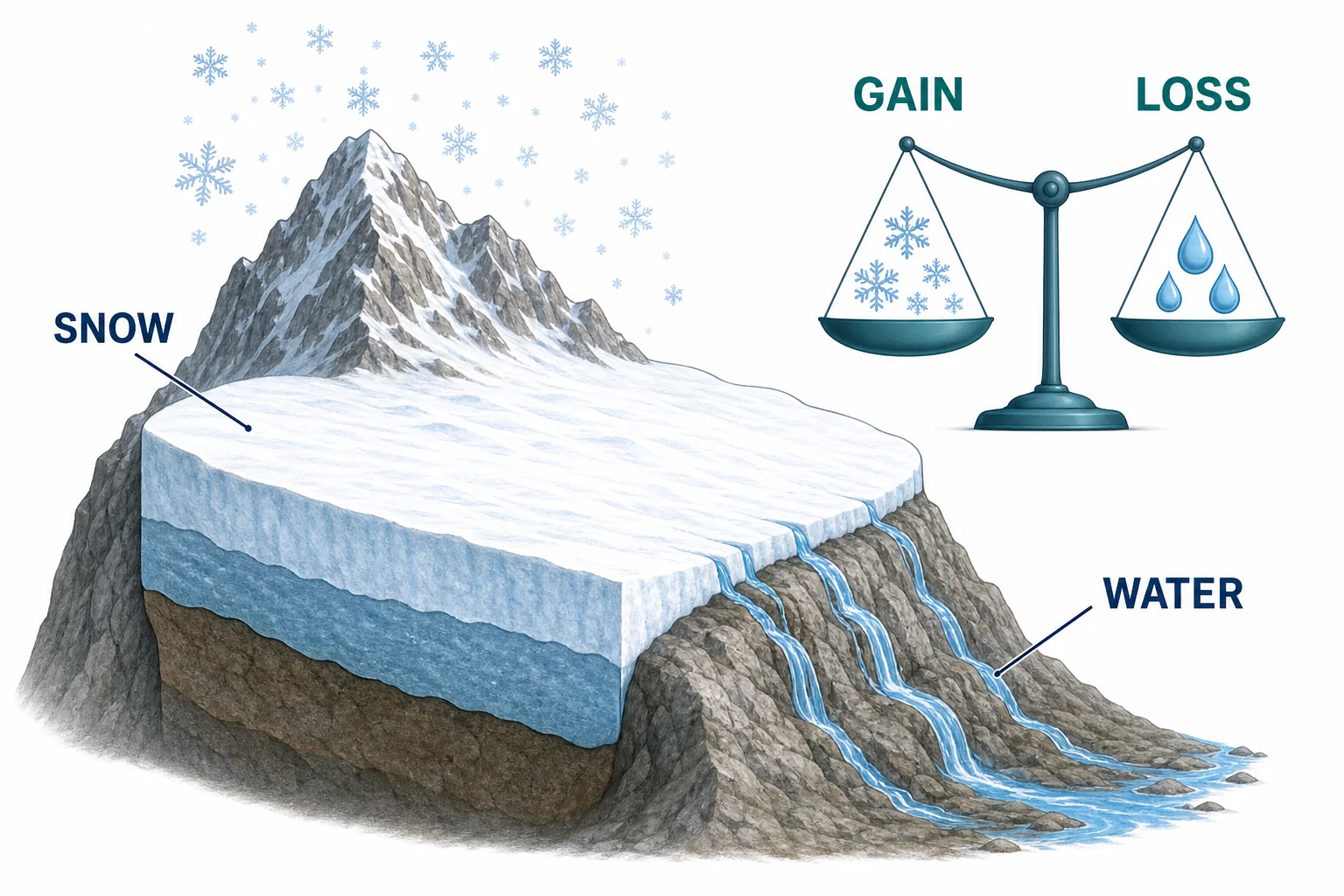
A lasting snow cap depends on both snowfall and melting.
Vocabulary
- Altitude
- Height above sea level.
- Atmospheric lapse rate
- The rate at which air temperature changes with height in the atmosphere.
- Air pressure
- The force from the weight of air pressing on a surface.
- Snow line
- The elevation where snow can remain on the ground during a season.
- Albedo
- A measure of how much light a surface reflects.
- Snowpack
- Layers of snow that build up on the ground over time.
In the Classroom
Map a mountain temperature profile
20 minutes | Grades 6-8
Students start with a valley temperature and use a lapse rate of $6.5\,^{\circ}\mathrm{C}$ per kilometer to estimate temperatures at several elevations. They mark where the temperature crosses freezing and compare that height with a possible snow line.
Model albedo with paper surfaces
25 minutes | Grades 6-8
Place black paper and white paper under the same lamp and measure surface temperature over time. Students connect the results to clean snow, dark rock, and dusty snow on mountains.
Build a snowpack balance chart
30 minutes | Grades 6-8
Students make a simple table of monthly snowfall and melting for a fictional mountain. They graph when the snowpack grows, when it shrinks, and when summer snow can survive.
Key Takeaways
- • Air usually gets colder as altitude increases.
- • Rising air expands in lower pressure and cools.
- • High summits can receive snow while lower slopes receive rain.
- • Shade, albedo, wind, and dust affect how fast snow melts.
- • Summer snow remains when snow gains match or exceed snow losses.