CAS Calculator
A computer algebra system that works with exact symbols, not rounded decimals. Factor, solve, differentiate and integrate, then see each answer on a graph. Pick one of the ready-made examples to start.
Algebra
Equations
Calculus
Numbers
Factor
Write a polynomial as a product of factors, or a whole number as a product of primes.
How to type math
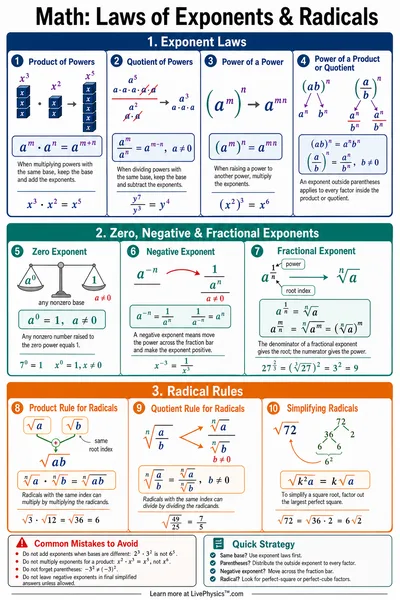
- x^2 power
- 2x times
- sqrt(x) root
- nthRoot(x, 3)
- abs(x)
- 5! factorial
- ln(x), log(x, 10)
- e^x, exp(x)
- sin(x), asin(x)
- pi, e, i
- [[1, 2], [3, 4]]
- inf infinity
Separate the equations of a system with commas, such as x + y = 10, x - y = 2.
History
Each calculation is saved here. Click one to run it again.
Result
Pick a command, type an expression and press Compute.
Graph
Reference Guide
Exact Answers, Not Decimals
A regular calculator turns every answer into a decimal. A computer algebra system keeps symbols such as , and exactly as they are.
The exact form shows structure that a decimal such as 3.7320508 hides. Use the Decimal value command when you need a number.
Commands
- Simplify. Combines like terms and cancels common factors.
- Expand. Multiplies out products and powers.
- Factor. Writes a polynomial as a product, or a whole number as primes.
- Partial fractions. Splits a rational expression into simpler fractions.
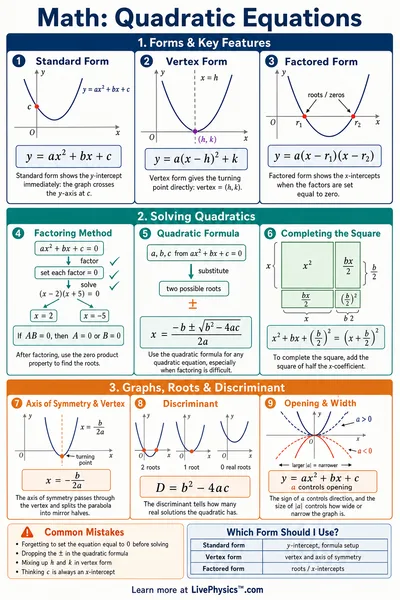
- Solve. Solves one equation, or a system separated by commas.
- Derivative, Integral, Limit. The core calculus operations, with exact results.
- Taylor series. Approximates a function with a polynomial about a center.
- Determinant and Inverse. Work on square matrices typed as rows.
Typing Math
Type math as plain text. The preview under the box shows how it was read.
| x^2 - 3x | |
| sqrt(x + 1) | |
| (x^2 + 1)/(x - 1) | |
| e^(2x) sin(x) | |
| ln(x), log(x, 2) | |
| [[1, 2], [3, 4]] |
Parentheses matter. Type 1/(x + 1), not 1/x + 1, when the whole sum belongs in the denominator.
Check Answers on the Graph
After Simplify, Expand or Factor, the result is drawn as a dashed line over the input. The two curves overlap when the rewrite is correct.
A derivative is drawn next to its function. Where , the graph of is flat.
For a definite integral, the shaded region is the signed area. Area below the axis counts as negative.