Understanding Cross-Sections of 3D Solids Explorer
A useful way to think about a cut is to focus on the material exposed inside the solid. The outside outline of the object can look complicated from one viewpoint, while the newly exposed surface has a much simpler shape.
The position of the plane matters as much as its tilt. A plane can miss part of a solid, pass through its center, or barely clip a corner, and each placement changes the size or even the type of result.
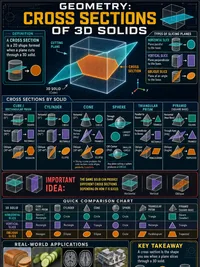
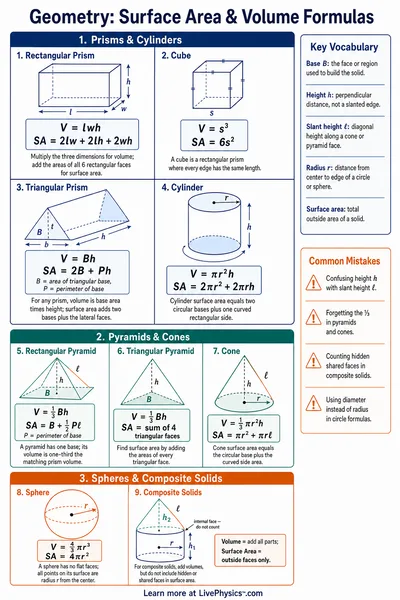
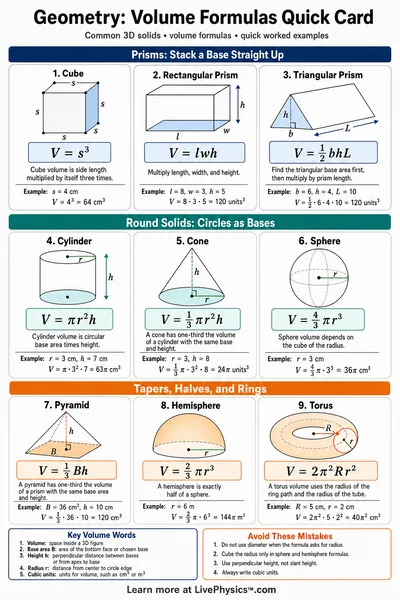
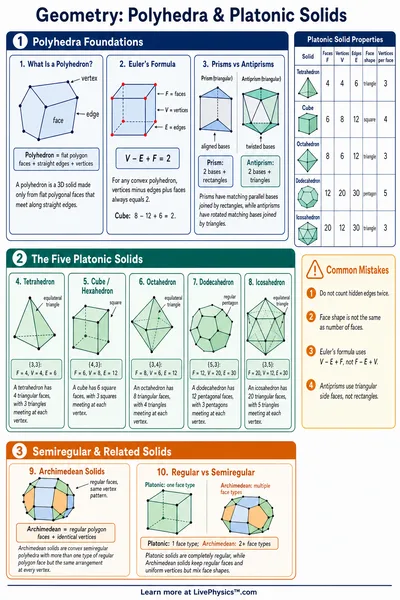
For a cube, cuts parallel to a face keep the same square shape until the plane reaches an end. Slanted cuts can meet several edges, producing polygons whose number of sides depends on exactly which edges are touched.
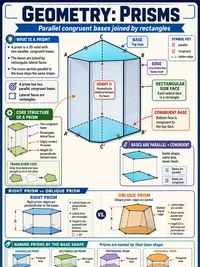
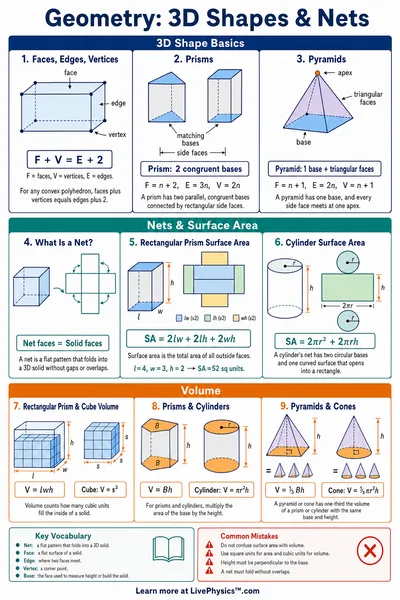
Prisms reveal an important idea about repeated shape. A cut parallel to either base gives a copy of that base, because the sides carry the base shape straight from one end to the other.
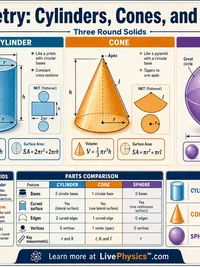
Cylinders behave differently because their curved side has no edges to count. A level cut gives a circle, a vertical cut through the axis gives a rectangle, and a tilted cut usually gives an ellipse.
Cones connect this topic to conic sections, which appear later in geometry and algebra. Circles and ellipses can be seen within a finite cone, while parabolas and hyperbolas are understood by imagining the cone surface extended beyond the physical solid.
Every plane that passes through a sphere creates a circle. The largest circle occurs through the center, and slices farther from the center become smaller until the plane only touches the sphere at one point.
When the result is a polygon, tracing its vertices is a reliable method. Each vertex usually occurs where the cutting plane meets an edge of the solid, so following those edge crossings helps prevent missing a side.
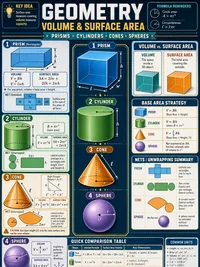
Parallel slices through a pyramid or cone have related shapes, but their sizes change steadily. Slices closer to the tip are smaller, and this pattern supports later work with similarity, scale factors, and volume formulas.
Cross-sections matter outside geometry class because many real objects are studied in layers. Medical scans build images from body slices, engineers inspect internal parts, and mapmakers use contour-like sections to show changes in land.
A common mistake is to name the shape based on a perspective drawing rather than the actual cut surface. Rotating the solid helps separate what the eye sees on the outside from what the plane truly exposes inside.
When practicing, predict the result before moving the plane, then compare the prediction with the model. Pay close attention to whether the plane is parallel to a face, passes through a vertex, or intersects an edge, since these details control the outcome.