Volume City Builder Lab
Design buildings by stacking unit cubes. Calculate their volumes, compare different shapes, and complete city-building missions.
Guided ExperimentVolume City Builder Investigation
If you change only the height of a building but keep length and width the same, what happens to the volume? Make a prediction.
Write your hypothesis in the Lab Report panel, then click Next.
Choose Your Mission
Controls
City Skyline
Data Table
(0 rows)| # | Building | Length | Width | Height | Volume (cubic units) |
|---|
Reference Guide
Volume Formula
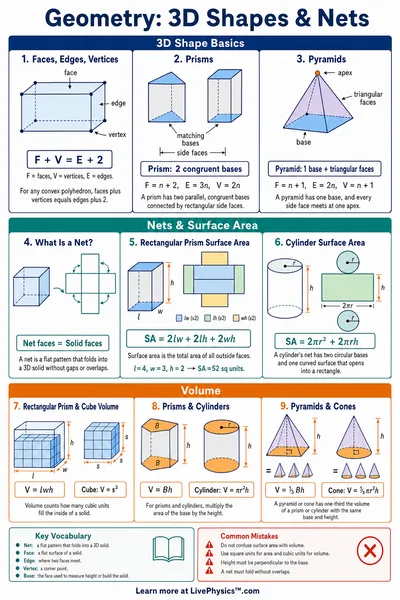
Volume tells us how much space a 3D shape takes up. For a rectangular prism
Volume = Length x Width x Height
Volume is measured in cubic units (cm3, in3, unit3).
Same Volume, Different Shape
Many different shapes can have the same volume. A 1x2x12 box has the same volume as a 2x3x4 box -- both equal 24 cubic units.
This is why architects have many choices when designing buildings!
Layers of Cubes
Think of volume as layers. Each layer has Length x Width cubes. Stack Height layers to get the total volume.
Example, A 3x4 base with 2 layers high = 3 x 4 x 2 = 24 cubes.
City Planning
Real city planners use volume to calculate how much space is in a building and how many people it can hold.
Skyscrapers are tall and thin. Warehouses are wide and flat. Both can have the same volume!