Economic Systems Comparator
Compare the four economic systems side by side and answer the three basic economic questions. Sort real world scenarios and countries with an interactive quiz.
Choose a mode
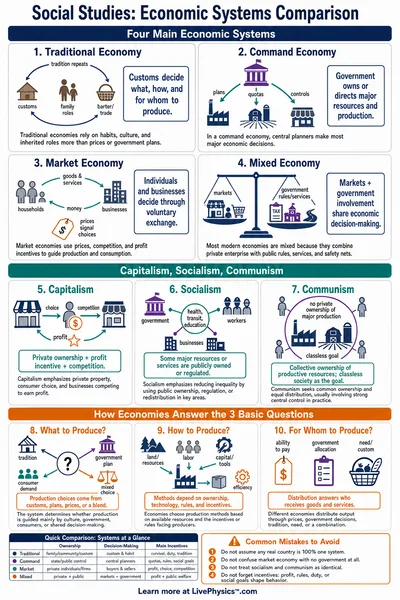
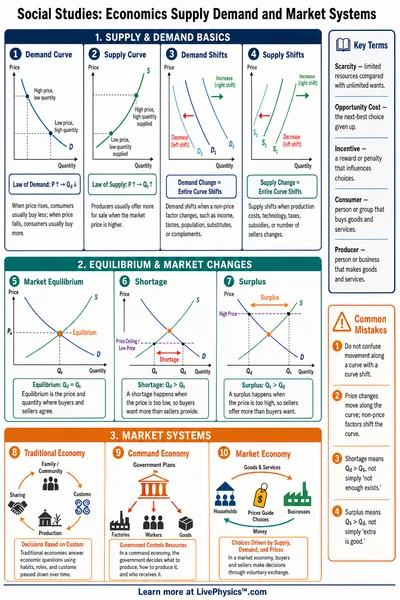
Every economy must answer three basic questions, what to produce, how to produce it, and for whom. Compare how the four systems answer them.
| Dimension | Traditional Custom and habit decide. | Command The government plans everything. | Market Supply and demand decide. | Mixed Markets plus government. |
|---|---|---|---|---|
| What to produce? | The same goods that have always been produced. Choices follow custom, ritual, and the needs of the community. | Central government planners decide what goods and services the whole economy will produce. | Private buyers and sellers decide through supply and demand. Firms make what earns a profit. | Mostly private buyers and sellers, but the government also funds public goods like roads and schools. |
| How to produce? | Using methods passed down through generations, often by hand or with simple tools. Skills are taught by family and elders. | The government owns the factories and sets production methods, quotas, and targets through a central plan. | Private firms choose methods that lower cost and raise profit while competing with one another. | Private firms decide, within rules and regulations the government sets for safety and fairness. |
| For whom to produce? | Goods go to the family, clan, or village based on tradition and social role rather than payment. | The government decides who receives goods, often aiming for equal distribution rather than letting prices choose. | Those with the money and willingness to pay. Income determines who gets which goods. | Mostly income and prices, but the government redistributes through taxes and welfare programs. |
| Private property | Often communal. Land and resources are shared by the group rather than owned by individuals. | Mostly banned. The state owns land, factories, and major resources on behalf of the people. | Strongly protected. Individuals and businesses own land, capital, and the goods they make. | Protected, with some regulation. Most property is private, but the state runs some industries. |
| Role of government | Little to no central authority. Decisions rest with families, elders, and long standing customs. | Total. The state controls prices, wages, jobs, and production across the entire economy. | Minimal. Government mainly protects property rights and enforces contracts (laissez-faire). | Active but limited. Government regulates, taxes, provides services, and corrects market problems. |
| Real world examples | Subsistence farming and herding communities, the Inuit, the San people, and rural villages in parts of Africa, Asia, and South America. | The former Soviet Union, North Korea, Cuba, and Maoist era China. | No country is a pure market economy, but Hong Kong and Singapore lean strongly toward it. | The United States, the United Kingdom, Canada, Germany, Japan, France, and most modern nations. |
How it works
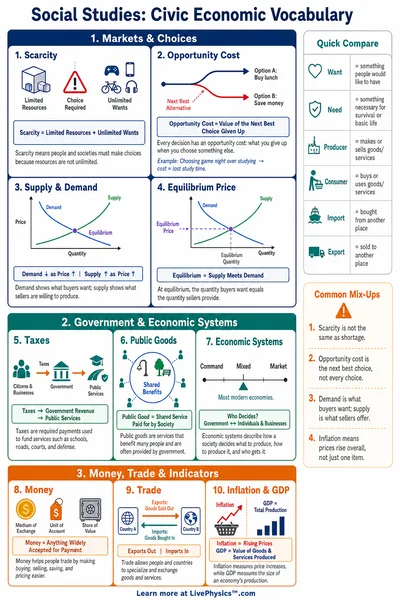
Every society answers three basic economic questions. What goods and services to produce, how to produce them, and who gets them. The four systems answer these questions in very different ways.
Use the comparison table to study each system across six dimensions, then switch to quiz mode to sort real world scenarios and countries under the correct system. Learn mode offers hints, Practice removes them, and Challenge focuses on tricky mixed versus market cases.
Curriculum alignment
This tool supports middle school and high school social studies and economics units on comparative economic systems. It reinforces the three basic economic questions of scarcity, the role of government, and private property.
It pairs well with lessons on supply and demand, civics, and world geography where students classify real countries by how their economies are organized.
The Four Economic Systems
Traditional
Custom, habit, and inherited skills decide what is produced and how. Resources are often communal and goods are shared by social role. There is little or no central government. Examples include subsistence farming and herding communities.
Command
A central government owns the means of production and plans the entire economy. The state sets prices, wages, and output. Private property is mostly banned. Examples include the former Soviet Union, North Korea, and Cuba.
Market
Private buyers and sellers decide through supply and demand. Firms make what earns a profit, and prices guide who gets what. Government stays minimal. No country is a pure market economy, though Hong Kong and Singapore lean strongly toward it.
Mixed
Markets do most of the work, but the government regulates, taxes, funds public goods, and redistributes income. Property is private with some regulation. Most modern nations, including the United States, Canada, Germany, and Japan, use this system.