Trade & Comparative Advantage Simulator
Two countries, Northland and Southland, can each grow grain or make cloth. Set what each one can produce, see the opportunity cost of every good, and watch how specializing where you give up the least and then trading lets both countries end up with more.
Guided ExperimentWhich country should grow grain, and why?
Each country can make grain or cloth. Predict which country should specialize in grain, and explain whether your answer depends on who can make the most grain or on what each country gives up to make grain.
Write your hypothesis in the Lab Report panel, then click Next.
Trade Map
Each country specializes in the good with its lower opportunity cost and ships it to the other. The lower bars compare total world output without trade (grey) with output under specialization (color). Longer color bars mean trade raised total output.
Controls
50% of resources go to grain and 50% go to cloth before any trade.
50% of resources go to grain and 50% go to cloth before any trade.
Results
| Country | Opp cost of grain | Opp cost of cloth |
|---|---|---|
| Northland | 1 cloth | 1 grain |
| Southland | 3 cloth | 0.33 grain |
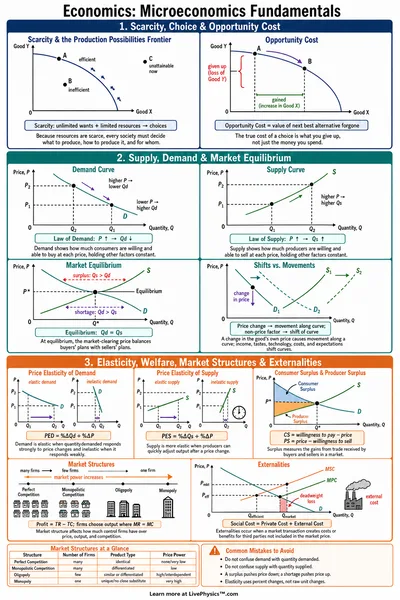
Opportunity cost of grain is how much cloth a country gives up to make one more unit of grain. The lower that number, the cheaper grain is for that country.
Northland should specialize in grain, because it gives up the least cloth to make it. Southland should specialize in cloth.
Data Table
(0 rows)| # | Scenario | Northland opp cost (grain) | Southland opp cost (grain) | Autarky grain | Autarky cloth | Specialized grain | Specialized cloth |
|---|
Reference Guide
Opportunity Cost on a Production Frontier
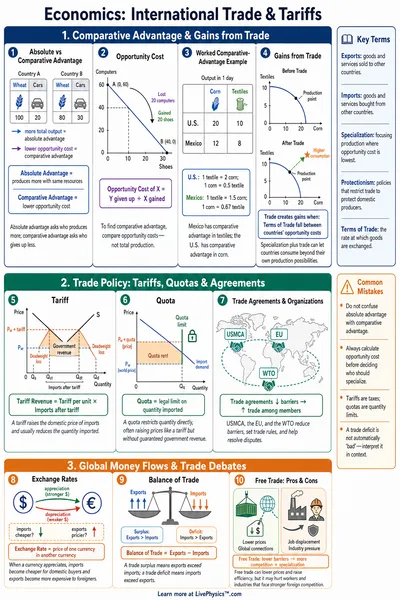
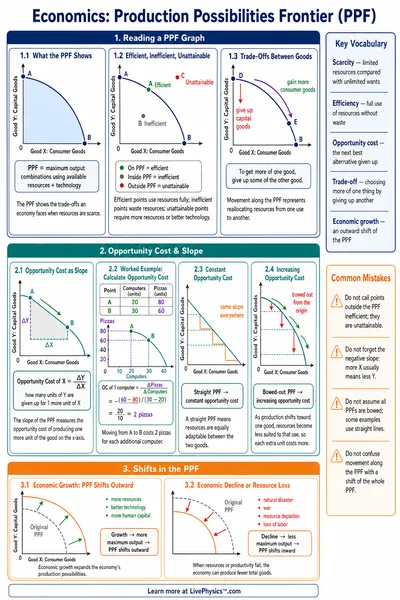
A production possibility frontier shows the most a country can make if it splits its resources between two goods. When the frontier is a straight line, every unit of grain costs a fixed amount of cloth, and that trade-off is the opportunity cost.
If a country can make at most 100 grain or 100 cloth, then one grain costs one cloth. If it can make 60 grain or 180 cloth, then one grain costs three cloth. The lower that number, the cheaper grain is for that country to produce.
Comparative vs Absolute Advantage
Absolute advantage means a country can simply make more of a good than another country can. Comparative advantage means a country gives up less of the other good to make it, so its opportunity cost is lower.
These are not the same. A country can hold an absolute advantage in both goods and still gain from trade, because what matters for specialization is the opportunity cost. Each country should make the good it gives up the least to produce.
How Specialization and Trade Expand Output
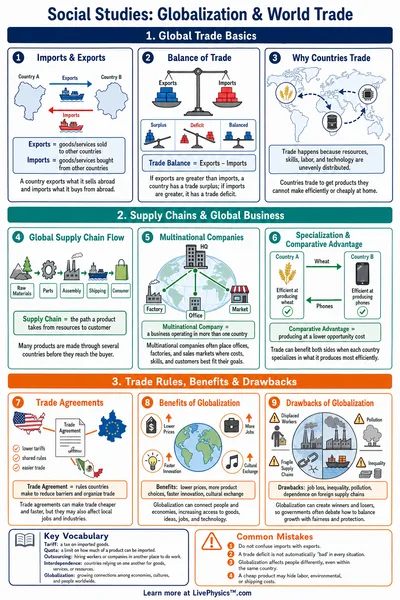
Without trade, each country makes some of both goods and is limited by its own frontier. With trade, each country shifts all of its resources to the good where its opportunity cost is lower, then swaps for the good it no longer makes.
When opportunity costs differ, this specialization raises total world output, so both countries can end up consuming more than they could alone. When the opportunity costs are identical there is no comparative advantage and no gain from trade.
How to Read the Lab
The trade map shows each country and the good it specializes in, with arrows for the goods that flow each way. The bars below compare total world output without trade with output under specialization.
The results panel lists each country's opportunity cost, states who should make grain and who should make cloth, and shows the gains from trade. Use the scenario presets to compare classic comparative advantage, an absolute advantage in both goods, and a case with no gains at all.