Galactic Distance and Hubble's Law
From standard candles to Hubble's Law. Slide the apparent and absolute magnitudes to find the distance to a Cepheid variable or a Type Ia supernova, then switch to Hubble's Law and watch how redshift translates into recession velocity and megaparsec distances. Aligned with AP Physics cosmology topics for high school and advanced students.
Distance Modulus Inputs
How bright the object appears from Earth. The Sun is m ≈ -26.7, a full moon is about -12.7, the faintest naked-eye stars are about +6.
How bright the object would be at exactly 10 pc. Type Ia supernovae reach M ≈ -19.3, Cepheid variables sit near M ≈ -4.
Distance from standard candle
Distance modulus mu = m - M = 4
Reference Guide
Distance Modulus
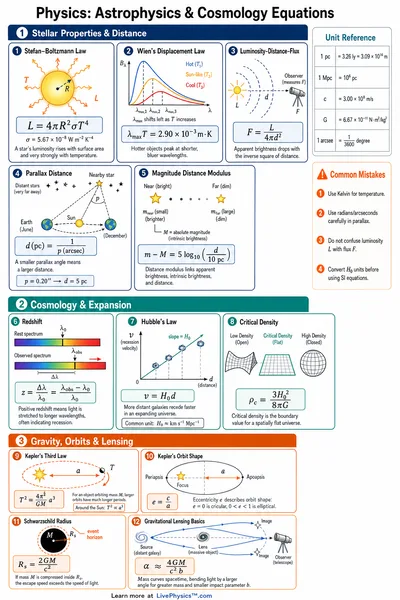
The distance modulus relates how bright an object appears (apparent magnitude m) to how bright it would look at exactly 10 parsecs (absolute magnitude M).
Solving for the distance d in parsecs gives the working formula used in the calculator.
Hubble's Law
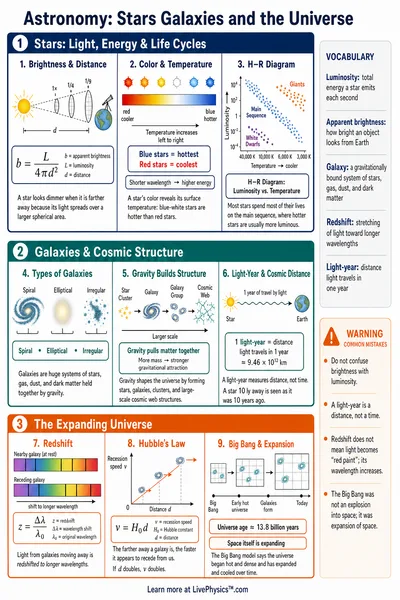
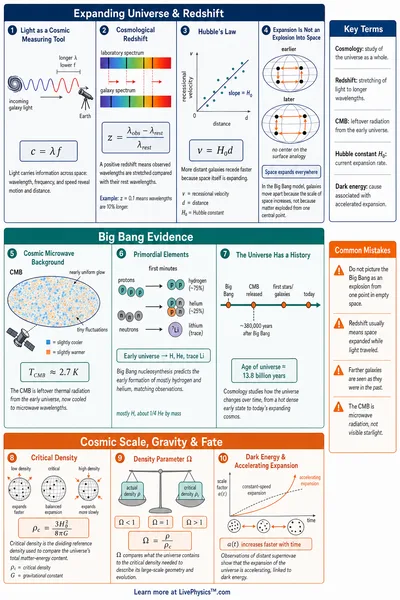
Distant galaxies move away from us at speeds proportional to their distance. The constant of proportionality is the Hubble constant H₀, given in km/s per megaparsec.
For nearby galaxies, the recession velocity v is related to the observed redshift z by v ≈ z c, with c the speed of light. Combining the two gives the distance.
Modern values of H₀ are near 67 km/s/Mpc from the cosmic microwave background and near 73 km/s/Mpc from the local distance ladder. The gap is the Hubble tension.
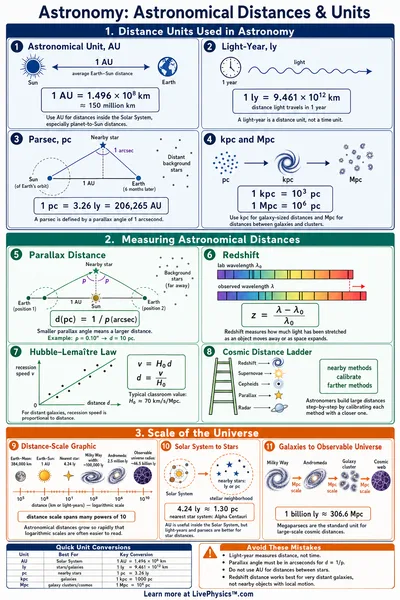
The Cosmic Distance Ladder
Astronomers stack methods to reach larger and larger distances. Each rung is calibrated against the one below it.
- Parallax. Direct geometric distance out to about 10 kpc, anchored by Gaia.
- Cepheid variables. Period-luminosity relation gives M, then the distance modulus gives d. Good to roughly 30 Mpc.
- Type Ia supernovae. Standardizable thermonuclear explosions with M ≈ -19.3. Reach billions of light-years.
- Redshift and Hubble's Law. Cosmological distances using v = H₀ d for nearby objects, and the full cosmological model for high z.
Quick Reference
Unit conversions.
- 1 parsec ≈ 3.262 light-years ≈ 206 265 AU
- 1 parsec ≈ 3.086 × 10¹³ km
- 1 Mpc = 10⁶ pc ≈ 3.262 × 10⁶ light-years
- Speed of light c = 299 792.458 km/s
Typical absolute magnitudes.
- The Sun in the V-band, M ≈ +4.83
- RR Lyrae variables, M ≈ +0.6
- Cepheid variables, M ≈ -4 (period-dependent)
- Type Ia supernovae, M ≈ -19.3 at peak
- Bright galaxies like the Milky Way, M ≈ -20.5
The v = z c approximation works for z below about 0.1. At larger redshifts use the relativistic Doppler formula or a full cosmological model.