Maxwell-Boltzmann Speed Distribution Explorer
Choose a gas or set a molar mass, pick a temperature, and watch the speed distribution take shape. The tool draws f(v) against v and marks the three characteristic speeds. Overlay a second curve to compare temperatures or gases side by side.
Speed distribution f(v)
Curve 1
Enable the overlay to see how a higher temperature shifts the curve to the right and flattens it, or how a heavier gas shifts it to the left.
Characteristic speeds
Ordering is always vₚ < v̄ < vᵣₘₛ. The ratios are fixed, vᵣₘₛ / vₚ ≈ 1.225 and v̄ / vₚ ≈ 1.128, independent of temperature and gas. R = 8.314 J/(mol·K), M = 28.00 g/mol, T = 300 K.
Reference Guide
What the Distribution Describes
In a gas at thermal equilibrium, molecules do not all move at the same speed. They span a wide range, from nearly at rest to very fast. The Maxwell-Boltzmann distribution gives the probability density f(v) of finding a molecule with speed v.
The curve starts at zero (no molecule is perfectly still), rises to a peak at the most probable speed, then falls off with a long tail toward high speeds. The area under the whole curve equals 1, because every molecule has some speed.
The distribution is set entirely by two quantities, the temperature T and the molar mass M. It assumes an ideal gas of non-interacting particles in three dimensions.
The Three Characteristic Speeds
Three speeds summarise the curve. Each uses R = 8.314 J/(mol·K) and M in kg/mol.
They always satisfy vₚ < v̄ < vᵣₘₛ. The ratios are fixed at vᵣₘₛ / vₚ ≈ 1.225 and v̄ / vₚ ≈ 1.128, no matter the gas or temperature. The most probable speed sits at the peak of f(v), while the mean and rms lie further along the high-speed tail.
How Temperature and Molar Mass Change the Curve
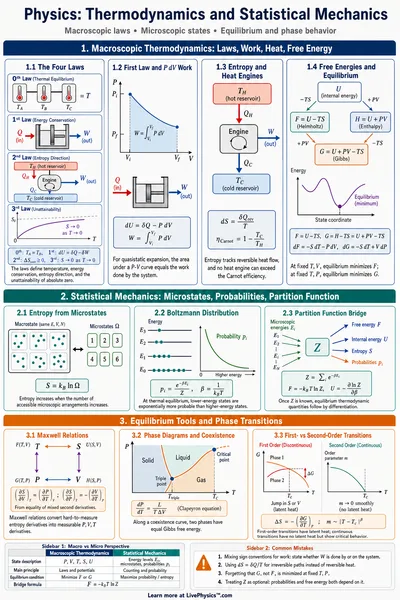
Raising the temperature shifts the whole distribution to the right and flattens it. Molecules move faster on average, the peak moves to a higher speed, and the spread of speeds grows wider, so the peak height drops to keep the total area at 1.
Increasing the molar mass does the opposite. A heavier gas moves more slowly at the same temperature, so the curve shifts left and grows taller and narrower. At 300 K, light hydrogen is far faster than heavy carbon dioxide.
Because every characteristic speed scales as √(T / M), doubling the temperature multiplies the speeds by √2, and quadrupling the molar mass halves them.
Link to Kinetic Theory
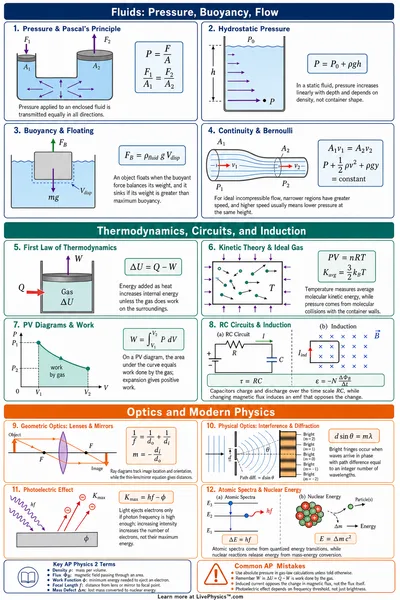
The distribution connects directly to the kinetic theory of gases. The average translational kinetic energy of a molecule depends only on temperature, ½m⟨v²⟩ = (3/2)kT, where k is the Boltzmann constant. The root-mean-square speed comes straight from this relation.
This is why the rms speed, not the mean or most probable speed, appears in energy and pressure calculations. It is the speed tied to the kinetic energy that the gas actually carries.
The same scaling explains everyday effects, such as why lighter gases like helium and hydrogen escape a planet's atmosphere more readily than heavier nitrogen and oxygen.