Optimization Problem Builder
Work through 12 classic calculus optimization problems. Adjust constraint sliders to see how the optimal value changes, watch the objective function curve update live, and follow a complete step-by-step solution for each problem.
Optimization Problem Builder
Select a problem, adjust the constraint, and follow the step-by-step calculus solution.
Maximize Rectangle Area
Find the rectangle with fixed perimeter that has the greatest area.
Maximize A = xy with 2x + 2y = P
Diagram
Constraint Parameters
Objective Function Graph
The optimal point (green dot) moves as you adjust parameters.
Step-by-Step Solution
Let x and y be the side lengths of the rectangle. The perimeter is fixed.
Show all steps
Let x and y be the side lengths of the rectangle. The perimeter is fixed.
We want to maximize the area A.
Solve the perimeter equation for y, then substitute.
Now A depends only on x.
Critical point at x = P/4.
The square x = y = 10 m gives maximum area 100 m².
Reference Guide
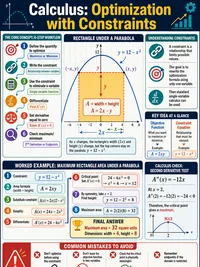
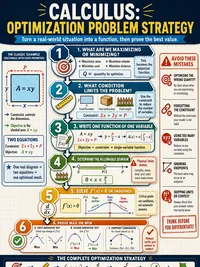
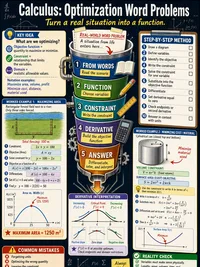
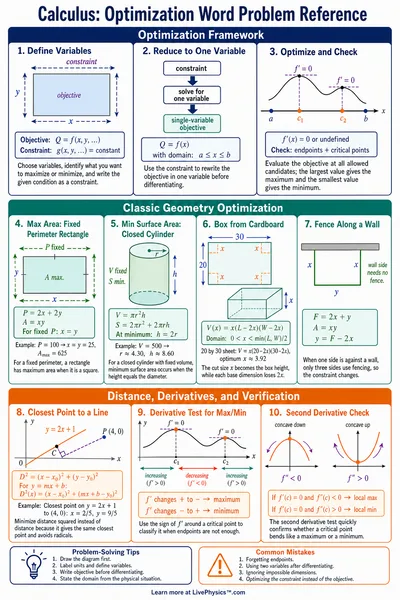
The Optimization Method
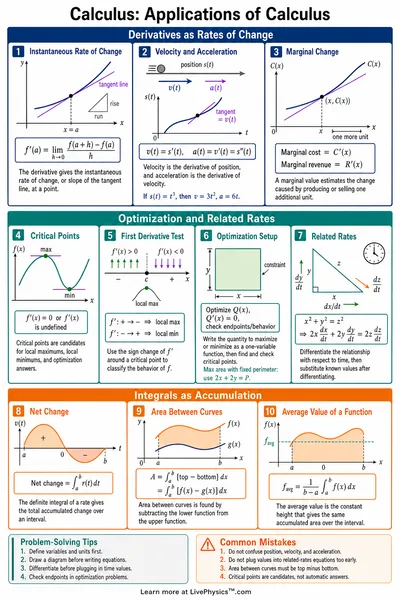
- Identify the quantity to maximize or minimize (objective function).
- Write the constraint equation relating the variables.
- Substitute the constraint to reduce to one variable.
- Differentiate the objective and set f'(x) = 0.
- Solve for the critical point(s).
- Verify with the second derivative test or endpoint comparison.
First and Second Derivative Tests
If f'(c) = 0 and f' changes from positive to negative at c, then f has a local maximum at c. If f' changes from negative to positive, f has a local minimum.
If f'(c) = 0 and f''(c) < 0, the critical point is a maximum. If f''(c) > 0, it is a minimum. If f''(c) = 0, the test is inconclusive.
Common Optimization Setups
Fixed perimeter, max area. A square always maximizes area among rectangles with a given perimeter.
Fixed volume, min surface area. For a cylinder, h = 2r (height equals diameter) minimizes surface area.
Box from sheet. Cut corner size x = s/6 from a square sheet of side s to maximize open-box volume.
Distance minimization. Minimize D² instead of D to avoid the square root in differentiation.
AP Calculus Exam Tips
Label your variables. On the AP exam, define each variable clearly before writing equations. Partial credit depends on it.
State the domain. Always write the domain of the objective function (e.g., 0 < x < s/2 for the open box).
Justify the extremum. Say whether your critical point is a max or min and why (second derivative or sign chart).
Check endpoints. On closed domains, compare the objective at endpoints and at each critical point.
Related Calculus Concepts
Extreme Value Theorem. A continuous function on a closed interval always attains its maximum and minimum.
Critical Points. Points where f'(x) = 0 or f'(x) is undefined. All local extrema (inside the domain) must be critical points.
Closed Interval Method. Evaluate f at all critical points and endpoints; the largest value is the global max, smallest is global min.
Implicit Differentiation. Sometimes easier to differentiate the constraint implicitly rather than solving for one variable.