Organic Functional Group Identifier
Choose a molecule and the tool detects every functional group, highlights it on the structural diagram, and explains which group sets the IUPAC suffix. Filter the library by group type to find every molecule that contains an alcohol, an ester, an amine, and more.
Filter by functional group
Pick a group to spotlight every molecule that contains it.
Molecule library
Click a molecule to inspect its functional groups.
Try these
Hydrocarbon
Oxygen group
Nitrogen group
Sulfur group
Aromatic
Multi-functional
Click a chip below to highlight that group on the diagram.
IUPAC name
2-hydroxybenzoic acid
Common name
salicylic acid
Formula
C₇H₆O₃
Principal characteristic group
Carboxylic acid(suffix -oic acid)
Found in acne treatments and chemically related to aspirin.
Functional groups detected (3)
Naming hints
Suffix (principal group)
The carboxylic acid is the senior group, so it sets the ending -oic acid. The parent chain or ring keeps its base name and takes this suffix.
Prefixes (other groups)
- Alcohol (hydroxyl) adds the prefix hydroxy-
- Aromatic ring adds the prefix (aryl/phenyl)
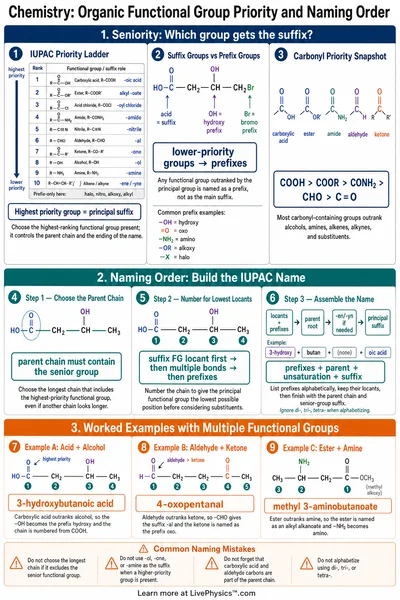
Seniority order that decides the principal group
When several characteristic groups are present, the highest-priority group that carries a suffix becomes the principal group. Everything below it is named as a prefix.
- 1. Carboxylic acid
- 2. Ester
- 3. Amide
- 4. Nitrile
- 5. Aldehyde
- 6. Ketone
- 7. Alcohol (hydroxyl)
- 8. Thiol
- 9. Amine
- 10. Alkene
- 11. Alkyne
Reference Guide
What functional groups are
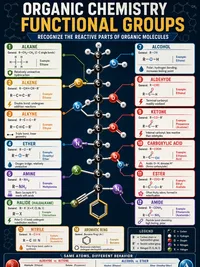
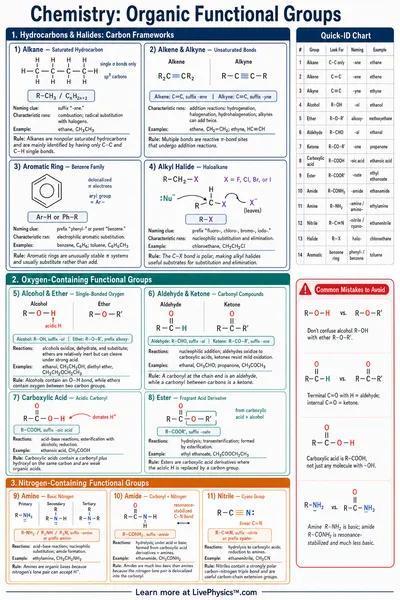
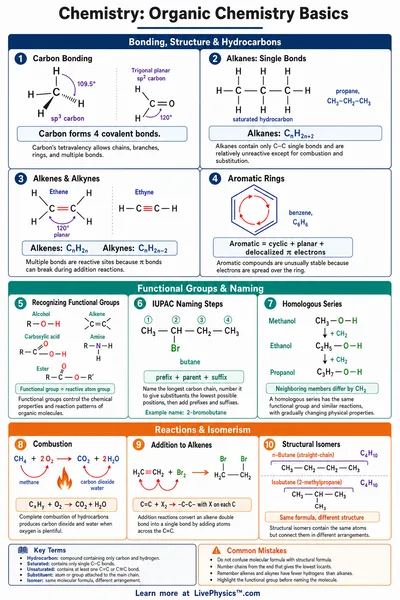
A functional group is a specific arrangement of atoms within a molecule that gives it a characteristic set of chemical reactions. The carbon skeleton mostly stays inert, while the functional group is where most reactions happen.
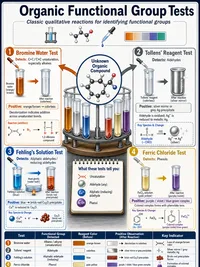
Molecules that share the same functional group behave in similar ways. Every alcohol can be oxidized, every carboxylic acid can donate a proton, and every alkene can add across its double bond. Recognizing the group tells you most of what a molecule will do.
A single molecule can carry several groups at once. Glycine has both an amine and a carboxylic acid, which is what makes it an amino acid.
Common groups and their suffixes
| Group | Key atoms | Suffix |
|---|---|---|
| Carboxylic acid | -COOH | -oic acid |
| Ester | -COO- | -oate |
| Amide | -CONH₂ | -amide |
| Aldehyde | -CHO | -al |
| Ketone | C=O | -one |
| Alcohol | -OH | -ol |
| Amine | -NH₂ | -amine |
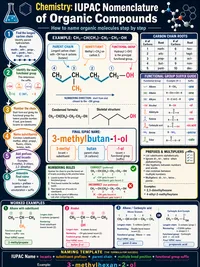
IUPAC naming priority order
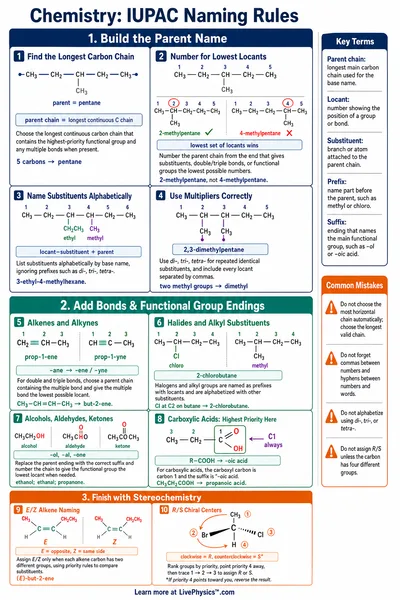
When a molecule has more than one functional group, only one can lend its suffix. That group is the principal characteristic group, chosen by seniority.
The order from highest to lowest is carboxylic acid, ester, amide, nitrile, aldehyde, ketone, alcohol, thiol, then amine. Double and triple bonds are handled in the parent chain rather than as the principal group.
- The senior group sets the suffix and the lowest locant.
- Every other group becomes a prefix, such as hydroxy or amino.
- In glycine the acid outranks the amine, giving aminoethanoic acid.
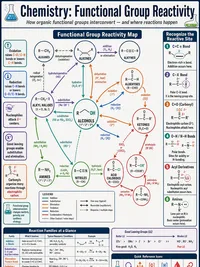
Why functional groups determine reactivity
Functional groups concentrate the electron density and polarity of a molecule. A carbonyl carbon is electron poor and invites attack by nucleophiles. A hydroxyl oxygen carries lone pairs and forms hydrogen bonds.
Because the group is the reactive site, chemists predict products by group, not by the whole molecule. Oxidizing a primary alcohol gives an aldehyde, then a carboxylic acid, regardless of how long the carbon chain is.
This is also why functional groups drive physical properties. Hydrogen bonding groups raise boiling points and water solubility, which is why small acids and alcohols mix freely with water.