Understanding pH, pOH & Acid-Base Calculator
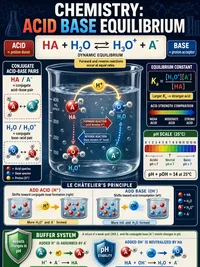
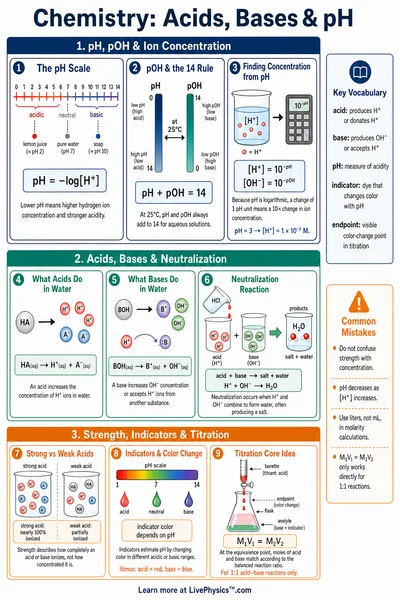
In water, an acid increases the amount of hydronium ions. A base reduces that amount or produces hydroxide ions, depending on how it reacts. Chemists often write hydrogen ion as a useful shortcut, though free hydrogen ions do not remain alone in liquid water.
They attach to water molecules and form hydronium. This helps explain why pH describes the behavior of a water solution rather than a collection of separate particles.
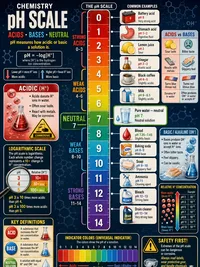
The pH scale is logarithmic, so equal steps do not represent equal chemical changes. A change of one pH unit means the hydronium ion concentration changes by a factor of ten. A solution at pH three has ten times more hydronium ions than one at pH four.
It has one hundred times more than one at pH five. Students often miss this point because the scale looks like an ordinary number line.
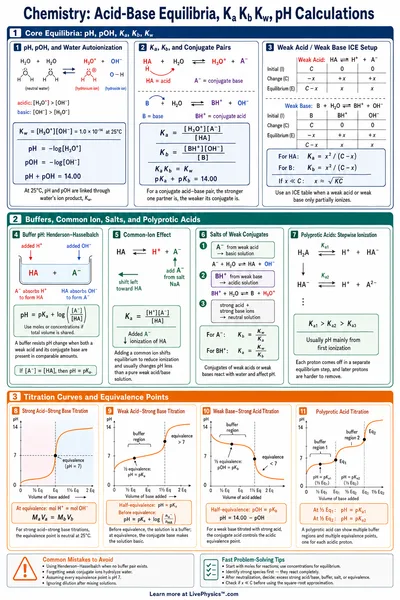
Water constantly forms tiny amounts of hydronium ions and hydroxide ions. At twenty five degrees Celsius, pH plus pOH equals fourteen for many school chemistry calculations. If one value rises, the other must fall.
Temperature matters because this relationship changes slightly when water gets warmer or colder. Neutral water is near pH seven at room temperature, but neutral does not always mean exactly seven under every condition.
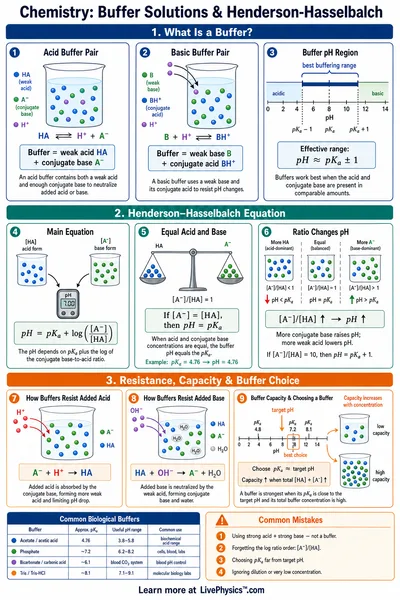
Strong acids and strong bases separate into ions almost completely in water. Weak acids and weak bases only separate partly, so their concentrations do not directly tell the whole story. This is why equal amounts of different acids can produce very different pH values.
Acid strength describes how much an acid ionizes, while concentration describes how much acid was added. These ideas are related, but they are not the same.
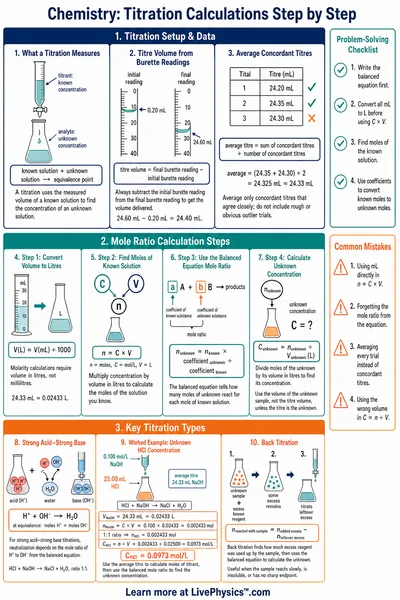
Acid-base chemistry appears in soil testing, swimming pools, digestion, cleaning products, blood chemistry, and water treatment. A small pH change can affect whether fish survive, whether chlorine disinfects properly, or whether a medicine works as intended. When solving problems, first check whether the given value is a concentration or a pH value.
Then pay attention to powers of ten, units, temperature assumptions, and whether the substance is strong or weak. Rounded calculator results can look precise, but measurements in real experiments always have some uncertainty.