Related Rates Visual Solver
Select a classic related rates problem, adjust the sliders to set values, and watch the animated diagram and step-by-step solution update instantly. All computation happens in your browser.
Related Rates Visual Solver
Pick a problem, adjust sliders, and watch the solution update in real time.
Choose a Problem
Ladder Sliding Down Wall
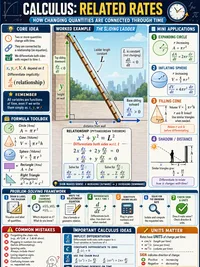
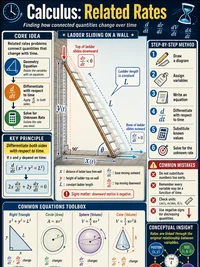
PythagoreanA 10 ft ladder leans against a wall. Its base slides away at dx/dt ft/s when the base is x ft from the wall. How fast does the top slide down?
Adjust Values
By the Pythagorean theorem, the three sides of the right triangle satisfy this relationship at every moment.
Reference Guide
Setting Up Related Rates
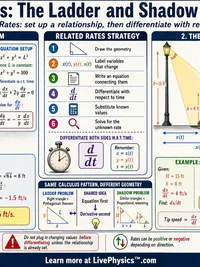
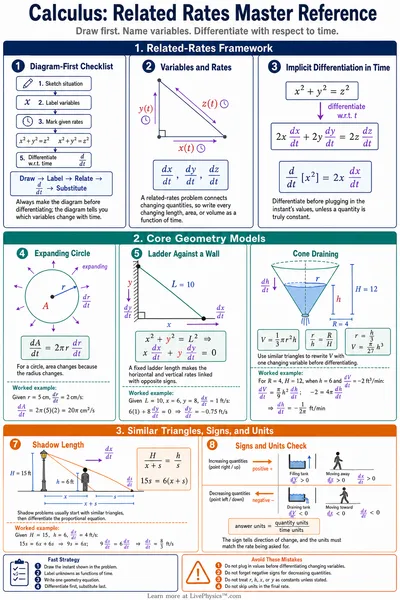
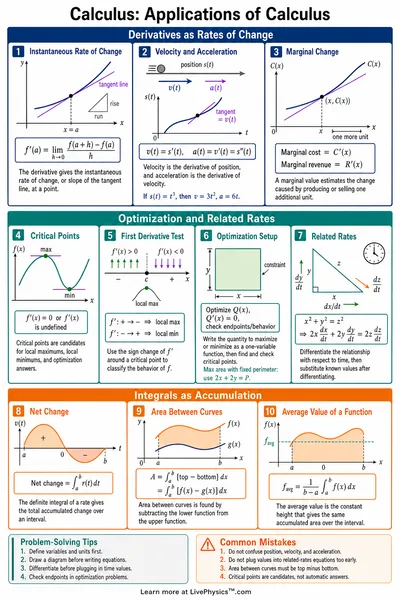
Every related rates problem follows the same four-step process.
- Draw and label a diagram at a specific instant.
- Write an equation relating the changing quantities.
- Differentiate both sides with respect to time t.
- Substitute known values and solve for the unknown rate.
The key insight is that every quantity that changes with time becomes a function of t, so the chain rule applies to every term when you differentiate.
Implicit Differentiation
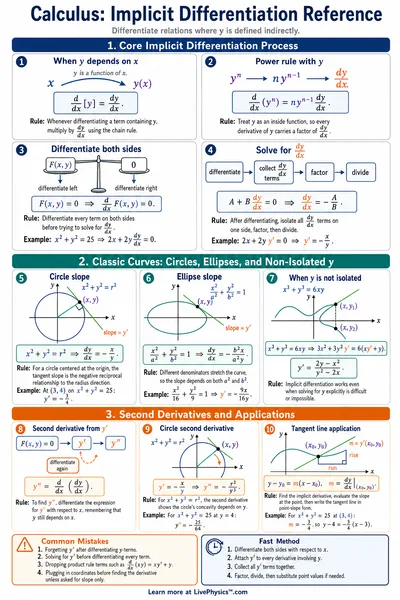
When variables are related by an equation, differentiate implicitly with respect to t. For any variable u(t)
Ladder example, starting from , differentiating gives since L is constant.
Common Patterns
- Right triangle
- Circle area
- Sphere volume
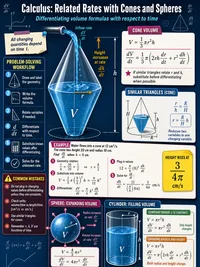
- Cone volume
- Cylinder
- Angle
Tips and Common Pitfalls
- Substitute values AFTER differentiating. Plugging in a specific value for x before differentiating treats it as a constant, losing the dx/dt term.
- Watch the sign of each rate. A car approaching means its distance is decreasing, so dx/dt is negative.
- Use similar triangles to reduce the number of variables before differentiating (ladder, shadow, cone).
- Units matter. If distance is in feet and time in seconds, rates are in ft/s. Keep units consistent across the entire equation.
Chain Rule in Related Rates
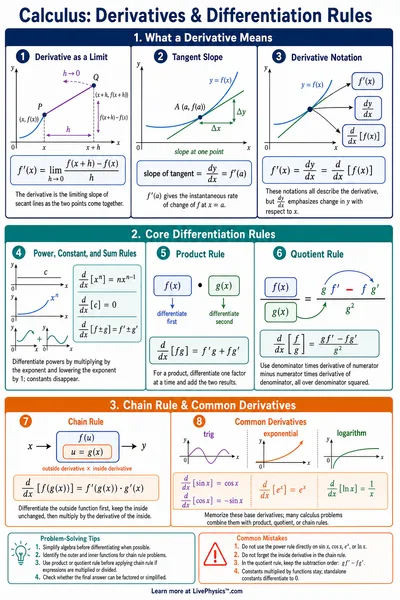
The chain rule is the engine behind every related rates calculation. Because x, y, r, h, and V are all functions of time t, every differentiation needs an extra factor.
For the product rule . This applies when two changing quantities multiply (box volume, triangle area).