Sampling Distribution Visualizer
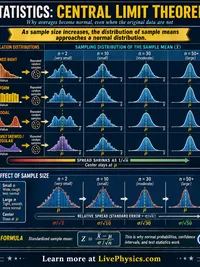
Pick a population distribution and watch the Central Limit Theorem in action. Draw random samples, plot the means, and see how the sampling distribution becomes normal regardless of population shape.
Choose a population distribution
Population Distribution
Sampling Distribution of the Mean
Controls
Draw samples
Animated draw
Samples are drawn instantly
Central Limit Theorem Facts
Population
Population mean
Population SD
Sample size
Sampling Distribution
Expected mean
Standard error (theory)
Observed mean
Observed SD
Draw samples to see the CLT in action. The observed standard deviation of the sample means should approach σ/√n = 0.9129 as the number of samples grows.
About the Central Limit Theorem
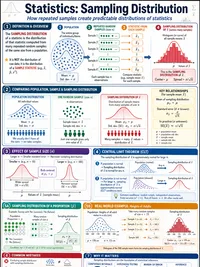
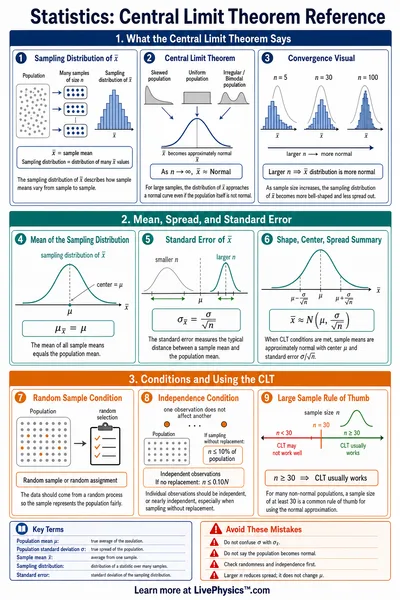
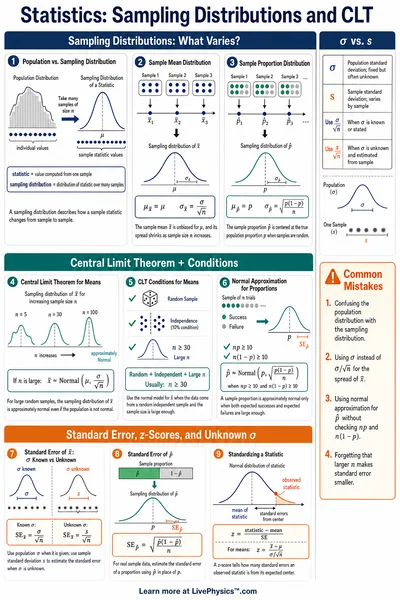
The Central Limit Theorem states that for a sufficiently large sample size n, the sampling distribution of the sample mean is approximately normal regardless of the population distribution. This is one of the foundational results in statistics. It is the reason normal-based inference (confidence intervals, z-tests, t-tests) works even when the underlying population is not normal.
Curriculum alignment
Supports AP Statistics units 5 and 6 (sampling distributions, confidence intervals), as well as introductory college statistics courses. The visualization makes the abstract CLT concrete, the distribution of sample means looks normal even when drawn from skewed or bimodal populations.
How to use this tool
- Step 1. Select a population shape (uniform, normal, skewed, or bimodal).
- Step 2. Choose a sample size n using the slider.
- Step 3. Click "Draw 100" or "Draw 1000" to collect sample means.
- Step 4. Watch the right histogram converge toward a bell curve centered on the population mean.
- Step 5. Change n and observe how the width of the sampling distribution narrows as n grows.
Key formulas
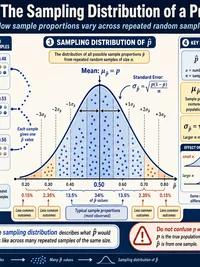
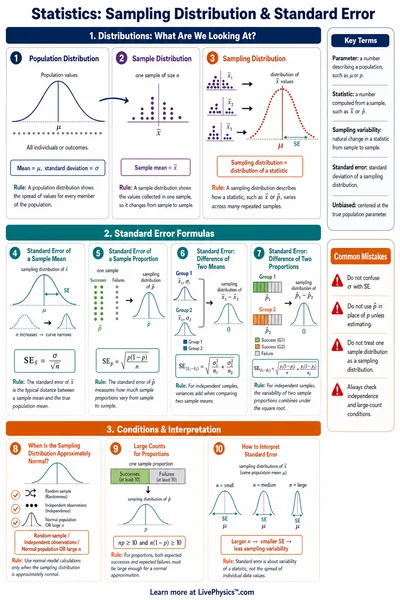
- Expected mean of sampling distribution same as population mean μ
- Standard error SE = σ / √n
- Larger n produces a narrower (more concentrated) sampling distribution
- Skewness fades with larger n - even bimodal populations produce normal-looking sample means