Descriptive Statistics Calculator
Enter your dataset to compute summary statistics, five-number summary, and visualize distributions with box plots and histograms. All calculations run in your browser.
Tip, Press Ctrl+Enter (Cmd+Enter on Mac) to calculate.
Reference Guide
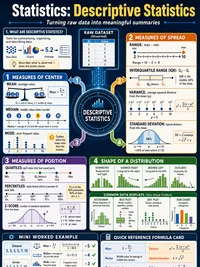
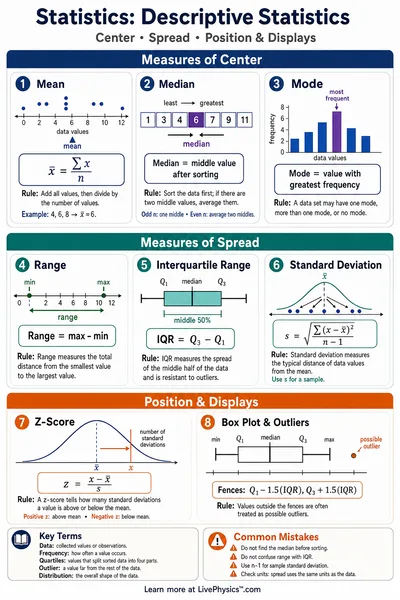
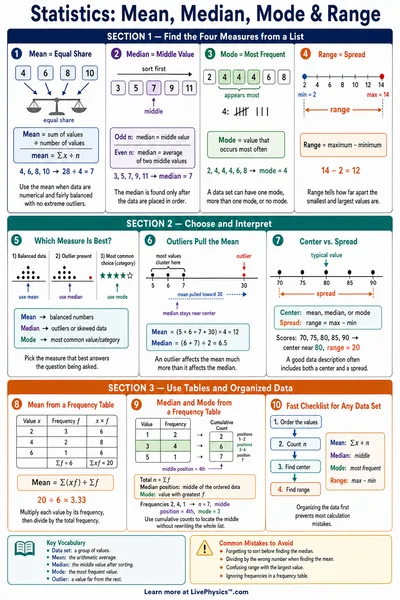
Measures of Central Tendency
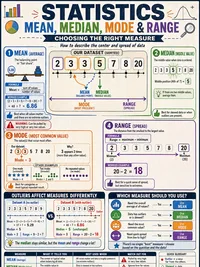
Mean The arithmetic average.
Median The middle value when data is sorted. For even-count datasets, it is the average of the two middle values.
Mode The most frequently occurring value(s). A dataset can have one mode, multiple modes, or no mode if all values are unique.
Measures of Spread
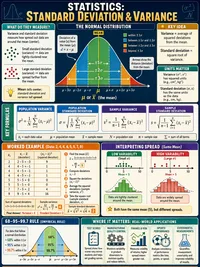
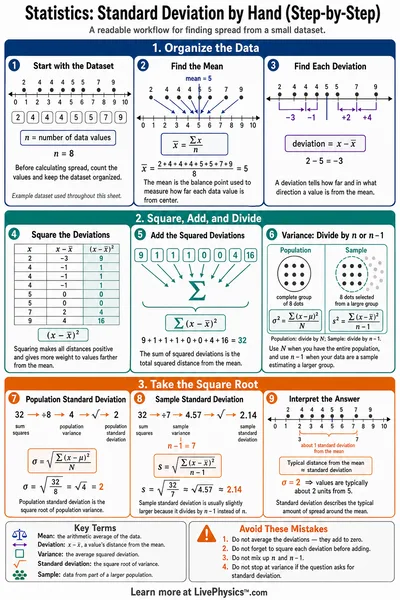
Sample Variance
Population Variance Uses instead of in the denominator.
Standard Deviation The square root of variance.
Interquartile Range (IQR) . Measures the spread of the middle 50% of data.
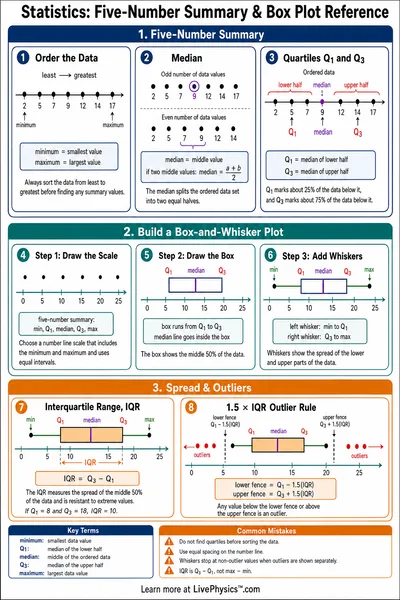
Five-Number Summary and Box Plots
The five-number summary consists of Min, Q1, Median, Q3, and Max. These five values form the basis of the box plot.
Quartiles (Tukey's Hinges) Q1 is the median of the lower half, Q3 is the median of the upper half.
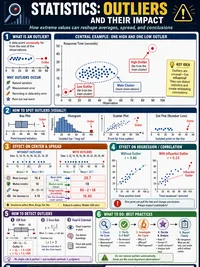
Outlier Detection Points below or above are considered outliers and displayed as individual dots on the box plot.
Histograms and Distribution Shape
A histogram groups data into bins and shows frequency counts. Adjusting the number of bins can reveal different patterns in the data.
Skewness Measures asymmetry. Positive skewness means a longer right tail (mean > median). Negative skewness means a longer left tail (mean < median).
Kurtosis Measures tail heaviness relative to a normal distribution. Excess kurtosis of 0 means normal-like tails. Positive values indicate heavier tails.
Sturges' Rule The default bin count is , which works well for moderate-sized datasets.
Related Content
Visual Explainers
Why Can Averages Be Misleading?
How one number can hide the shape of data
Why Do Graphs Sometimes Lie?
How design choices can change a data story
Why Can a Survey of 1000 People Predict an Election?
How random samples can stand in for millions
Why Do Insurance Companies Always Win in the Long Run?
How averages make risk predictable
Related Tools
Mean, Median & Mode Explorer
Enter a dataset to see mean, median, and mode on an interactive number line with a balance-point fulcrum, box plot, and step-by-step calculations.
Linear Regression Calculator
Find the best-fit line for paired data. See slope, intercept, correlation, R-squared, scatter plot, and residual analysis.
Probability Distributions Explorer
Explore normal, binomial, Poisson, and uniform distributions. Visualize PDF/CDF plots, compute probabilities with draggable bounds, and find inverse values.
Hypothesis Testing Calculator
Run z-tests, t-tests, two-sample t-tests, and chi-square goodness-of-fit tests. See test statistics, p-values, critical values, and step-by-step breakdowns.
Related Labs
Exploratory Data & Distribution Lab
Enter data and compute descriptive statistics including mean, median, quartiles, standard deviation, skewness, and kurtosis. Visualize with histograms, box plots, and dot plots. Compare two datasets side by side
Mean, Median & Mode Lab
Enter number datasets, compute mean, median, mode, and range instantly, and record multiple datasets to discover when each measure of center best represents the data.
Normal Distribution Lab
Set a mean and standard deviation, adjust a raw score X, and see the Z-score, percentile, and shaded bell curve area update instantly. Explore the 68-95-99.7 rule.
Central Limit Theorem & Sampling Distributions Lab
Draw samples from uniform, skewed, bimodal, and exponential populations. Watch the sampling distribution of means converge to normal as sample size increases