Understanding Spherometer Simulator
A lens or a curved mirror is part of a sphere, but the centre of that sphere is usually far away and cannot be reached with a ruler. A spherometer finds the radius without going near the centre. It measures how much the surface bulges or dips over a small, known distance.
Three legs are used because three points always rest steadily on a surface, flat or curved. With the legs 40.0 mm apart, each tip is 40.0 divided by the square root of 3 from the screw axis, which is about 23.1 mm.
The screw tip touches the surface at the middle of that circle. The height h between the tip and the plane of the leg tips is the bulge of the sphere across a circle of radius 23.1 mm. A strongly curved surface gives a large h, and a nearly flat one gives a small h.
Geometry links h to the radius R. For a circle of radius r cut from a sphere, R equals r squared divided by 2h, plus half of h. The triangle of legs makes r squared equal to l squared divided by 3, which turns the first term into l squared divided by 6h.
Take a height of 1.00 mm as an example. Here l squared is 1600 mm², and 1600 divided by 6 is 266.7 mm. Adding half of h gives R = 266.7 + 0.5 = 267.2 mm.
Now halve the height to 0.50 mm. The first term doubles to 533.3 mm and R becomes 533.6 mm. Flatter surfaces have smaller heights and much larger radii.
This is why the fine screw matters. At a height of 0.50 mm, a slip of one disc division changes R by about 10 mm. The same slip at a height of 2.00 mm changes R by less than 1 mm.
The screw has a pitch of 1 mm, so each full turn moves the tip 1 mm and the pitch scale counts the turns. The disc divides one turn into 100 parts of 0.01 mm. A disc edge just above the 1 mm mark with disc line 25 at the scale edge gives a height of 1.25 mm.
Below zero the same rule holds, though it feels backwards. The disc still counts upward from the mark beneath its edge. An edge just above the minus 1 mark with disc line 30 gives minus 1 plus 0.30, which is minus 0.70 mm, a dip of 0.70 mm.
Finding the moment of contact is the real skill. On glass, watch the tip and its reflection approach each other and stop when they meet. On a real instrument one turn too many makes the frame wobble, which shows that a leg has lifted.
The radius is rarely the final goal. The focal length of a spherical mirror is half its radius of curvature, and the lens maker's formula uses the radii of both faces of a lens. That is where students meet the spherometer.
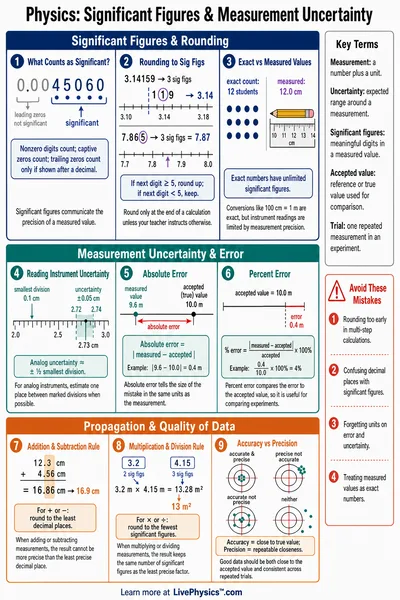
Record h to two decimal places and repeat the contact three times, always finishing with a downward turn. State R with no more significant figures than h has.