Understanding Vernier Caliper Simulator
A ruler marked in millimetres lets you read a length to the nearest millimetre, and a careful eye can guess about half of one more division. A vernier caliper reads ten to fifty times finer than that without any guessing. The trick is a second, sliding scale whose lines are spaced a little differently from the main scale.
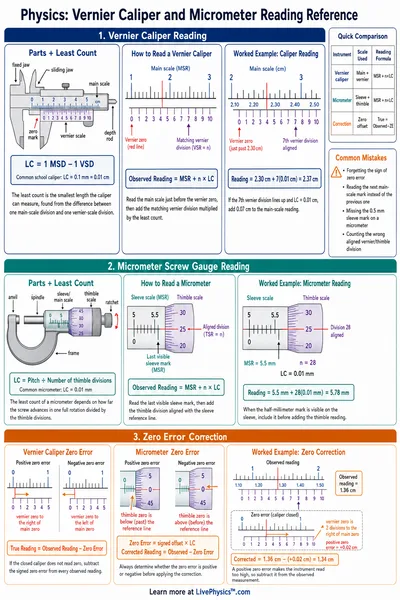
On a common 0.05 mm caliper, the vernier scale has 20 divisions spread over 39 mm. Each vernier division is therefore 1.95 mm long, which is 0.05 mm short of two whole millimetres. That small shortfall is the least count, the smallest step the caliper can show.
When the jaws are closed, the vernier zero sits on the main scale zero and the last vernier line sits on 39 mm. Open the jaws by 0.05 mm and vernier line 1 moves onto a main scale mark. Open them by 0.10 mm and line 2 lines up instead. Each extra step of the least count moves the match one line further along.
That is why the number of the matching line tells you the fraction of a millimetre. You never estimate a gap by eye. You only decide which pair of lines looks most like a single straight line, and people are very good at that judgement.
Reading the caliper always follows the same order. First find the last main scale mark to the left of the vernier zero, which gives the whole millimetres. Then find the vernier line that lines up best and multiply its number by the least count. Add the two parts for the total reading.
Suppose the vernier zero sits just past 45 mm and line 16 lines up. On a 0.05 mm caliper the reading is 45 plus 16 times 0.05, which is 45.80 mm. The final zero matters, because it records that the caliper resolved the length to the nearest five hundredths of a millimetre.
Two neighbouring vernier lines can both look close to a main scale mark. Look at the lines on either side of them as well. On one side the vernier lines sit slightly left of the main marks, and on the other side they sit slightly right, so the true match is the line where that pattern flips.
The highlight option in this simulator marks the main scale reading and the matching line in colour. It is a good support while you learn the pattern. Turn it off once you can find the match on your own, because a real caliper offers no such help.
Practice mode hides every number on the instrument and asks for your reading instead. The feedback says whether the whole millimetres or the vernier part is wrong. That points you to the exact step that needs another look.
Changing the least count shows how the same idea scales. A 0.1 mm caliper squeezes 10 divisions into 19 mm, and a 0.02 mm caliper squeezes 50 divisions into 49 mm. More divisions give finer readings, but the lines sit closer together and are harder to separate by eye.
Teachers can set up a reading, switch to Practice, and copy the link. Anyone who opens it sees the same caliper with the same opening, so a whole class can work on one measurement at once and compare answers afterwards.
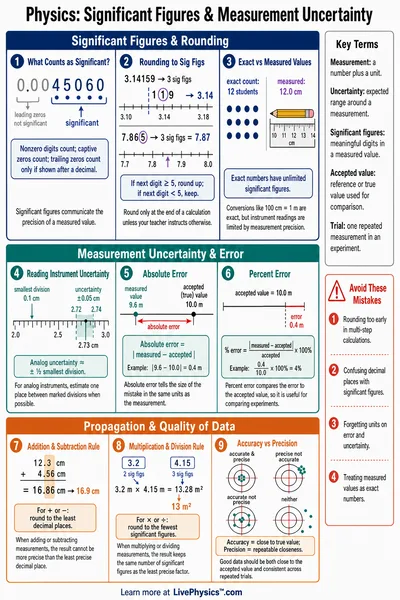
The same skill carries over to other instruments. A micrometer screw gauge, a travelling microscope and many lab balances also combine a coarse scale with a fine one. Recording each reading to the instrument's least count keeps your later uncertainty and significant figure work honest.