Surface Area Net Builder
Pick a 3D shape, adjust its dimensions, and see the unfolded net with color-coded faces. The surface area formula and all face areas update instantly. All computation runs in your browser.
Select a shape
Dimensions
Surface Area Formula
Face Areas Breakdown
| Face | Count | Area (each) | Subtotal |
|---|---|---|---|
| Face | 6 | 16.00 | 96.00 |
| Total Surface Area | 96.00 cm² | ||
Unfolded Net
Surface Area Reference
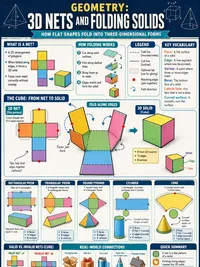
What is a Net?
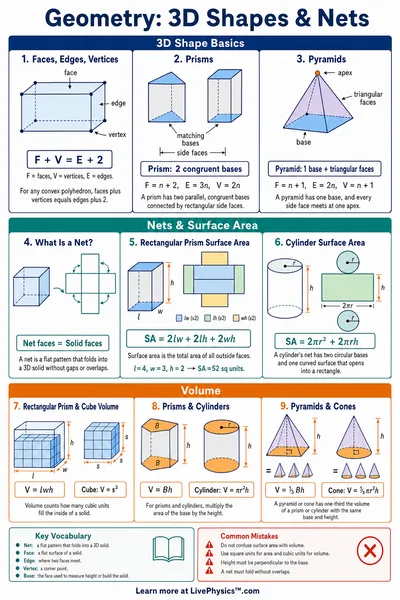
A net is the flat shape you get when you unfold a 3D solid so that all its faces lie in a single plane. Cutting along certain edges and unfolding produces the net.
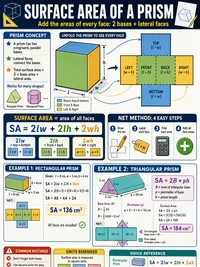
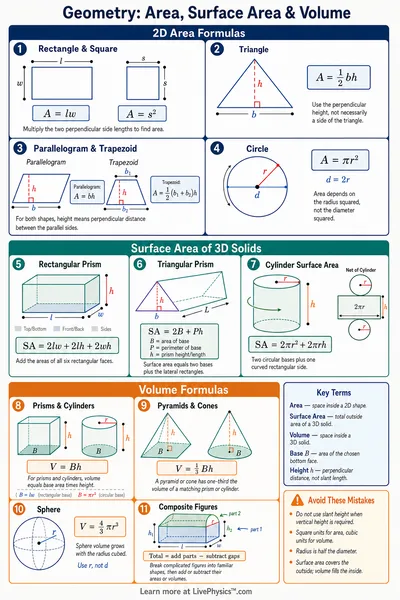
By computing the area of each face in the net and adding them together, you get the total surface area of the solid. This is useful in manufacturing, packaging design, and everyday problem-solving.
Many different nets can produce the same solid. For a cube, there are exactly 11 distinct nets.
Cube and Rectangular Prism
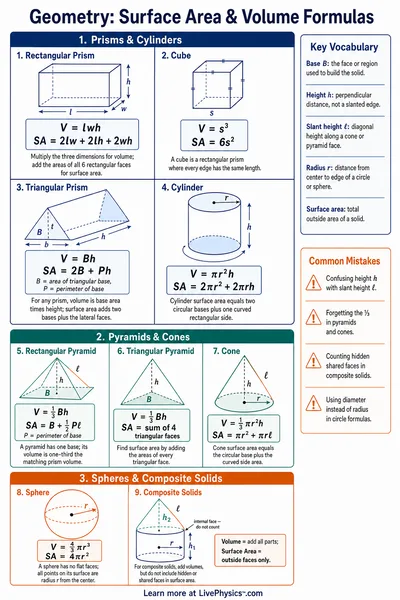
A cube has 6 identical square faces. Each face has area .
A rectangular prism has 3 pairs of identical rectangular faces.
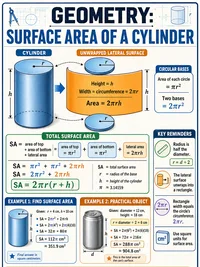
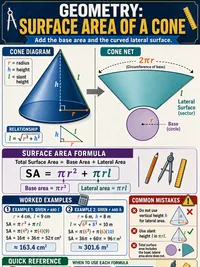
Cylinder and Cone
A cylinder's net is a rectangle (lateral surface) and two circles. The rectangle's width equals the circumference .
A cone's net is a circular sector (lateral surface) and one circle. The sector's radius equals the slant height .
Pyramids and Triangular Prisms
A square pyramid has a square base and 4 triangular faces. Each triangular face has area where is the slant height.
A triangular prism with right-triangle base (legs , hypotenuse ) has two triangular ends and three rectangular faces.
Real-World Applications
Surface area calculations appear in many practical situations
- Packaging. Box manufacturers unfold cardboard into a net before cutting.
- Painting. Coverage per liter depends on the surface area to coat.
- Heat transfer. Radiators and cooling fins maximize surface area.
- Biology. Cell surface-to-volume ratio determines nutrient exchange rates.
- Architecture. Cladding material estimates for curved roofs use cone and cylinder formulas.
Slant Height vs Vertical Height
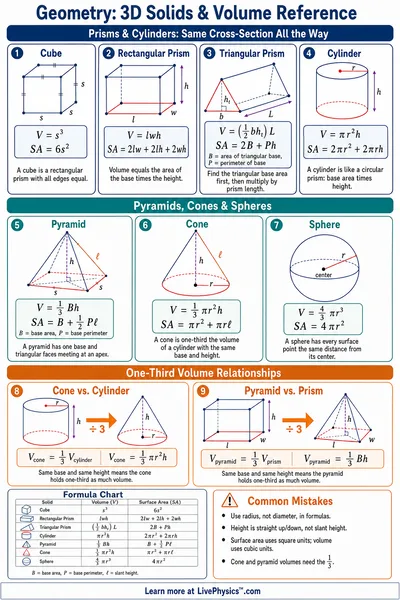
For cones and pyramids, the slant height is the distance along the slanted face from the apex to the base edge. This differs from the vertical height .
They relate via the Pythagorean theorem. For a cone with base radius :
Surface area formulas for cones and pyramids always use slant height, not vertical height.