Truss Load Calculator
Method of joints for 5 classic truss types. Pick a template, adjust span and height, choose a point load or a uniform distributed load, then read off support reactions and member forces. Click any joint for its full free-body diagram.
Truss Parameters
Alternating triangles with no verticals. Each diagonal alternates between tension and compression along the span.
Support Reactions
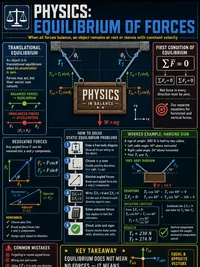
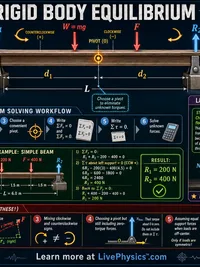
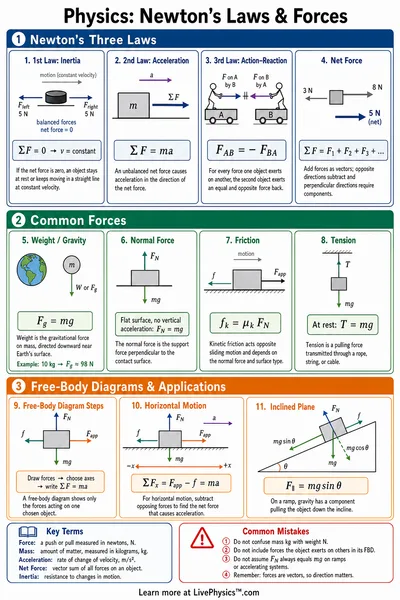
Positive = upward / rightward. From global equilibrium ΣFx = 0, ΣFy = 0, ΣM_A = 0.
Member Forces
| Member | Joints | Force | Type |
|---|---|---|---|
| L1L2 | L1 - L2 | 18.75 kN T | T |
| T2T3 | T2 - T3 | 15.00 kN C | C |
| L0T1 | L0 - T1 | 13.98 kN C | C |
| T1L1 | T1 - L1 | 13.98 kN T | T |
| L1T2 | L1 - T2 | 13.98 kN C | C |
| T1T2 | T1 - T2 | 12.50 kN C | C |
| L2L3 | L2 - L3 | 11.25 kN T | T |
| T2L2 | T2 - L2 | 8.39 kN C | C |
| L2T3 | L2 - T3 | 8.39 kN T | T |
| T3L3 | T3 - L3 | 8.39 kN C | C |
| L3T4 | L3 - T4 | 8.39 kN T | T |
| T4L4 | T4 - L4 | 8.39 kN C | C |
| T3T4 | T3 - T4 | 7.50 kN C | C |
| L0L1 | L0 - L1 | 6.25 kN T | T |
| L3L4 | L3 - L4 | 3.75 kN T | T |
Reference Guide
Method of Joints
Each joint of a statically determinate truss is in equilibrium under the external loads, support reactions, and the axial forces in the members that meet there. Writing the two scalar equilibrium equations at every joint gives enough equations to solve for all unknown member forces.
The trick is to start at a joint with at most two unknown member forces. Once those are solved you propagate to the neighbours, and so on across the truss.
Tension is taken as positive. A negative member force means the bar is in compression.
Five Truss Types
Warren
Alternating triangles of equal angles. No verticals at the panel centers. Common in railway and highway bridges.
Pratt
Verticals carry compression and diagonals slope toward the centerline carrying tension under gravity load. A staple of steel rail bridges since the 1800s.
Howe
Mirror of the Pratt. Diagonals slope away from the centerline and carry compression. Suited to timber where diagonals resist compression more easily than tension.
Fink
Peaked roof truss. Web members radiate from a central peak out to the bottom chord. Common in residential roofs.
K-truss
Tall verticals split at midheight with K-shaped diagonal bracing. Used in transmission towers and deep bridges.
Statically Determinate
A truss can be solved by equilibrium alone when the number of unknown member forces plus reaction components equals the total number of equilibrium equations.
where m is the number of members, r is the number of reaction components, and j is the number of joints. Each joint contributes two scalar equilibrium equations in 2D.
All five templates in this tool satisfy m + r = 2j with a pin plus a roller (r = 3). Switching to two pins adds one more reaction component, leaving the system statically indeterminate and unsolvable by equilibrium alone.
AP Physics Alignment
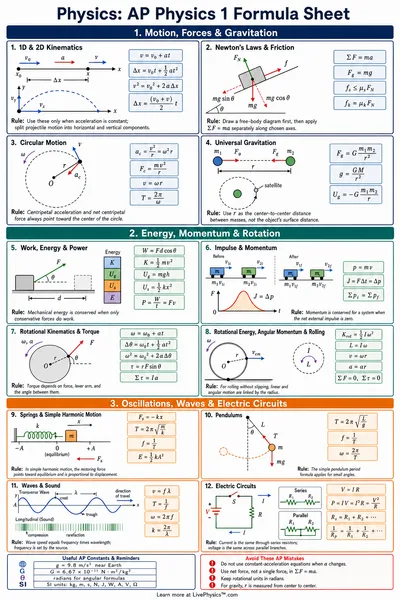
The tool reinforces equilibrium of rigid bodies and force resolution, a core topic in AP Physics 1 statics and in introductory engineering statics.
- Recognize that two-force members carry axial force only.
- Apply ΣFx = 0, ΣFy = 0, and ΣM = 0 to a rigid structure to solve for reactions.
- Resolve member forces into x and y components using direction cosines from the geometry.
- Identify zero-force members by inspection at joints with three members where two are collinear.
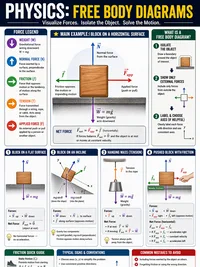
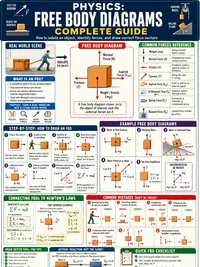
The tool also supports the pre-college engineering pathway by exposing the full per-joint free-body diagram, letting students see exactly which equation produced each member force.