Bridge Design Simulator
Choose a bridge type, add truss reinforcement, then apply a test load to see how structural forces are distributed. Color-coded stress indicators show when a design is approaching its limit.
Design Controls
Bridge Type
Truss Reinforcement
Current capacity 120 kN- safe
No test run yet
Choose a bridge and truss level, then click "Test Bridge"
Max Load Comparison (kN)
| Truss | Beam | Arch | Suspension |
|---|---|---|---|
| None | 120 | 200 | 350 |
| Light | 168 | 280 | 490 |
| Medium | 228 | 380 | 665 |
| Heavy | 300 | 500 | 875 |
Highlighted cell shows your current configuration.
Reference Guide
Bridge Types
Beam Bridge
The simplest design, a horizontal deck supported at both ends. Loads cause the deck to bend, creating compression on the top and tension on the bottom. Efficient for short spans up to about 200 m.
Arch Bridge
A curved structure that redirects load into compressive forces directed along the arch toward the abutments. Arch bridges handle heavy loads efficiently and are well-suited for medium spans (up to 300 m).
Suspension Bridge
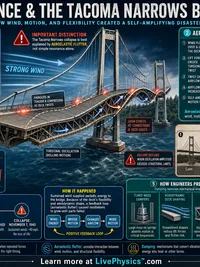
Main cables hanging between towers carry load through tension. Vertical suspenders transfer deck loads to the cables. Best for very long spans (up to 2000 m), such as the Golden Gate Bridge.
Structural Forces
Compression
A pushing or squeezing force that shortens a member. Arch bridges are almost entirely in compression. Concrete performs well in compression but poorly in tension.
Tension
A pulling or stretching force that elongates a member. Suspension cables are in tension. Steel handles high tensile loads very effectively.
Shear and Bending
Loads that act perpendicular to a member's axis create shear stress. Bending combines compression and tension in the same cross-section, which is why beam bridges have an upper compression zone and a lower tension zone.
Safety Factor
The ratio of the bridge's maximum capacity to the applied load. A safety factor of 2.0 means the bridge can hold twice the tested load. Real bridges target factors of 1.5 to 4.0 depending on usage.
Truss Engineering
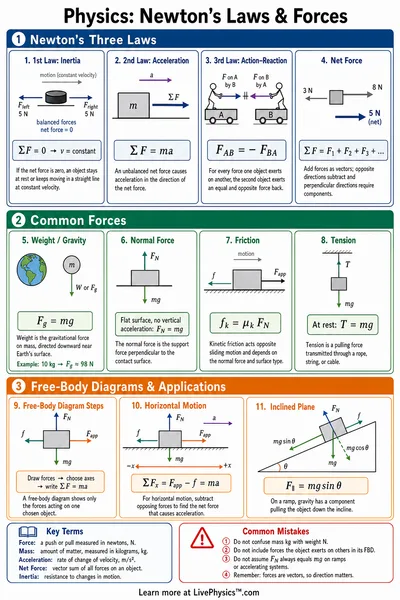
A truss is a framework of triangles that converts bending loads into simpler tension and compression forces in each member. Triangles are the only rigid polygon shape, making trusses extremely stiff per unit of material.
How Trusses Increase Capacity
- Diagonal members carry load paths that bypass weak bending
- More panels distribute load across a greater length
- Top chord adds a compression path parallel to the deck
Real-World Examples
- Warren truss - equal triangles, common in railway bridges
- Pratt truss - vertical members in compression, diagonals in tension
- Howe truss - reverse of Pratt; diagonals in compression
- K-truss - splits panels for very long spans