Practice writing equilibrium constant expressions and calculating Kc from concentration data in tables.
Read each concentration table carefully. Write the correct Kc expression, substitute the equilibrium concentrations, and calculate the equilibrium constant. Show your work in the space provided.
Using equilibrium and ICE tables to calculate Kc
Chemistry - Grade 9-12
- 1
For the reaction A(g) ⇌ B(g), the equilibrium concentrations are [A] = 0.25 M and [B] = 0.75 M. Write the Kc expression and calculate Kc.
- 2
For the reaction H2(g) + I2(g) ⇌ 2HI(g), the equilibrium concentration table is: [H2] = 0.020 M, [I2] = 0.020 M, and [HI] = 0.160 M. Calculate Kc.
- 3
For the reaction N2O4(g) ⇌ 2NO2(g), the equilibrium concentrations are [N2O4] = 0.12 M and [NO2] = 0.30 M. Calculate Kc.
- 4
For the reaction 2SO2(g) + O2(g) ⇌ 2SO3(g), the equilibrium concentrations are [SO2] = 0.10 M, [O2] = 0.20 M, and [SO3] = 0.40 M. Calculate Kc.
- 5
For the reaction PCl5(g) ⇌ PCl3(g) + Cl2(g), the initial concentrations are [PCl5] = 0.500 M, [PCl3] = 0 M, and [Cl2] = 0 M. At equilibrium, [PCl5] = 0.200 M. Use the concentration changes to find the equilibrium concentrations of PCl3 and Cl2, then calculate Kc.
- 6
For the reaction A(g) + 2B(g) ⇌ C(g), the equilibrium concentrations are [A] = 0.10 M, [B] = 0.20 M, and [C] = 0.80 M. Calculate Kc.
- 7
For the reaction CO(g) + Cl2(g) ⇌ COCl2(g), the equilibrium concentrations are [CO] = 0.050 M, [Cl2] = 0.100 M, and [COCl2] = 0.350 M. Calculate Kc.
- 8
For the reaction 2NOBr(g) ⇌ 2NO(g) + Br2(g), the initial concentrations are [NOBr] = 0.60 M, [NO] = 0 M, and [Br2] = 0 M. At equilibrium, [NOBr] = 0.20 M. Use an ICE table to calculate Kc.
- 9
For the reaction H2(g) + CO2(g) ⇌ H2O(g) + CO(g), the equilibrium concentrations are [H2] = 0.15 M, [CO2] = 0.25 M, [H2O] = 0.35 M, and [CO] = 0.45 M. Calculate Kc.
- 10
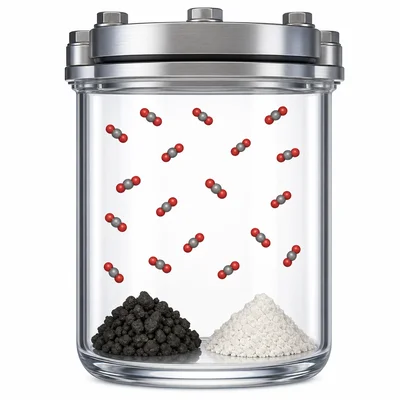
For the reaction CaCO3(s) ⇌ CaO(s) + CO2(g), the equilibrium concentration of CO2 is 0.020 M. Write the Kc expression and calculate Kc.
- 11
For the reaction A(g) ⇌ 2B(g), the equilibrium concentrations are [A] = 0.40 M and [B] = 0.20 M. Calculate Kc for the forward reaction. Then calculate Kc for the reverse reaction, 2B(g) ⇌ A(g).
- 12
For the reaction N2(g) + 3H2(g) ⇌ 2NH3(g), the equilibrium concentrations are [N2] = 0.50 M, [H2] = 0.20 M, and [NH3] = 0.30 M. Calculate Kc.
- 13
For the reaction A(g) + 2B(g) ⇌ 3C(g), the equilibrium concentrations are [A] = 0.250 M, [B] = 0.400 M, and [C] = 0.500 M. Calculate Kc.
- 14
For the reaction N2O4(g) ⇌ 2NO2(g), the initial concentration of N2O4 is 0.100 M and the initial concentration of NO2 is 0 M. At equilibrium, [NO2] = 0.080 M. Find [N2O4] at equilibrium, then calculate Kc.
- 15
For the reaction PCl3(g) + Cl2(g) ⇌ PCl5(g), the initial concentrations are [PCl3] = 0.40 M, [Cl2] = 0.40 M, and [PCl5] = 0 M. At equilibrium, [PCl5] = 0.25 M. Use an ICE table to calculate Kc.