Molarity & Dilution Calculator
Calculate molarity from mass, molar mass, and volume. Use the dilution equation M1V1 = M2V2, or find how much solute to weigh for a target concentration. The reference guide below also shows how to convert concentration to molarity and how to go from molarity to grams or mg/mL.
Solution
Parameters
Results
Step-by-Step Calculation
1. Formula
2. Calculate moles
3. Calculate molarity
Reference Guide
Molarity
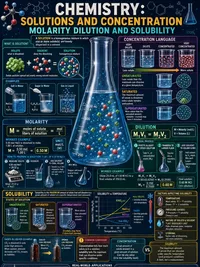
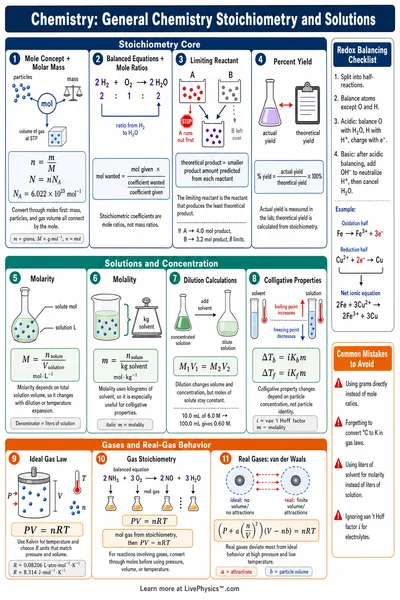
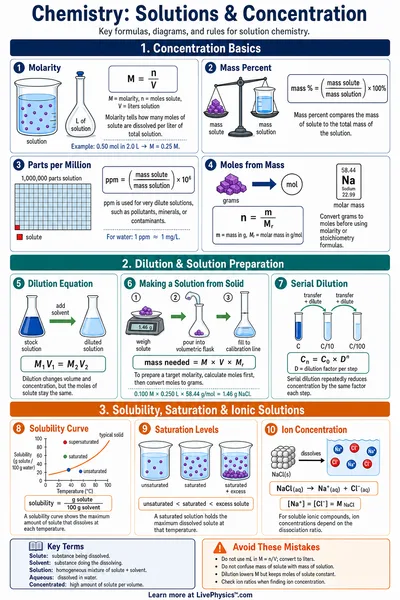
Molarity (M) is the number of moles of solute per liter of solution. It is the most common unit for solution concentration in chemistry.
Dilution Equation
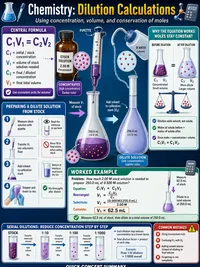
When you dilute a solution, the number of moles of solute stays the same. This gives the dilution equation.
Solution Preparation
To prepare a solution of a specific molarity, calculate the required mass of solute, mass = M x V x molar mass.
Lab Tips
Always add solute to solvent, not the reverse. For acids, add acid to water ("do as you oughta, add acid to water"). Use a volumetric flask for precise volumes.
Converting between molarity, grams, and mg/mL
Molarity to grams
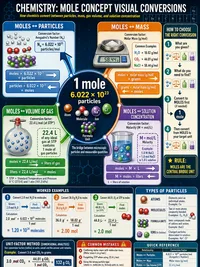
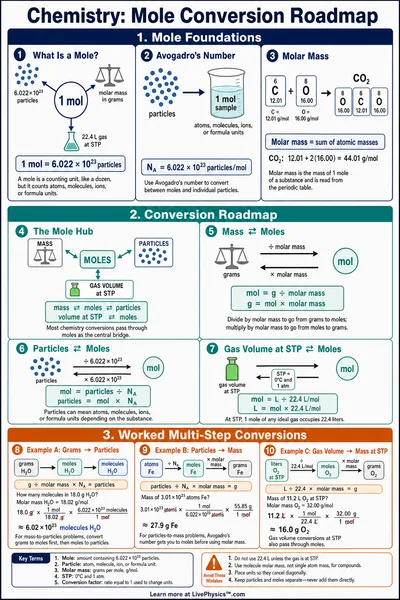
To convert molarity to grams, first find the moles of solute, then multiply by the molar mass.
Example. For 0.50 M NaCl in 2.0 L, moles = 0.50 x 2.0 = 1.0 mol, so grams = 1.0 x 58.44 = 58.44 g. Use the Solution Preparation mode above to do this automatically.
Concentration to molarity
A concentration in grams per liter converts to molarity by dividing by the molar mass.
Example. For 20 g/L NaOH with a molar mass of 40.00 g/mol, M = 20 / 40.00 = 0.50 M. Enter the grams and volume in the Molarity mode to get the same result.
Molarity to mg/mL
Molarity times molar mass gives grams per liter, and grams per liter equals milligrams per milliliter.
Example. For 0.10 M glucose with a molar mass of 180.16 g/mol, 0.10 x 180.16 = 18.0 g/L, which equals 18.0 mg/mL.
How to calculate molarity from concentration
Molarity is a measure of concentration, so the two are closely linked. To calculate molarity from a mass concentration, divide the mass of solute by its molar mass to get moles, then divide the moles by the volume of solution in liters.
For a worked example, 5.85 g of NaCl in 0.500 L of solution gives 5.85 / 58.44 = 0.100 mol, and 0.100 / 0.500 = 0.200 M. The Molarity mode above performs this calculation and shows every step.