Equilibrium Shift Investigation Lab
A full Le Chatelier investigation with quantitative Kc tracking. Apply concentration spikes, sweep temperature, and change volume on five preset gas-phase equilibria. Predict the shift, then check Q against K to confirm.
Choose an Investigation
Investigation A. Concentration Stress
When a single species concentration is changed, in which direction does the system shift to re-establish equilibrium, and does K stay constant?
Spike amount on one chosen species (positive = add, negative = remove)
Reaction quotient Q immediately after the stress, and shift direction toward new equilibrium
- Temperature T (held constant for this investigation)
- Total volume (no compression or expansion)
- Identity of the reaction and its K at the chosen T
Predict the shift direction (forward or reverse) for each stress before running it. Then check, does Q match K after the system re-equilibrates? Does K itself change?
Adding a reactant raises Q's denominator-side moles, pushing Q below K and shifting forward. Adding a product raises Q above K and shifts reverse. K is unchanged because temperature is constant.
- Pick a reaction and let it equilibrate at T (K is computed from van't Hoff)
- Choose a species to spike and an amount (positive add, negative remove)
- Predict the shift direction using Le Châtelier's principle
- Record the trial, then compare predicted vs observed shift
- Summarize how many predictions matched, and what K stayed at
Setup
N₂(g) + 3 H₂(g) ⇌ 2 NH₃(g) · K(298 K) = 6.00e+2 · ΔH = -92 kJ/mol · Δn(gas) = -2
Investigation A spikes a single species while T is held; B sweeps T and derives ΔH from van't Hoff; C compresses or expands the volume.
Equilibrium Analysis
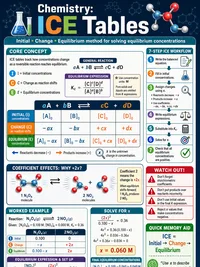
| Species | Initial equilibrium [M] | After stress [M] | New equilibrium [M] |
|---|---|---|---|
| N₂ (1) | 0.121 | - | 0.574 |
| H₂ (3) | 0.362 | - | 0.223 |
| NH₃ (2) | 1.858 | - | 1.951 |
Initial equilibrium is solved at T using K from van't Hoff. The stress is applied to the equilibrium snapshot, then the system re-equilibrates.
Prediction vs Observation
Pick a prediction before recording.
The shift direction is computed from sign of (Q after stress) − K. If Q below K, system goes forward; if above K, reverse. Δn-zero reactions show no shift to volume changes.
Q after stress vs Trial
Record at least 2 trials (or load sample data) to see the regression line.
Data Table
(0 rows)| # | Trial | Reaction | Stress applied | Q after stress | K at T | Predicted shift | Observed shift | Match? |
|---|
Reference Guide
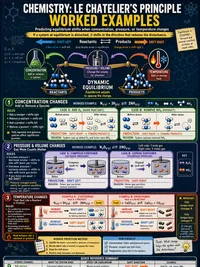
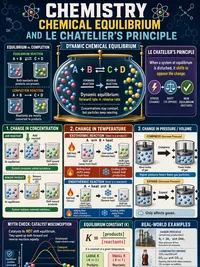
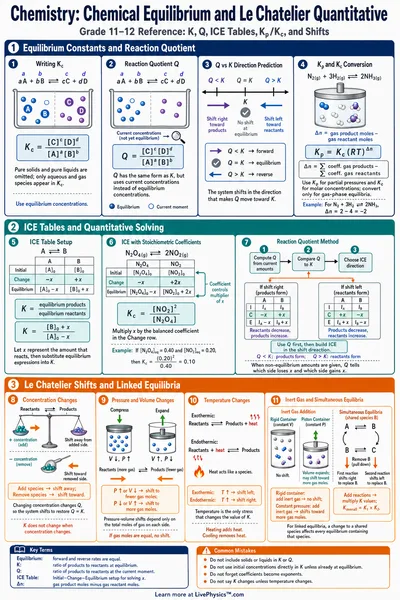
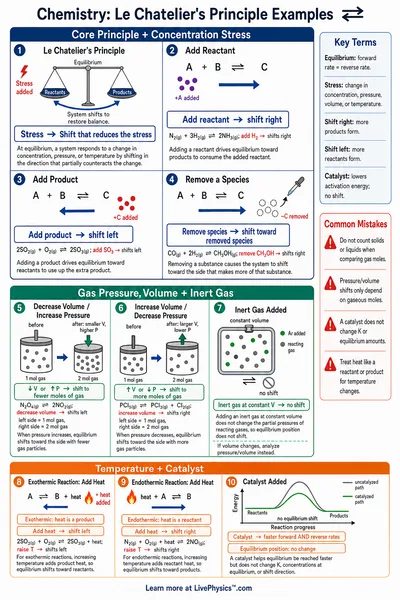
Le Chatelier's Principle
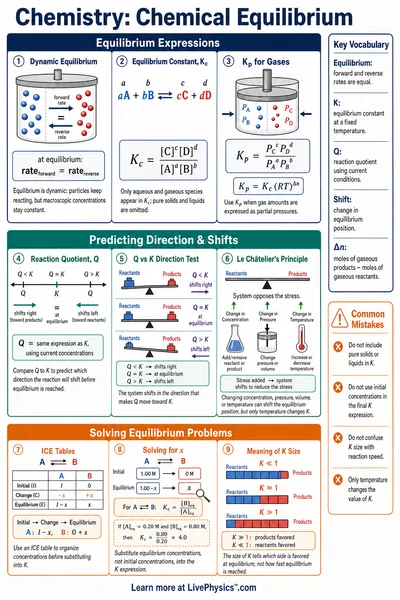
When a stress is applied to a system at equilibrium, the system shifts to partially counteract the stress and restore Q to K.
- Add reactant -> shift forward (toward products)
- Add product -> shift reverse
- Remove a species -> shift toward the side just depleted
- Raise T (exothermic) -> shift reverse and K decreases
- Lower V (compression) -> shift toward fewer mol of gas
Concentration and volume stresses do not change K, but temperature stresses do.
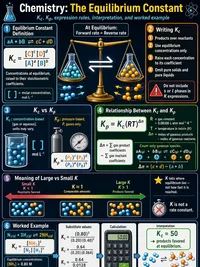
Reaction Quotient and K
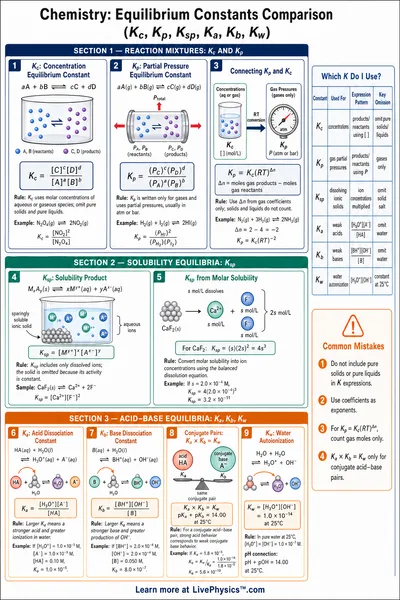
For a A + b B ⇌ c C + d D the quotient is
Compare Q to K. If Q is below K the system shifts forward; if Q is above K the system shifts reverse; if Q equals K the system is already at equilibrium.
vant Hoff Equation
The temperature dependence of K follows
Plot ln K vs 1/T. The slope is -deltaH/R. With R = 8.314 J/(mol K) the derived enthalpy is deltaH = -slope x R, expressed in kJ/mol. Negative deltaH means exothermic; raising T lowers K.
Pressure and Volume
For an ideal gas at constant T, compressing the volume by a factor f multiplies every gas concentration by 1/f. Q scales by f to the power of deltaN where deltaN = (c + d) - (a + b) for gas species.
If deltaN is zero the compression does not shift the system. If deltaN is negative compression drives forward; if positive compression drives reverse.