Understanding Buffer & Acid-Base Equilibrium Lab
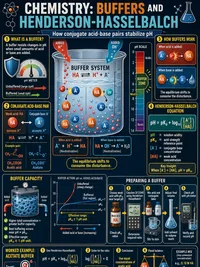
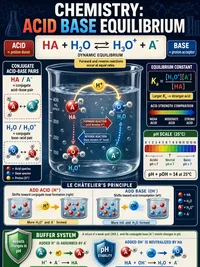
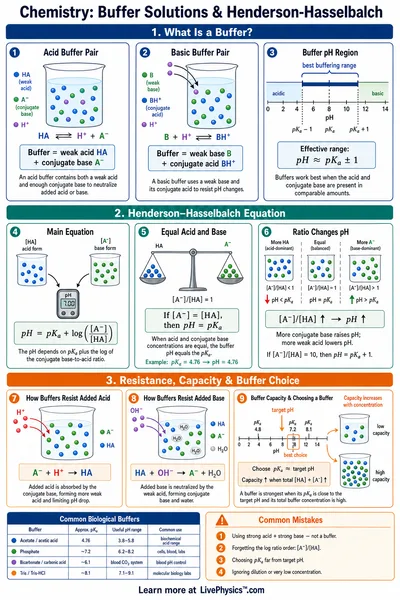
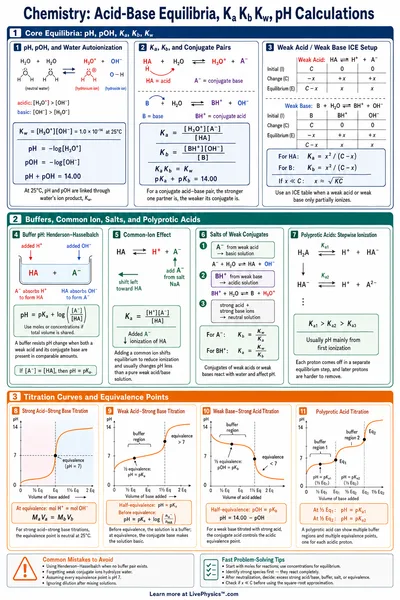
A buffer works because it contains a weak acid and a related base that can trade hydrogen ions. This reversible reaction acts like a chemical reserve, reducing sudden changes in the number of free hydrogen ions in solution.
When strong acid enters a buffer, the conjugate base reacts with most of the added hydrogen ions. It becomes more of the weak acid, so the pH falls only a little while enough conjugate base remains.
When strong base enters, the weak acid gives up hydrogen ions to neutralize hydroxide ions. The weak acid changes into its conjugate base, which keeps the pH from rising as sharply as it would in plain water.
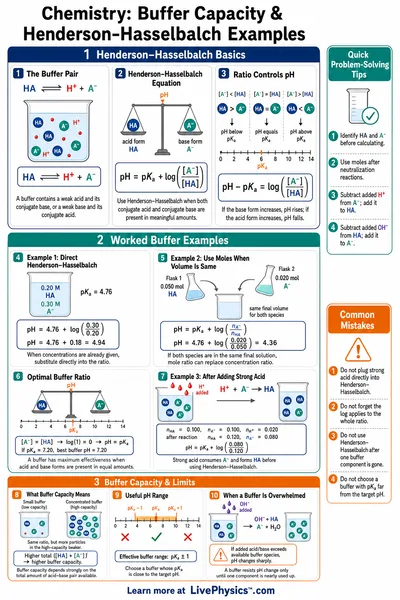
The Henderson Hasselbalch equation links pH with the acid strength and the balance between base and acid forms. A buffer has its most useful control near the acid's pKa, where similar amounts of both forms are present.
At that balance point, the buffer can respond well to acid or base additions because neither chemical reserve is nearly empty. If one form greatly exceeds the other, the buffer can still work, but its useful range becomes narrower.
Buffer capacity depends on the total amount of buffering chemicals, not just their ratio. A concentrated buffer contains more particles that can react with added acid or base, so it withstands a larger disturbance before its pH changes greatly.
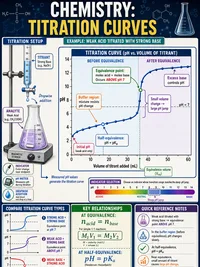
Capacity has a limit because every neutralization uses up one part of the buffer pair. Once most weak acid or most conjugate base has been converted, added strong acid or base remains free in solution and the pH changes rapidly.
Water has very little ability to absorb added acid or base because it lacks a substantial weak acid and conjugate base pair. This makes a buffered and unbuffered comparison useful for seeing that pH control comes from reactions, not from pH being fixed.
Real buffers are important in living things, medicines, foods, soil, and laboratory work. Blood uses several buffer systems to keep conditions suitable for cells, while many medicines need controlled pH to remain stable or dissolve properly.
In a lab calculation, pay close attention to amounts in moles rather than only concentration labels. Adding a solution changes the total volume, and that dilution can matter, especially when the buffer components start at low concentrations.
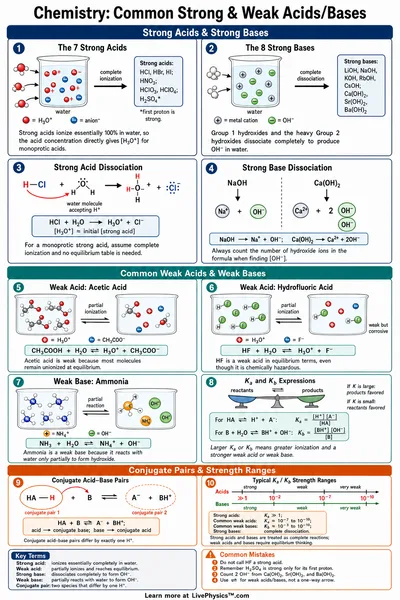
Strong acids and strong bases react nearly completely in water, so handle their neutralization step before estimating the final buffer pH. The remaining amounts of weak acid and conjugate base determine whether the buffer relationship still applies well.
A useful way to learn this topic is to track which species increases and which species decreases after every addition. This particle-level bookkeeping explains the pH trend and helps prevent the common mistake of treating a buffer as if it can resist changes forever.