Equilibrium Lab
Investigate chemical equilibrium for the reaction A + B ⇌ C + D. Set initial concentrations, apply Le Chatelier perturbations, and use ICE tables to predict where the system will settle.
Guided Experiment Le Chatelier's Principle Investigation
If you add more reactant A to a system at equilibrium, what do you predict will happen to the concentrations of C and D?
Write your hypothesis in the Lab Report panel, then click Next.
Controls
Equilibrium Analysis
| [A] | [B] | [C] | [D] | |
|---|---|---|---|---|
| Initial | 1.000 | 1.000 | 0.000 | 0.000 |
| Change | -0.667 | -0.667 | +0.667 | +0.667 |
| Equilibrium | 0.333 | 0.333 | 0.667 | 0.667 |
Concentration vs Time
Data Table
(0 rows)| # | Trial | [A](M) | [B](M) | [C](M) | [D](M) | Q | Keq | Shift |
|---|
Reference Guide
Chemical Equilibrium
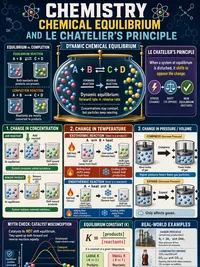
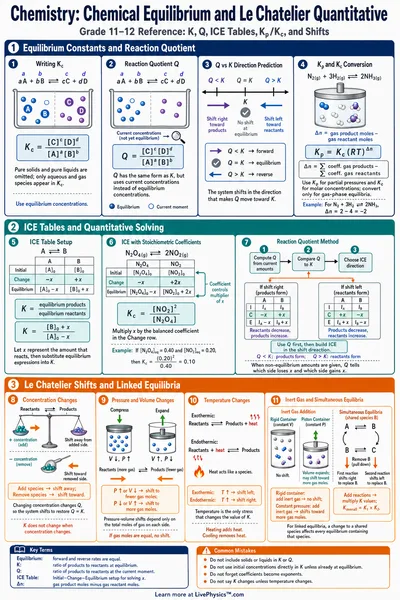
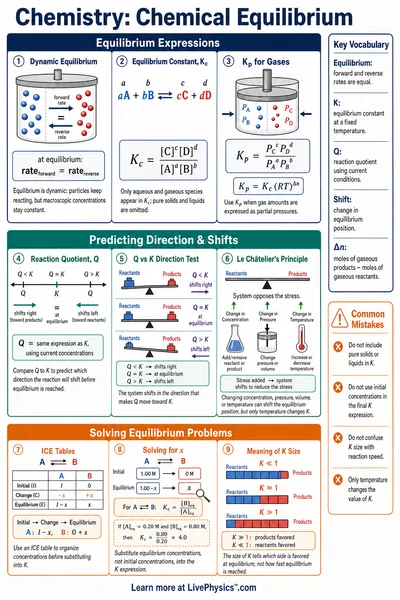
A reversible reaction reaches equilibrium when the forward and reverse rates become equal. Concentrations stop changing but both reactions continue at equal rates.
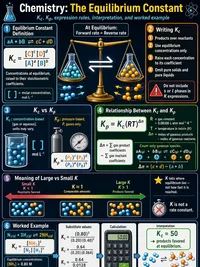
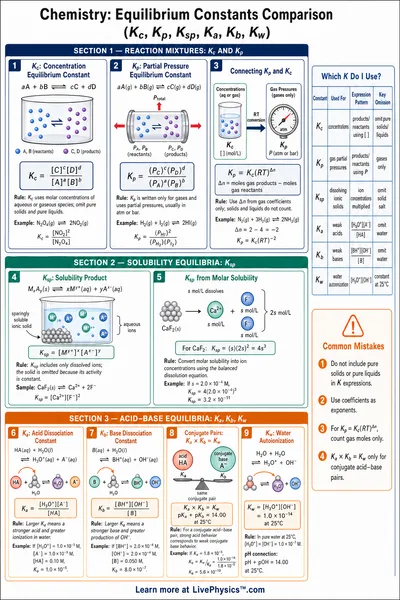
Keq depends only on temperature, not on initial concentrations or how equilibrium was reached. A large Keq means products are favored; a small Keq means reactants are favored.
Le Chatelier's Principle
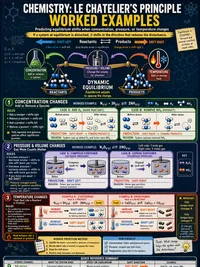
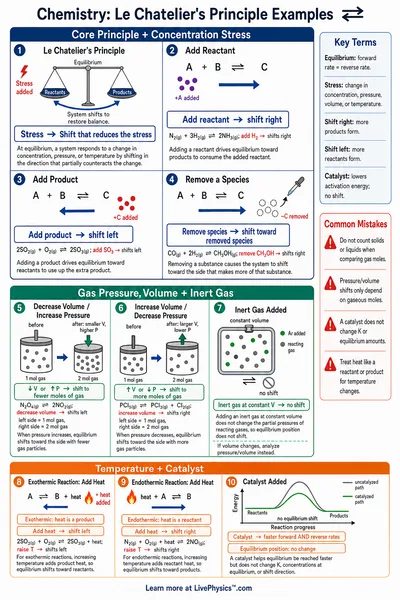
When a system at equilibrium is disturbed, it shifts in the direction that partially counteracts the disturbance.
- Adding reactant shifts the reaction forward
- Adding product shifts the reaction reverse
- Raising temperature favors the endothermic direction
- Lowering temperature favors the exothermic direction
The value of Keq changes only when temperature changes.
ICE Tables
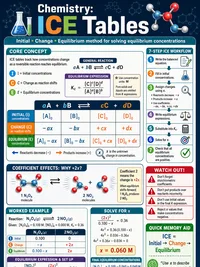
ICE stands for Initial, Change, Equilibrium. The table organizes concentration calculations for a reaction approaching equilibrium.
| Species | Initial | Change | Eq. |
|---|---|---|---|
| A | [A]₀ | -x | [A]₀-x |
| C | [C]₀ | +x | [C]₀+x |
Substitute equilibrium expressions into the Keq equation and solve for x.
Equilibrium Constant
The reaction quotient Q has the same form as Keq but uses current concentrations, not equilibrium concentrations.
- Q < Keq, reaction shifts forward (products form)
- Q > Keq, reaction shifts reverse (reactants form)
- Q = Keq, system is at equilibrium