Practice reading water filter lab data, comparing filter designs, and using evidence to make engineering improvements.
Read each problem carefully. Use the data provided to answer with complete sentences. Show your work in the space provided.
Collecting, comparing, and using data to improve a water filter design
Engineering - Grade 4-5
- 1
A class tested three water filters. Filter A removed 6 spoonfuls of dirt, Filter B removed 9 spoonfuls of dirt, and Filter C removed 7 spoonfuls of dirt. Which filter removed the most dirt?
- 2
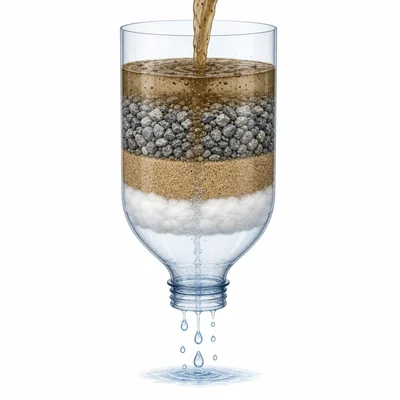
Maya's filter had layers in this order from top to bottom: gravel, sand, cotton. Explain why using layers can help clean dirty water better than using only one material.
- 3
A group measured how cloudy the water looked after filtering. They used a scale from 1 to 5, where 1 means very clear and 5 means very cloudy. Trial 1 scored 4, Trial 2 scored 3, and Trial 3 scored 2. What trend do the data show?
- 4
A filter cleaned 120 milliliters of dirty water. After filtering, 90 milliliters of water came out. How many milliliters of water were trapped in the filter materials?
- 5
Team Red tested a filter twice. The first test took 80 seconds. The second test took 100 seconds. What was the average filtering time?
- 6
Look at this lab data: Filter A had a clarity score of 2 and took 120 seconds. Filter B had a clarity score of 1 and took 180 seconds. If the goal is the clearest water, which filter is better and why?
- 7
A student says, "My filter is the best because I like how it looks." Is this a strong engineering claim? Explain your answer.
- 8
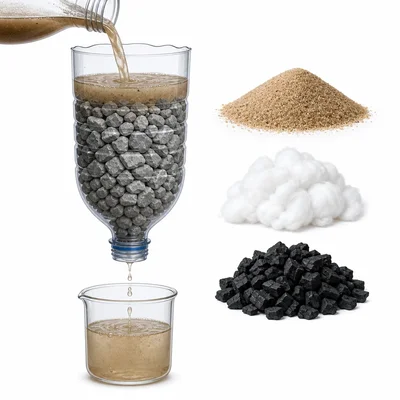
Team Blue used only gravel in its filter. The water came out quickly but was still cloudy. What is one design improvement the team could try next?
- 9
A class recorded the amount of dirt left after filtering. Filter X left 4 grams of dirt, Filter Y left 2 grams of dirt, and Filter Z left 5 grams of dirt. Which filter performed best based on this data?
- 10
Jamal changed one thing in his filter: he added more sand. The water was clearer in the next test. Why is it important that Jamal changed only one thing at a time?
- 11
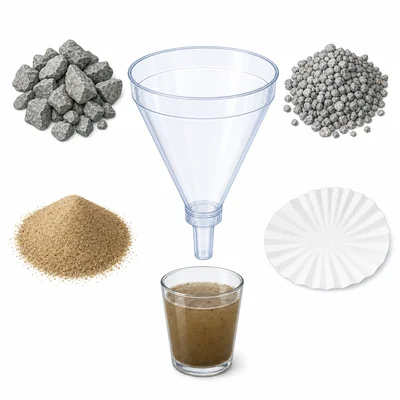
A filter has four layers: large gravel, small gravel, sand, and coffee filter paper. Put the layers in a helpful order from top to bottom for filtering muddy water, and explain your choice.
- 12
A group tested the same filter three times and got clarity scores of 2, 2, and 5. Why might the group want to repeat the test again?
- 13
The goal is to design a filter that makes water clearer and does not take more than 150 seconds. Filter A has a clarity score of 1 and takes 170 seconds. Filter B has a clarity score of 2 and takes 140 seconds. Which filter better meets both parts of the goal?
- 14
Create a simple data table with three columns for a water filter test. The columns should help an engineer compare filter designs.
- 15
A team noticed that charcoal made the water smell better, but their lab data did not include smell. What should the team add to the next test plan?