Water on Earth & Conservation Lab
Discover that less than 1% of Earth's water is freshwater, trace how water moves through the water cycle, and calculate how simple conservation habits can save dozens of gallons every week.
Guided ExperimentHousehold Water Audit
Which household activity do you predict uses the most water per day? How much could your family save if you reduced that activity by 25%?
Write your hypothesis in the Lab Report panel, then click Next.
Controls
Click each segment of the pie chart to learn about Earth's water.
💧
Click a segment to learn more about Earth's water.
Key Insight
Even though Earth looks blue from space, less than 1% of all water is available freshwater that humans can easily access for drinking, farming, and daily use.
Data Table
(0 rows)| # | Activity | Daily Use (gallons) | Conservation Action | Reduced Use (gallons) | Gallons Saved |
|---|
Reference Guide
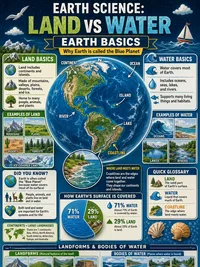
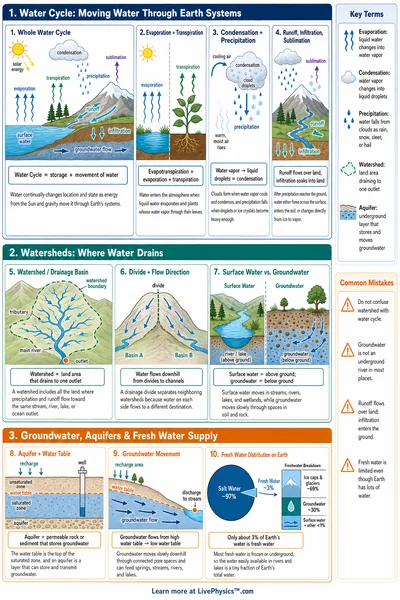
Earth's Water Distribution
Earth is called the "Blue Planet," but most of its water is not available for human use
- 97% - salt water in oceans (not drinkable)
- 2% - frozen in glaciers and ice caps
- 1% - freshwater in rivers, lakes, and groundwater
Even within that 1%, much is deep underground or in remote locations. The fraction easily accessible to humans is tiny.
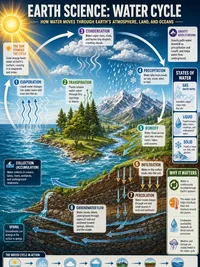
The Water Cycle
Water moves continuously through Earth's systems in a never-ending cycle
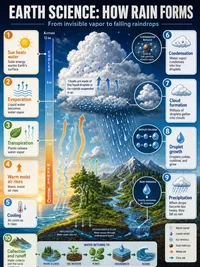
- Evaporation - sun heats water; it turns to vapor
- Condensation - vapor cools and forms clouds
- Precipitation - water falls as rain, snow, or hail
- Runoff - water flows into rivers and oceans
- Infiltration - water soaks into the ground
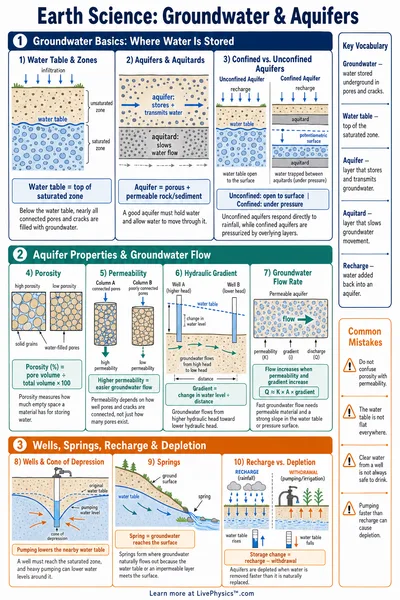
Why Freshwater Is Limited
Although water cycles continuously, the total amount of freshwater on Earth does not increase. Several factors make it scarce
- Population growth increases demand
- Pollution makes some freshwater unsafe
- Climate change affects rainfall patterns
- Groundwater replenishes slowly (takes decades or centuries)
Water Conservation Strategies
Small changes every day add up to significant water savings
- Shorter showers (saves up to 17 gal per shower)
- Fix leaky faucets (a drip wastes ~3,000 gal/year)
- Run full dishwasher loads only
- Turn off the tap while brushing teeth (saves 1 gal/use)
- Water lawns in the morning to reduce evaporation
Efficient appliances - like low-flow showerheads and high-efficiency washers - can cut water use by 30–50% without changing habits.