Surveys, Charts & Data Stories Lab
Pick a survey question, collect votes from your class, then read a bar chart or pictograph and answer questions about what the data tells you.
Guided ExperimentSurveys and Charts Investigation
Before you simulate the class votes, which option do you think will win? Write your prediction.
Write your hypothesis in the Lab Report panel, then click Next.
Controls
Pick a survey topic, collect votes, then read the chart and answer data questions.
Step 1. Pick a Survey Question
Step 2. Collect Votes
Click each option to add a vote. Then click "Simulate Class" to fill in the rest of the class (20 total).
"What is your favorite season?"
Total votes 0 / 20
Data Table
(0 rows)| # | Survey Topic | Winner | Total Votes | Winner Votes | Notes |
|---|
Reference Guide
What Is a Survey?
A survey is a set of questions you ask a group of people to find out what they think or prefer. Each person gives one answer, called a vote or response.
Surveys help us make decisions for a group. Asking "What snack should we bring to the party?" and counting responses gives you real data to work with.
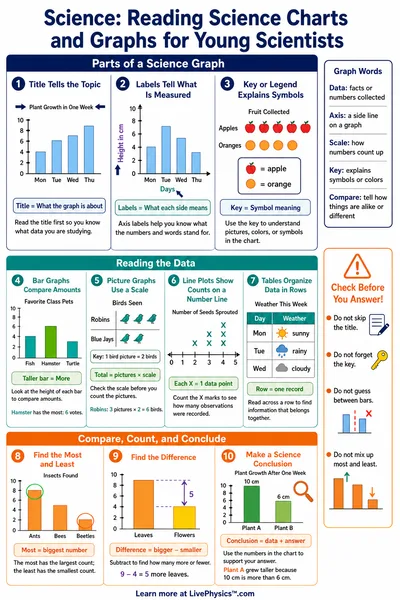
Reading a Bar Chart
A bar chart uses rectangles (bars) to show how many people chose each option. A taller bar means more votes. A shorter bar means fewer votes.
- The label at the bottom of each bar tells you the choice
- The length of the bar shows the count
- Compare bars side by side to find the winner
The Mode (Most Popular)
In math, the most common value in a data set is called the mode. In a survey, the mode is the option with the most votes.
If 8 students chose Summer and only 4 chose Spring, then Summer is the mode. The mode is the winner of the survey.
Turning Data into a Story
Data only becomes useful when you explain what it means. A data story answers three questions
- What did we find out? State the winner and the total
- Why might this be? Give a possible reason for the result
- What could we do with this? Suggest a decision based on the data
Example, "Summer won with 9 out of 20 votes. Many kids like warm weather and swimming. We could plan a summer-themed class party!"