Practice using Ohm's Law, series and parallel resistance, Kirchhoff's junction rule, and Kirchhoff's loop rule to solve DC circuit problems.
Read each problem carefully. Show your setup, equations, substitutions, and final units in the space provided.
Analyze current, voltage, resistance, and conservation laws in DC circuits
Physics - Grade 9-12
- 1
A 12 V battery is connected across a 6.0 ohm resistor. Use Ohm's Law to find the current through the resistor.
- 2
A resistor has a current of 0.30 A when connected to a 9.0 V battery. What is the resistance of the resistor?
- 3
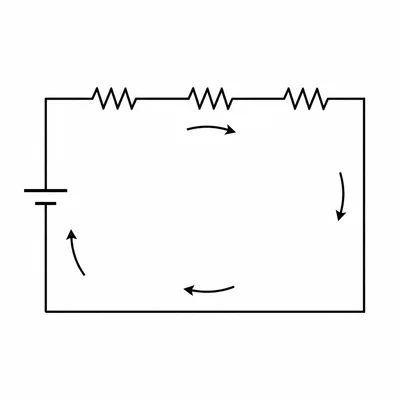
Three resistors of 4.0 ohms, 6.0 ohms, and 10.0 ohms are connected in series to a 24 V battery. Find the equivalent resistance, the circuit current, and the voltage drop across each resistor.
- 4
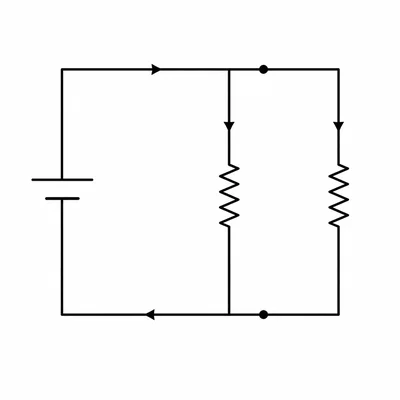
A 6.0 ohm resistor and a 3.0 ohm resistor are connected in parallel across a 12 V battery. Find the current through each branch, the total current, and the equivalent resistance.
- 5
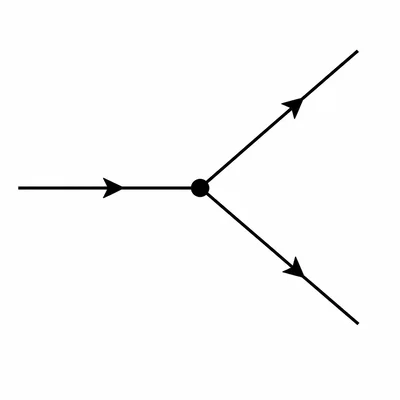
At a junction, a 3.0 A current enters from one wire. The current splits into two outgoing wires. One outgoing current is 1.2 A. What is the other outgoing current?
- 6
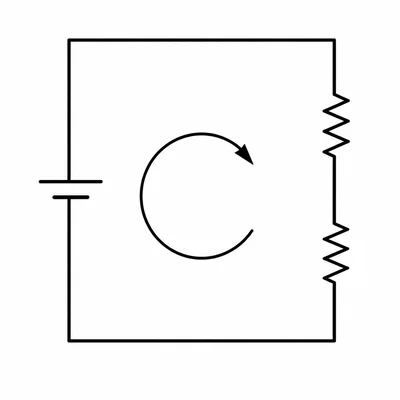
A single loop contains a 12 V battery, a 2.0 ohm resistor, and a 4.0 ohm resistor in series. Write Kirchhoff's loop equation and solve for the current.
- 7
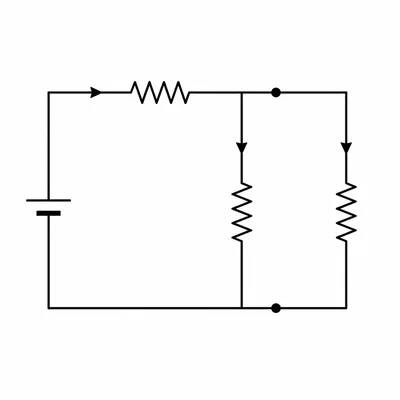
A circuit has an 8.0 ohm resistor in series with a parallel combination of 12.0 ohms and 6.0 ohms. The circuit is connected to an 18 V battery. Find the total current and the current through each parallel branch.
- 8
A circuit has a 9.0 V battery connected to a 100 ohm lamp. What is the current through the lamp? If the lamp resistance doubles to 200 ohms while the voltage stays the same, what is the new current?
- 9
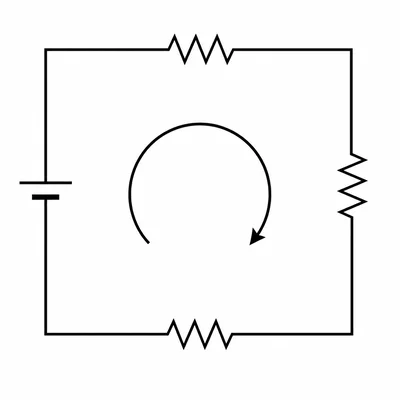
For a clockwise loop with a 9.0 V battery and three series resistors of 2.0 ohms, 5.0 ohms, and 1.0 ohm, write a Kirchhoff loop equation and solve for the current.
- 10
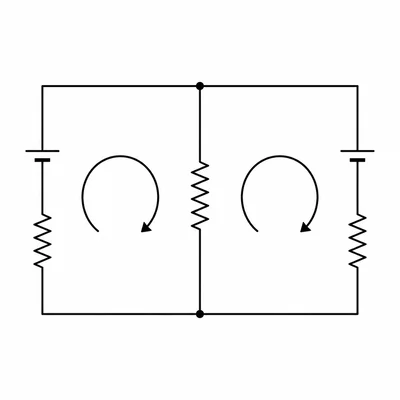
Two circuit loops share a 2.0 ohm resistor. The left loop has a 12 V battery and a 4.0 ohm resistor. The right loop has a 6 V battery and a 3.0 ohm resistor. Let clockwise mesh currents be I1 in the left loop and I2 in the right loop, with both batteries aiding the clockwise direction in their loops. Write the two loop equations and solve for I1 and I2.
- 11
A 12 V battery supplies a current of 0.50 A to a circuit. What power does the battery deliver? How much energy is delivered in 2.0 minutes?
- 12
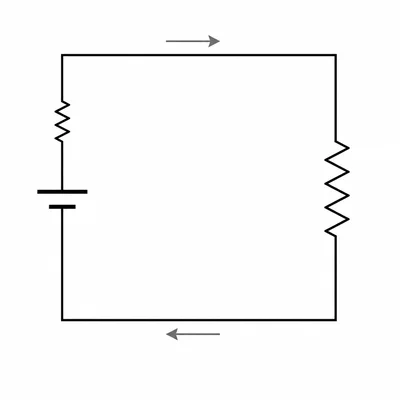
A real battery has an emf of 12.0 V and an internal resistance of 1.0 ohm. It is connected to a 5.0 ohm load resistor. Find the current in the circuit and the terminal voltage across the load resistor.
- 13
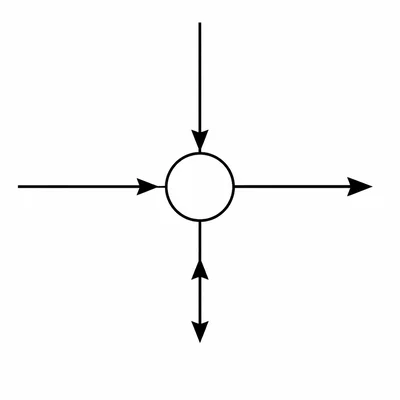
At a junction, 2.0 A enters from the left and 0.75 A enters from the top. A current of 1.40 A leaves to the right. Find the current in the bottom wire and state whether it enters or leaves the junction.
- 14
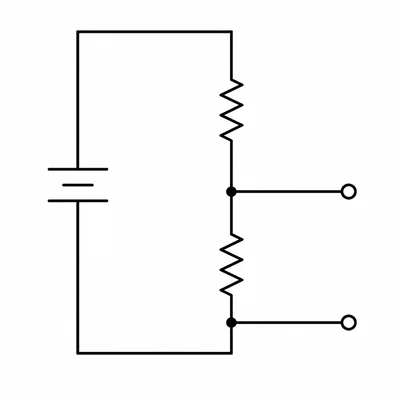
A voltage divider has a 2.0 kilo-ohm resistor in series with a 3.0 kilo-ohm resistor across a 10.0 V battery. Find the current in the circuit and the voltage across the 3.0 kilo-ohm resistor.
- 15
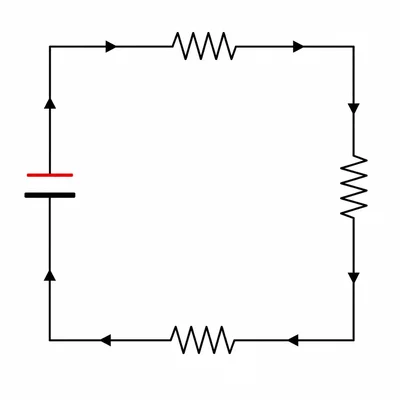
A student says that current is used up as it passes through resistors in a series circuit, so the last resistor gets less current than the first resistor. Explain what is wrong with this statement using Kirchhoff's rules.