Practice calculating molarity, determining moles of solute, comparing concentrations, and applying dilution relationships in solution chemistry.
Read each problem carefully. Show your work and include units in every calculation.
Calculating molarity, dilution, and concentration relationships
Chemistry - Grade 9-12
- 1
A solution contains 2.0 moles of sodium chloride dissolved to make 0.50 liters of solution. What is the molarity of the solution?
- 2
How many moles of potassium nitrate are present in 250 mL of a 0.80 M solution?
- 3
A student dissolves 5.85 grams of sodium chloride, NaCl, in water to make 500 mL of solution. What is the molarity of the solution? Use a molar mass of 58.5 g/mol for NaCl.
- 4
What volume in liters is needed to prepare a 0.25 M glucose solution that contains 0.75 moles of glucose?
- 5
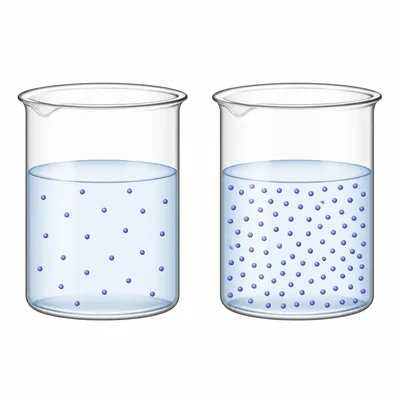
Which solution is more concentrated: 1.5 M hydrochloric acid or 0.75 M hydrochloric acid? Explain your answer.
- 6
A 2.0 L solution contains 0.10 moles of calcium chloride. What is the concentration in molarity?
- 7
How many grams of sodium hydroxide, NaOH, are needed to make 400 mL of a 1.5 M solution? Use a molar mass of 40.0 g/mol for NaOH.
- 8
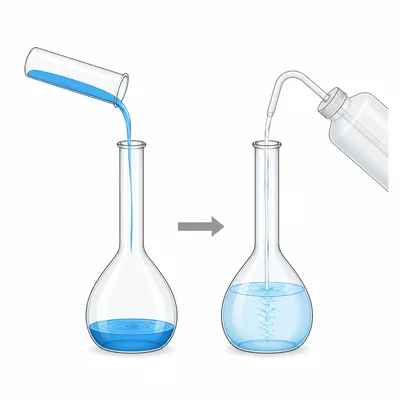
A stock solution has a concentration of 6.0 M. What will the final concentration be if 100 mL of this solution is diluted to 300 mL total volume?
- 9
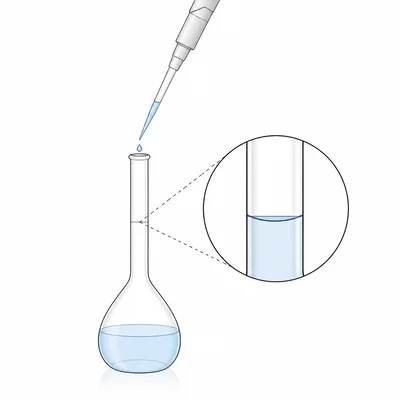
How much 3.0 M sulfuric acid is needed to prepare 250 mL of a 0.60 M solution?
- 10
A laboratory solution is labeled 0.10 M copper sulfate. How many moles of copper sulfate are in 1.20 L of this solution?
- 11
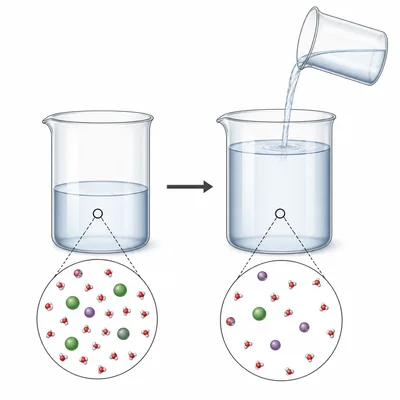
A student mixes 0.50 L of a 2.0 M sodium chloride solution with enough water to make 1.0 L of solution. What is the new molarity?
- 12
Explain in one or two complete sentences what it means when a solution has a molarity of 0.50 M.