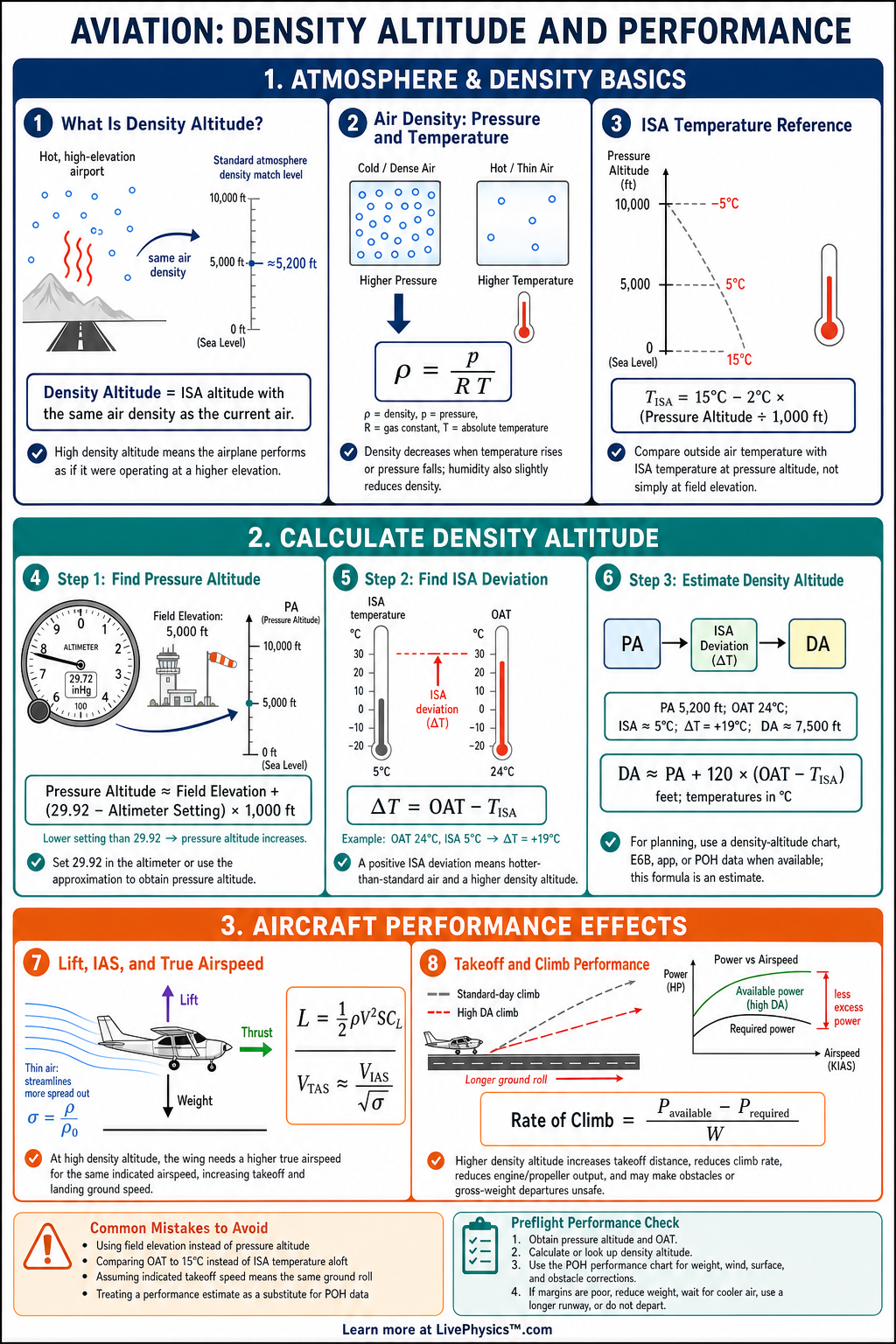
Density altitude explains how air conditions affect aircraft performance. It combines the effects of pressure, temperature, and humidity into one useful altitude value. Pilots use it to predict takeoff distance, climb capability, and aircraft handling before departure.
This cheat sheet helps students connect weather data with practical flight planning decisions.
Pressure altitude is the starting point for calculating density altitude. Temperature above standard makes density altitude higher, while colder-than-standard air makes it lower. High density altitude means thinner air and reduced performance from the wing, propeller, engine, and rotor system.
Accurate performance planning requires the pilot to use approved aircraft charts or electronic performance tools.
Key Facts
- Pressure altitude is the altitude shown when the altimeter is set to 29.92 inches of mercury or 1013.25 hectopascals.
- Density altitude approximately equals pressure altitude plus 120 feet times the difference between outside air temperature and ISA temperature in degrees Celsius.
- ISA temperature in degrees Celsius equals 15 minus 2 times the altitude in thousands of feet, within the lower atmosphere.
- When outside air temperature is above ISA temperature, density altitude is higher than pressure altitude.
- Higher density altitude increases takeoff distance and decreases climb rate because the air is less dense.
- At a given indicated airspeed, true airspeed is higher in less dense air, so the aircraft travels faster over the ground during takeoff.
- Aircraft performance calculations must use the approved flight manual charts or approved electronic performance data for the specific aircraft.
Vocabulary
- Density altitude
- Density altitude is pressure altitude corrected for nonstandard temperature and, to a smaller degree, humidity.
- Pressure altitude
- Pressure altitude is the altitude referenced to standard atmospheric pressure rather than the local pressure setting.
- ISA
- ISA is the International Standard Atmosphere, a reference model of standard pressure and temperature at each altitude.
- True airspeed
- True airspeed is the aircraft's actual speed through the air mass.
- Indicated airspeed
- Indicated airspeed is the speed displayed directly by the aircraft airspeed indicator before corrections.
- Normally aspirated engine
- A normally aspirated engine draws in outside air without using a turbocharger or supercharger to increase intake pressure.
Common Mistakes to Avoid
- Using field elevation as density altitude is wrong because temperature and local pressure can make the effective altitude much higher or lower than the airport elevation.
- Assuming a normal indicated liftoff speed means a normal ground roll is wrong because true airspeed and ground speed are higher in thin air.
- Ignoring aircraft weight is wrong because greater weight increases the required takeoff distance and reduces climb performance.
- Treating the 120 feet per degree Celsius method as exact is wrong because it is an estimate and does not replace approved aircraft performance data.
- Calculating density altitude but ignoring wind, runway slope, runway surface, and obstacles is wrong because these conditions also affect takeoff safety.
Practice Questions
- 1 An airport has a pressure altitude of 5,000 feet. The ISA temperature there is 5 degrees Celsius, and the outside air temperature is 25 degrees Celsius. Estimate the density altitude.
- 2 A pilot calculates a density altitude of 8,200 feet at an airport with a field elevation of 3,000 feet. State two aircraft performance effects the pilot should expect.
- 3 Using the ISA temperature rule, calculate the standard temperature at 7,500 feet.
- 4 Explain why a hot, high-elevation airport can require a pilot to reduce aircraft weight even when the runway is dry and the engine is operating normally.
Understanding Density Altitude and Performance
Air density is the mass of air in a given volume. Dense air has more air molecules available for the engine, propeller, and wing to use. Thin air has fewer molecules in the same space.
Density decreases as altitude rises because atmospheric pressure falls. It also decreases when temperature rises because warm air expands. Humidity further reduces density because water vapor is lighter than dry air.
Pressure altitude gives pilots a common reference based on standard pressure. It is the altitude indicated when the altimeter is set to 29.92 inches of mercury or 1013.25 hectopascals. At a high-elevation airport, pressure altitude is already high even on a standard day.
Density altitude then adjusts pressure altitude for nonstandard temperature. A useful estimate adds 120 feet for every degree Celsius that outside air temperature is above the standard temperature at that altitude.
High density altitude affects every major part of takeoff performance. A normally aspirated engine develops less power because it receives less oxygen. A propeller produces less thrust because it accelerates less dense air.
The wing must move faster through the air to create the required lift, but the airspeed indicator can still show the normal indicated liftoff speed. The aircraft therefore needs more true airspeed and a longer ground roll. Climb rate falls, obstacle clearance becomes weaker, and a heavily loaded aircraft may have little climb margin.
Pilots commonly encounter high density altitude on hot summer afternoons at airports located in mountains or high desert areas. Conditions can become especially demanding when high temperature, high field elevation, high aircraft weight, and a tailwind occur together. Humidity usually has a smaller effect than temperature and pressure, but it still worsens performance.
Students should learn to calculate or obtain density altitude, then use the aircraft flight manual performance charts. They should study how runway slope, surface condition, wind, weight, and obstacles add to the risk. A safe decision may require reducing weight, departing during cooler hours, selecting a longer runway, or delaying the flight.