Fluid Dynamics Calculator
LivePhysics™
Pipe Diagram
Parameters
Pa
Pa
m/s
m/s
m
m
kg/m\u00B3
Results
p2
103300
Step-by-Step
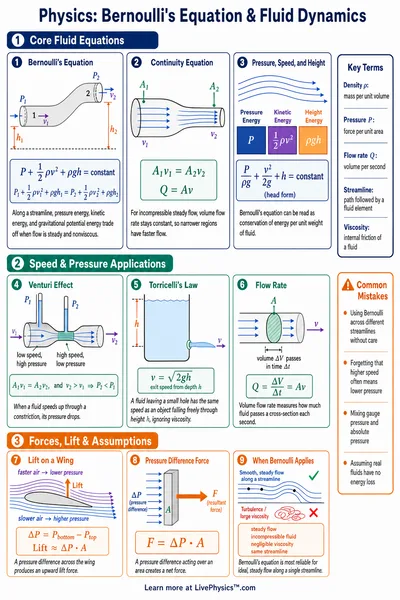
1. Bernoulli's equation
2. Substitute and solve for P₂
3. Result
Reference Guide
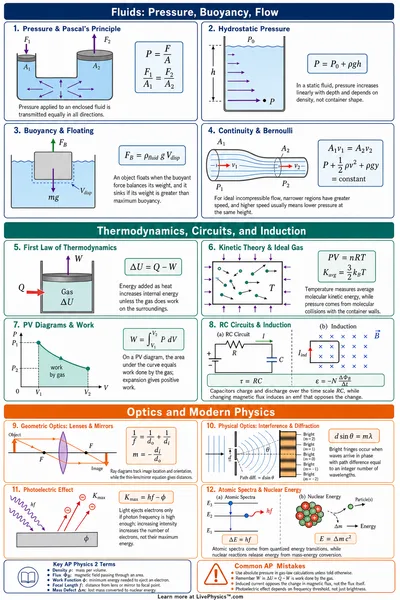
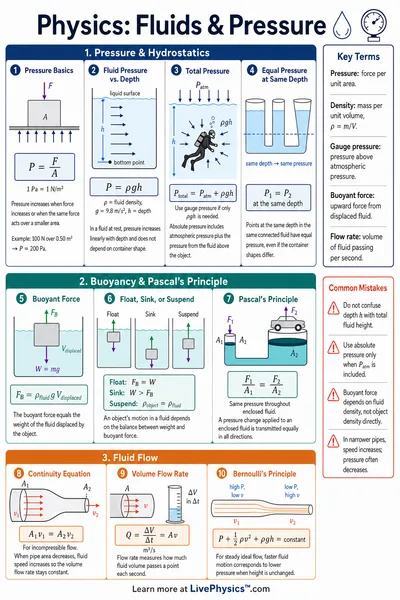
Free Bernoulli equation and continuity equation calculator. Solve for pressure, velocity, or height at two points in a fluid flow with step-by-step math.
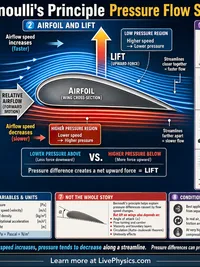
Bernoulli Equation
primary
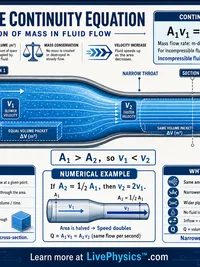
Continuity Equation
secondary
Applications
tertiary
Limitations
Related Content
Related Tools
Projectile Motion Calculator
Calculate trajectory, range, max height, and time of flight for projectile motion. Visualize the parabolic path with an interactive time slider and velocity vectors.
Circuit Calculator
Calculate voltage, current, resistance, and power with Ohm's law. Build series and parallel resistor networks with step-by-step equivalent resistance.
Lens & Mirror Calculator
Visualize image formation with interactive ray diagrams for lenses and mirrors.
Kinematics Solver
Solve constant-acceleration problems with step-by-step solutions and motion graphs.
Related Labs
Fluid Dynamics & Bernoulli Lab
Solve Bernoulli's equation and the continuity equation for pipe flow. Explore Torricelli's theorem, Venturi effect, Reynolds number, and airplane wing lift
Viscosity & Poiseuille Flow Lab
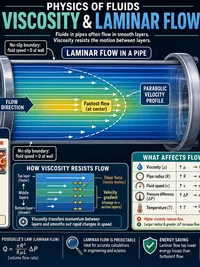
Change pipe radius, length, pressure difference, and fluid viscosity to see how the volumetric flow rate responds through the Hagen-Poiseuille law. Verify the fourth-power radius dependence (doubling the radius multiplies the flow by 16), watch the parabolic velocity profile, and check whether the flow stays laminar with the Reynolds number
Pressure in Fluids Lab
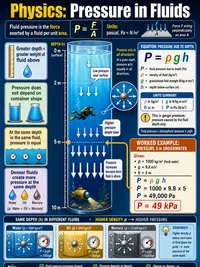
Explore hydrostatic pressure using a U-tube manometer simulation. Vary fluid density (water, oil, mercury, glycerin) and depth to observe pressure changes via P = rho*g*h. Displays gauge pressure, absolute pressure, and pressure in multiple units (Pa, atm, bar, mmHg, psi). A fluid-height visualization shows the manometer response.
Hydraulics & Pascal's Law Lab
Explore Pascal's law, hydraulic presses, and hydrostatic pressure. Calculate force multiplication, mechanical advantage, and pressure at depth with interactive diagrams