Sign in to save

Bookmark this page so you can find it later.

Sign in to save

Bookmark this page so you can find it later.

Astronomy elementary May 24, 2026

Why Do Stars Twinkle but Planets Don't?

Air wiggles starlight on its way to your eyes
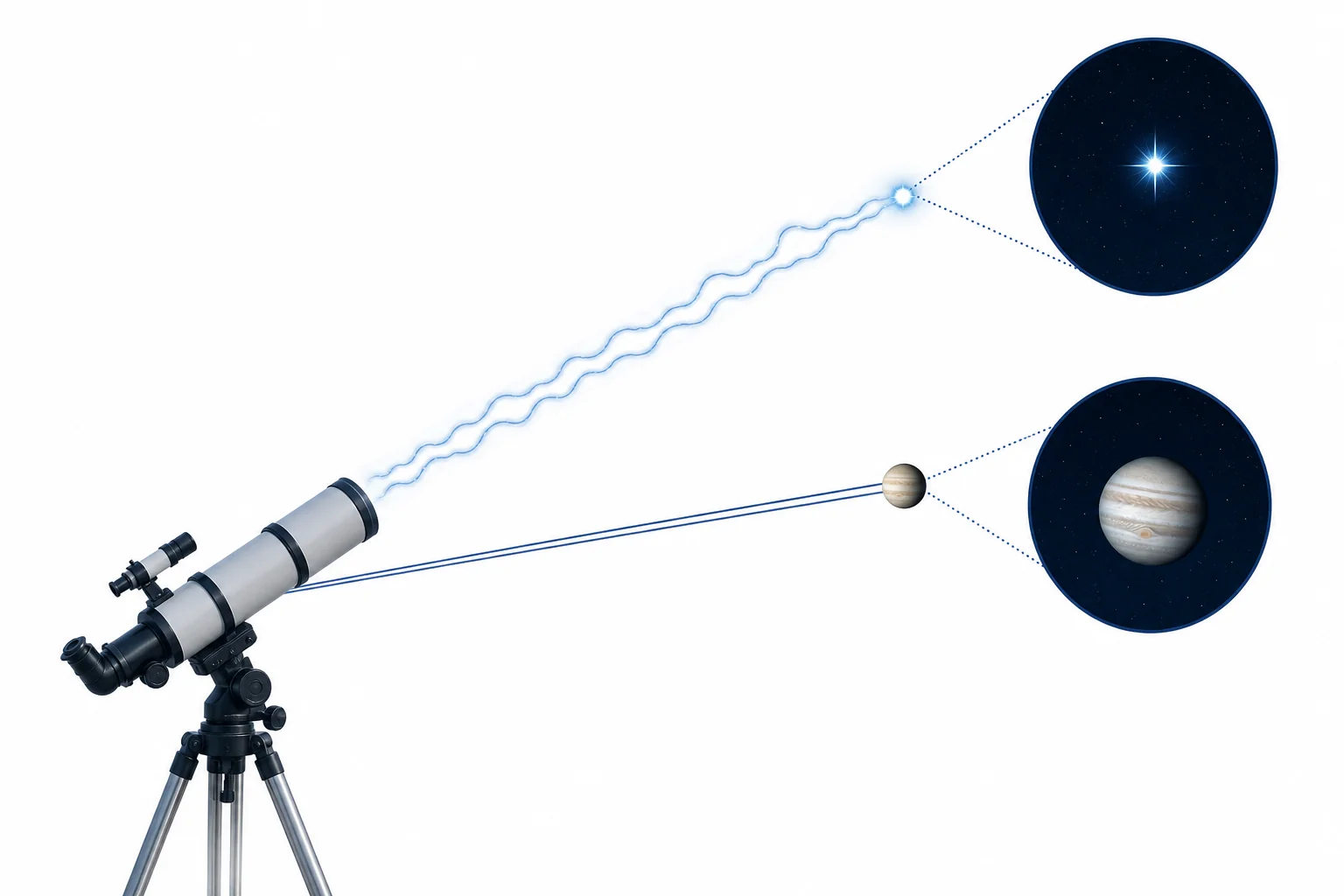
A night sky comparison showing a twinkling star and a steadier planet above a simple layer of moving air.

Stars look like tiny points from Earth, so moving air can make their light jump around. Planets look like tiny disks, so their light comes from a slightly wider patch of sky. The wiggles mostly average out for planets, so they usually shine more steadily.

Big Idea. NGSS 1-ESS1-1 connects careful sky observations to patterns we can describe and compare.

On a clear night, some bright dots in the sky seem to blink, shimmer, or change color. Other bright dots stay more steady. That difference can help you tell stars and planets apart from your backyard. The cause is not that stars are flashing on and off. Stars shine all the time. The flicker happens because their light passes through Earth’s air before it reaches your eyes. That air is always moving. Warm and cool pockets bend light in slightly different ways. A star is so far away that it looks like one tiny point. When that point gets bent a little, the change is easy to notice. A planet is much closer. Even though it still looks like a dot to your eye, it acts more like a tiny disk of light. Those many light paths smooth each other out.

Air is not still
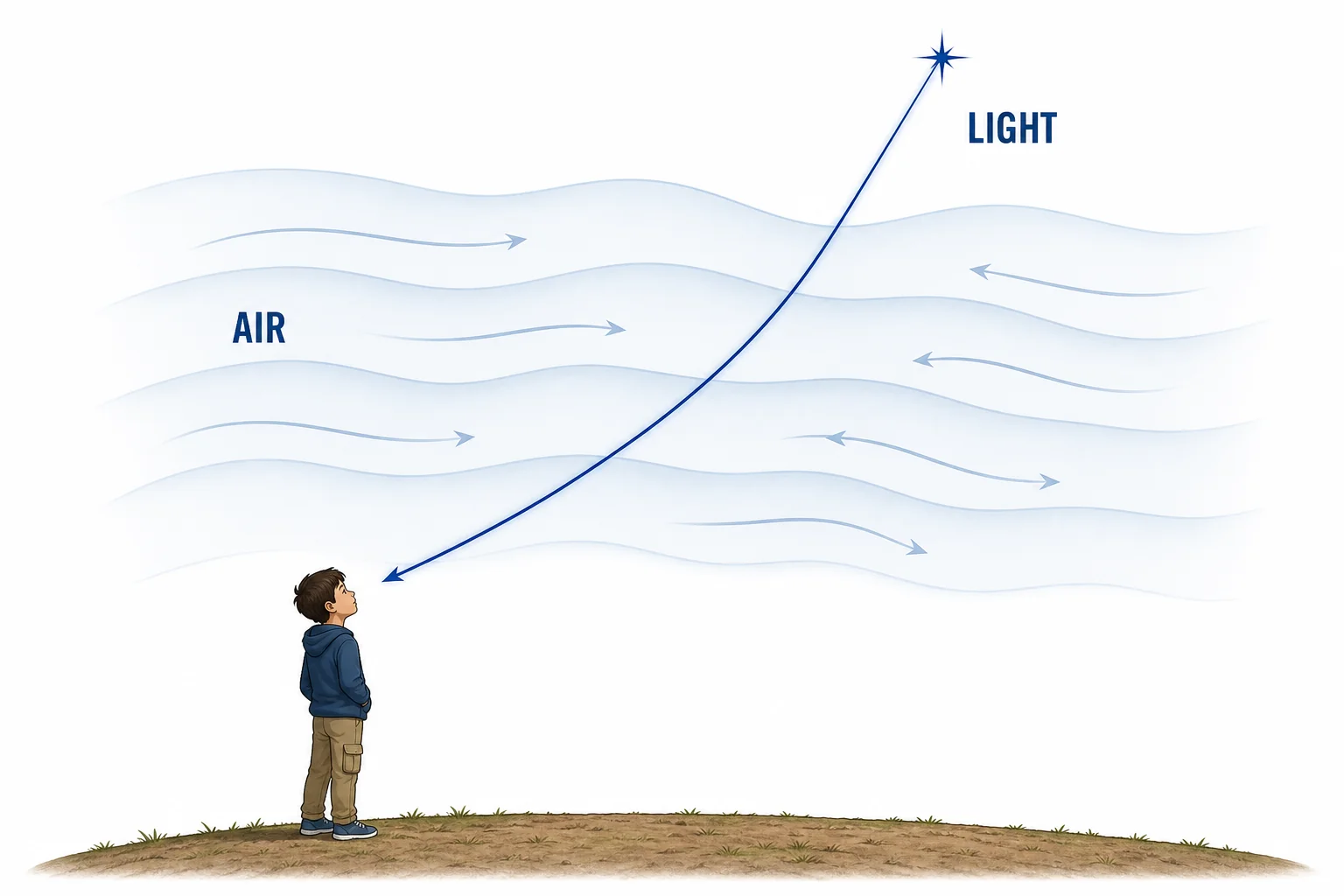
Layers of moving warm and cool air bend a narrow beam of starlight before it reaches an observer on Earth.
Moving air bends light in changing ways
Earth’s atmosphere is a blanket of gas around the planet. It is not a smooth sheet. Air near the ground warms and rises. Cooler air sinks. Wind pushes air sideways. These moving patches have slightly different temperatures and densities. That means they bend light by slightly different amounts. The bending is small, but starlight travels a long way through this moving air near the end of its trip. By the time it reaches your eyes, the light may shift a little from moment to moment. Your brain notices that as twinkling. This effect is strongest when the air is bumpy, such as over a warm roof, pavement, or chimney. It is often weaker after the ground cools and the air settles.

Twinkling starts in Earth’s air, not inside the star.

Stars act like points
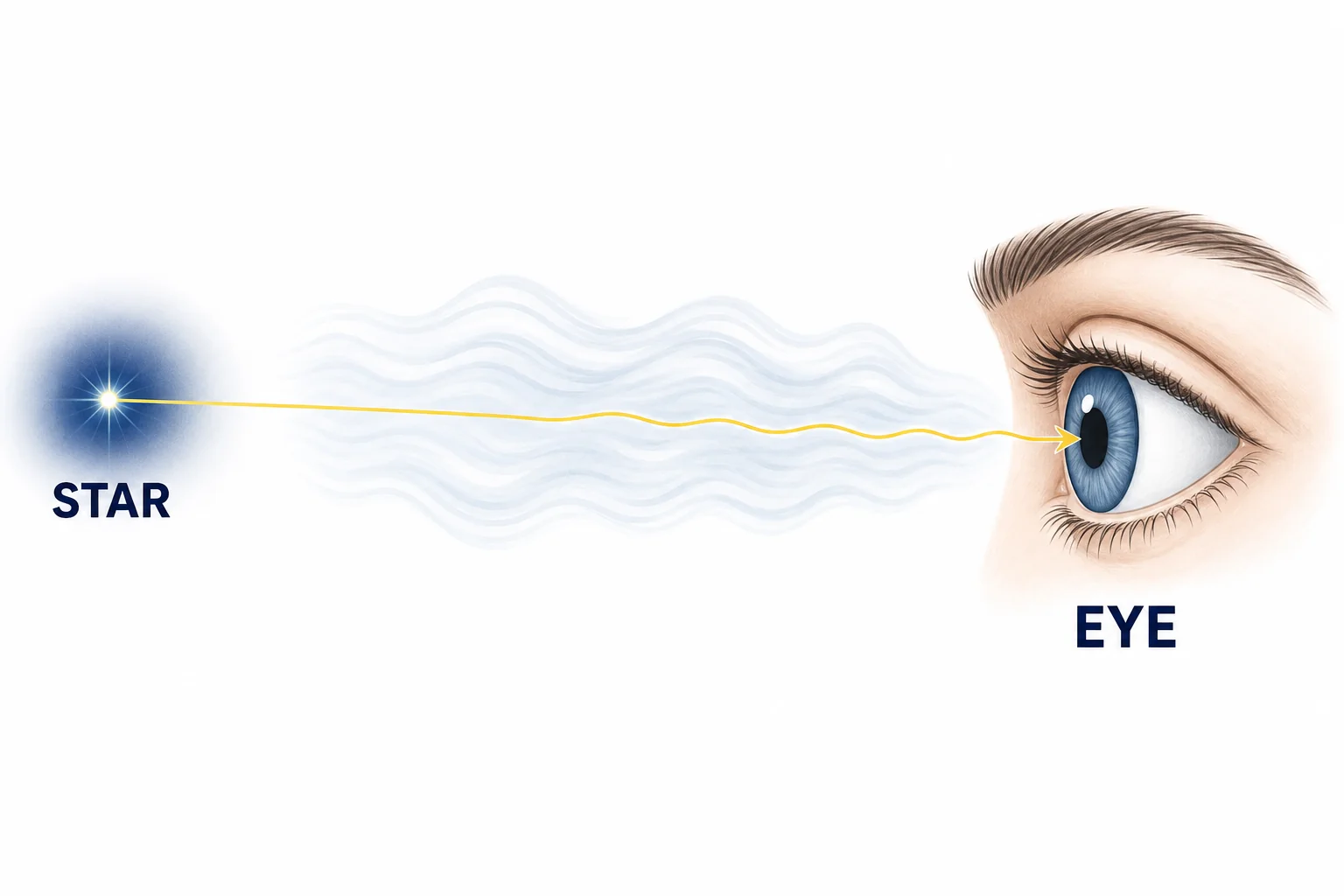
A distant star is shown as a single point of light, with its narrow light path wiggled by air before reaching an eye.
A star is nearly a point of light
Stars are enormous, but they are also very far away. To our eyes, each star is almost a single point of light. That makes the star easy for the atmosphere to disturb. Imagine shining a tiny flashlight dot through rippling water. The dot dances because one small path of light is being bent. Starlight behaves in a similar way as it passes through moving air. The star may seem brighter, dimmer, or slightly shifted. Sometimes it even seems to flash red or blue for a moment. The star is not really changing color that fast. The atmosphere is spreading and bending the light unevenly. Telescopes also see this effect. Astronomers call it seeing, because it affects how sharp the sky looks from the ground.

A tiny point of light can flicker a lot when its path shifts.

Planets act like tiny disks
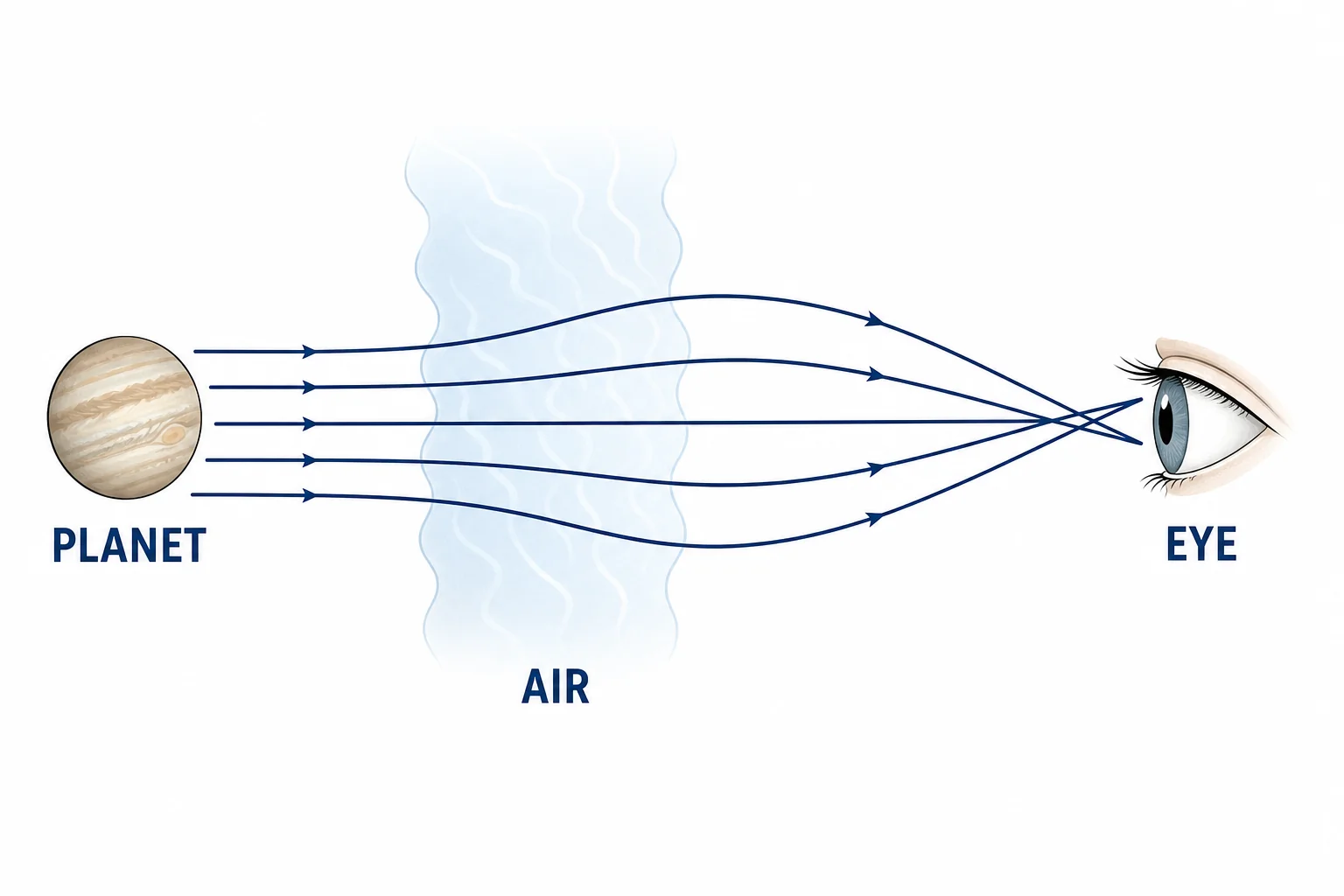
A small planet disk sends several light rays through moving air, showing how the rays average into steadier light.
A planet sends light from a small disk
Planets are much closer than stars. Through your eyes, they still look like points. Through a telescope, many show a tiny disk. That size matters. Light from one edge of the planet’s disk may be bent one way by the atmosphere. Light from another edge may be bent a different way. Your eye receives many nearby light paths at once. Some get brighter while others get dimmer. The changes often average together. That is why Venus, Jupiter, Saturn, and Mars usually look steadier than bright stars. They can still shimmer when they are low in the sky or when the air is very rough. The rule is not perfect, but it is useful. A steady bright dot is often a planet.

A planet’s tiny disk helps smooth out the wiggles.

Low objects twinkle more
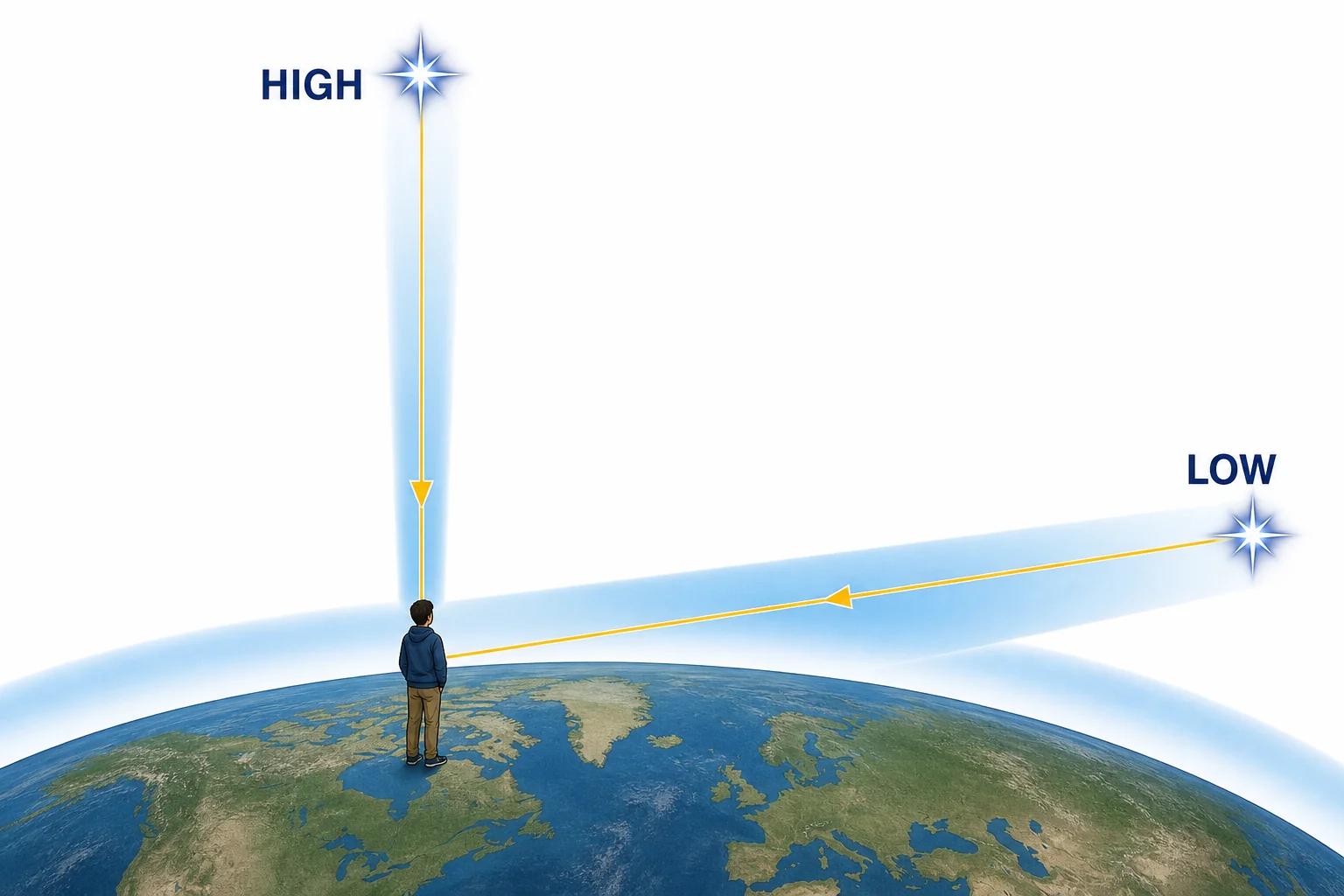
Two light paths reach an observer, one short path from high overhead and one longer path from near the horizon through more air.
Near the horizon, light crosses more air
Where an object sits in the sky also matters. A star high overhead sends light through a shorter path of air. A star near the horizon sends light through a much longer slanting path. More air gives the light more chances to bend. That is why objects close to the horizon often shimmer, change color, or look blurry. Planets can twinkle there too. This is especially common when you look across warm ground, city pavement, or rooftops. The best test is to compare objects that are high enough above the horizon. Look for a bright steady object and a bright twinkly object in the same part of the sky. The steadier one may be a planet. A sky map can help you check your guess.

Closer to the horizon usually means more twinkle.

Try it tonight
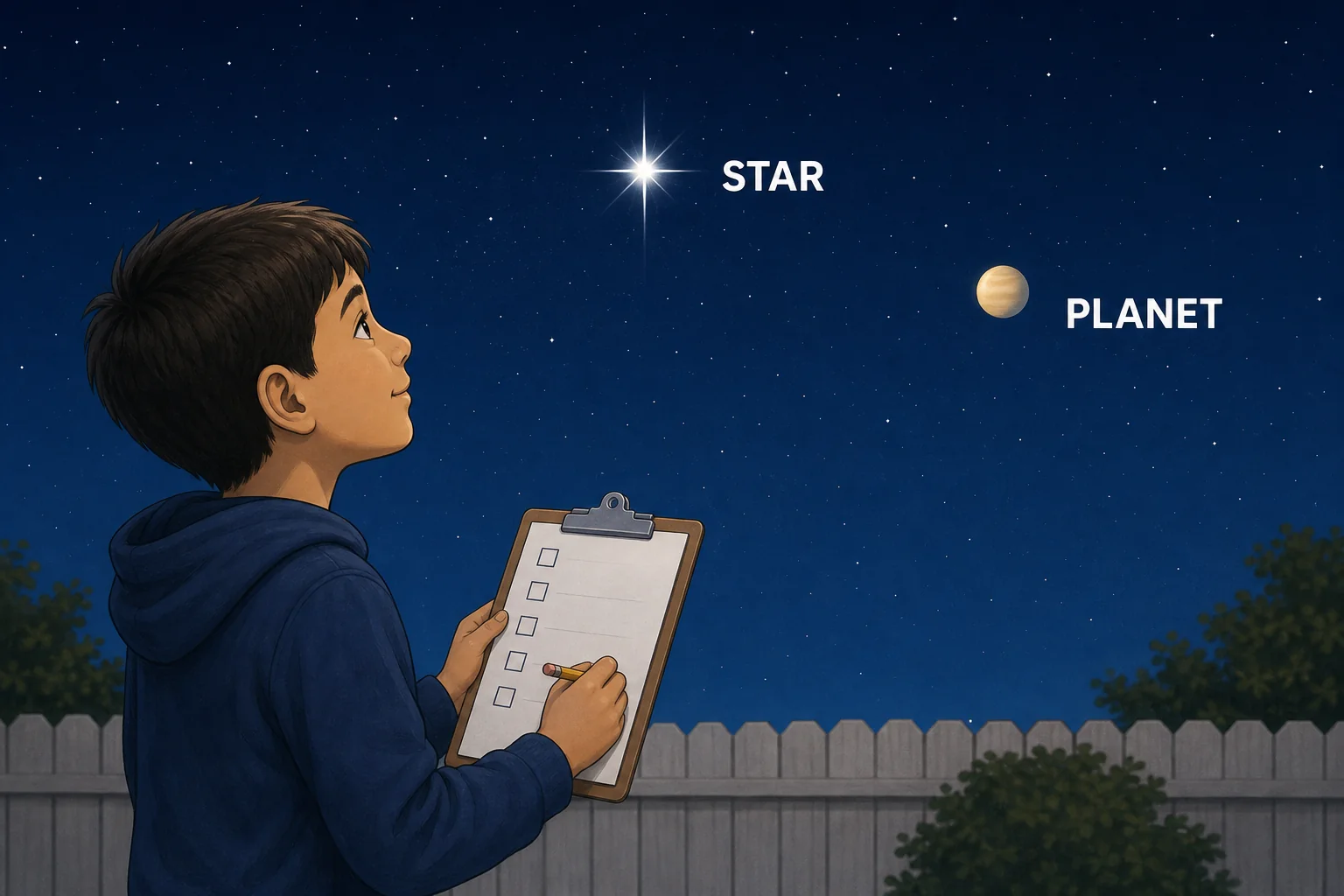
A student compares bright sky objects from a backyard and records whether each object looks steady or twinkly.
A backyard sky test
You can test this idea with your own eyes. Choose a clear evening with a safe viewing spot away from bright lights if possible. Look for several bright dots in the sky. Watch each one for ten seconds. Does it blink and change color, or does it hold steady? Write down what you notice. Try again later in the night, because objects move across the sky as Earth turns. If you have an adult-approved sky map app or printed chart, check which dots are planets. You may find that planets are steadier than nearby stars. You may also see exceptions. A planet low on the horizon can shimmer. A star high in calm air may twinkle less. Real observing is about patterns, not one perfect rule.

A steady bright dot is a clue, then a sky map can confirm it.

Vocabulary

Atmosphere
The layer of gases around Earth.
Scintillation
The scientific name for the twinkling or flickering of light from a star.
Point source
An object that looks like one tiny point of light because it is very far away.
Angular size
How wide something appears in the sky from where you are viewing it.
Horizon
The line where the sky seems to meet the ground.

In the Classroom

Twinkle log

20 minutes | Grades 3-5

Students observe three bright sky objects with an adult and record whether each one looks steady or twinkly. The next day, the class compares observations and looks for patterns.

Rippled light model

15 minutes | Grades 2-5

Shine a flashlight through a clear container of water onto a wall. Gently stir the water and have students describe how the light spot changes, then connect the model to moving air.

Point or disk sorting

15 minutes | Grades 3-5

Give students cards showing a distant star, a nearby planet, the Moon, and a flashlight. Students sort which objects act more like points and which act more like disks, then explain their choices.

Key Takeaways

  • Stars twinkle because moving air bends their light before it reaches your eyes.
  • Stars are so far away that they act like tiny points of light.
  • Planets are closer and act more like tiny disks, so their light changes average out.
  • Objects near the horizon twinkle more because their light crosses more air.
  • Watching for twinkle is a useful backyard clue, but a sky map gives the best check.