Climate Graph Analyzer
Select from 20 cities to see a Walter-Lieth climograph showing annual temperature and precipitation patterns. Auto-classifies Köppen climate zones and supports side-by-side city comparison.
Lat 25.8°N
Tropical Monsoon
Tropical Climate
All months are warm (above 18°C). High humidity and rainfall year-round support dense tropical vegetation.
Annual Mean Temp
25.5°C
Annual Precipitation
1628 mm
Temperature Range
10.0°C
Köppen Code
Am
Warmest Month
Jul (30°C)
Coldest Month
Jan (20°C)
Driest Month
Jan (51 mm)
Wettest Month
Sep (241 mm)
Reference Guide
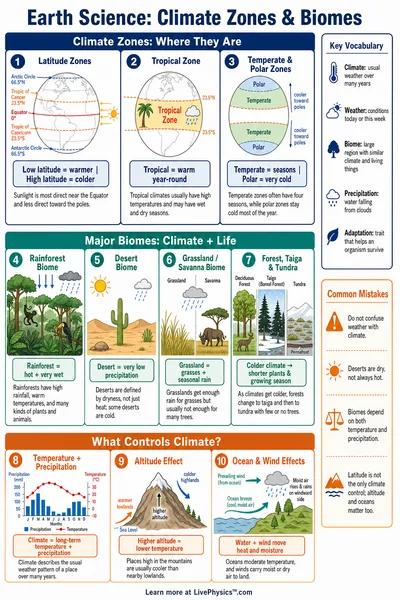
Köppen Climate Classification
Group A - Tropical
All 12 months have mean temperatures above 18°C. High humidity and abundant rainfall support tropical rainforest, monsoon, and savanna biomes.
Group B - Dry
Potential evaporation exceeds precipitation. Includes hot and cold deserts (BW) and semi-arid steppes (BS). The threshold depends on annual temperature and seasonal rainfall distribution.
Groups C, D - Temperate and Continental
C climates have mild winters (coldest month between -3°C and 18°C). D climates have cold winters (below -3°C). Both are subdivided by summer temperature and wet/dry season patterns.
Group E - Polar
Tundra (ET) climates have a warmest month between 0°C and 10°C. Ice cap (EF) climates stay below 0°C year-round. Vegetation is very limited or absent.
Reading a Climograph
Dual Axes
The left y-axis shows temperature in degrees Celsius. The right y-axis shows precipitation in millimeters. The Walter-Lieth convention scales them so 10°C equals 20 mm, making wet and dry seasons immediately visible.
Temperature Line
The red line connects monthly mean temperatures. Its shape reveals the seasonality and amplitude of the annual temperature cycle. Tropical cities show a nearly flat line; continental cities show a steep arch.
Precipitation Bars
Blue bars show mean monthly precipitation. When bars are below the temperature line, the month is climatically dry. A Mediterranean climate shows tall bars in winter and almost no bars in summer.
Shading
Yellow background indicates months above 20°C (warm season). Diagonal hatching marks dry months where precipitation is less than twice the temperature value.
Biome Distribution
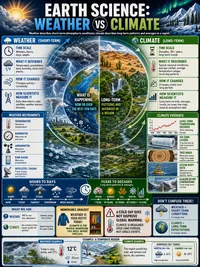
Climate patterns determine which plants and animals can survive in a region. Each Köppen zone corresponds closely to a major biome type.
- Af/Am Tropical rainforest - dense canopy, high biodiversity, little temperature variation year-round
- Aw Tropical savanna - seasonal drought drives grassland with scattered trees
- BW Desert - sparse xerophytic vegetation, extreme heat or cold
- Csb/Csa Mediterranean shrubland (chaparral) - drought-adapted shrubs, dry summers
- Cfb Temperate deciduous forest - broad-leaf trees, four distinct seasons
- Dfb/Dfc Boreal forest (taiga) - coniferous trees adapted to harsh winters
- ET Tundra - low shrubs, mosses, and lichens; permafrost below