Sign in to save

Bookmark this page so you can find it later.

Sign in to save

Bookmark this page so you can find it later.

Environmental Science middle-school May 24, 2026

Why Is Earth's Climate Getting Hotter?

How heat-trapping gases shift Earth's energy balance
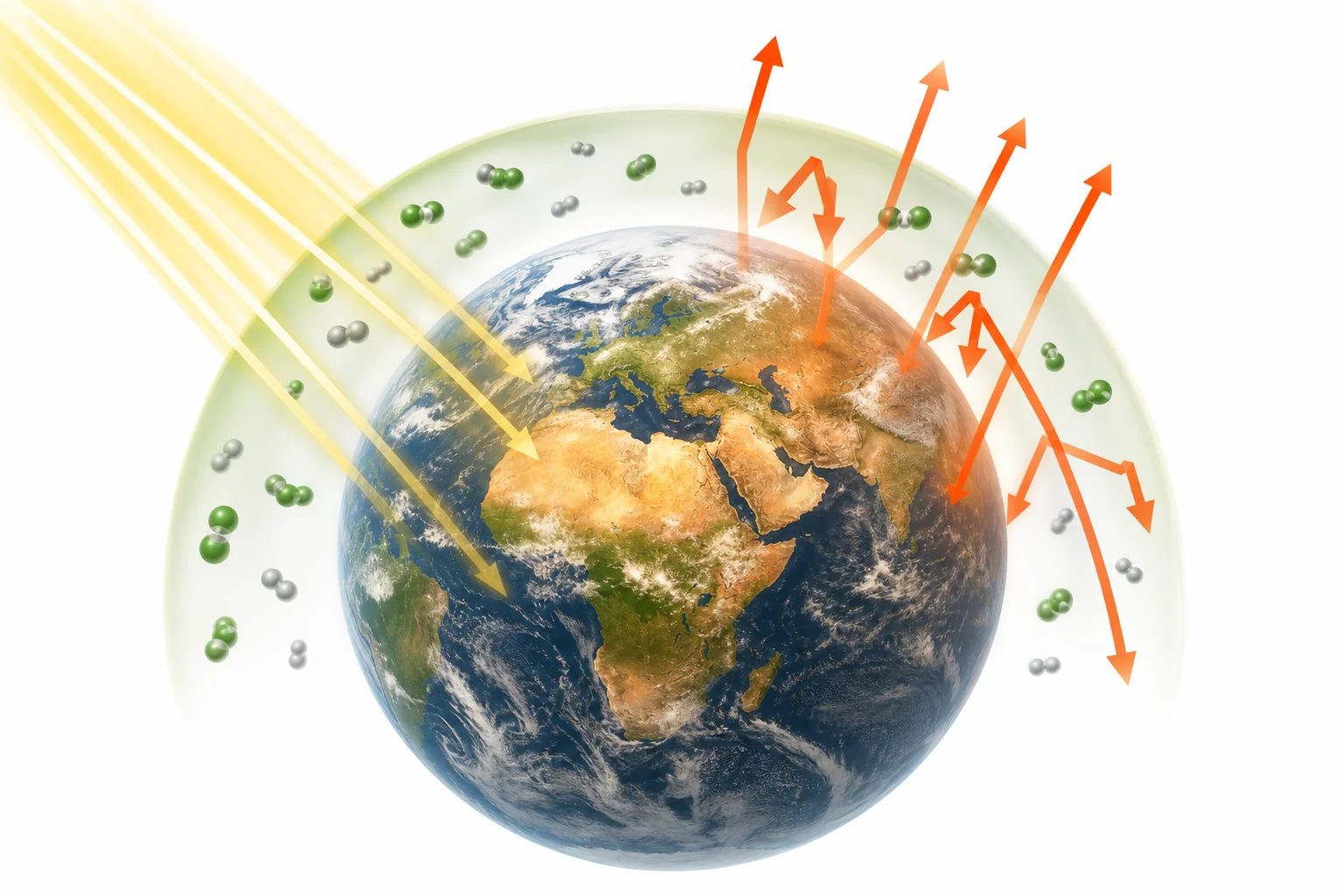
Earth receiving sunlight while some heat leaves to space and some is held by greenhouse gases in the atmosphere.

Earth is getting hotter because more heat-trapping gases are building up in the air. These gases come mostly from burning coal, oil, and gas, and from farming and waste. They slow the escape of heat to space, so the planet's average temperature rises.

Big Idea. NGSS MS-ESS3-5 asks students to explain how human activities affect Earth's systems, including the gases that warm the climate.

Earth has always had warm years, cool years, storms, droughts, and icy winters. That is weather. Climate is the pattern you get when you average weather over many years. Scientists measure climate using thermometers, ocean buoys, satellites, ice cores, and other records. Those records show a clear trend. Earth’s average surface temperature is rising. The main reason is not that the Sun suddenly became much stronger. The main reason is that people have added extra greenhouse gases to the atmosphere. Carbon dioxide, methane, and a few other gases absorb some of the heat energy that Earth gives off after sunlight warms the surface. This changes Earth’s energy budget. More energy comes in than goes out, so the planet stores heat. Most of that extra heat goes into the oceans, but land, air, and ice respond too.

Weather is not climate
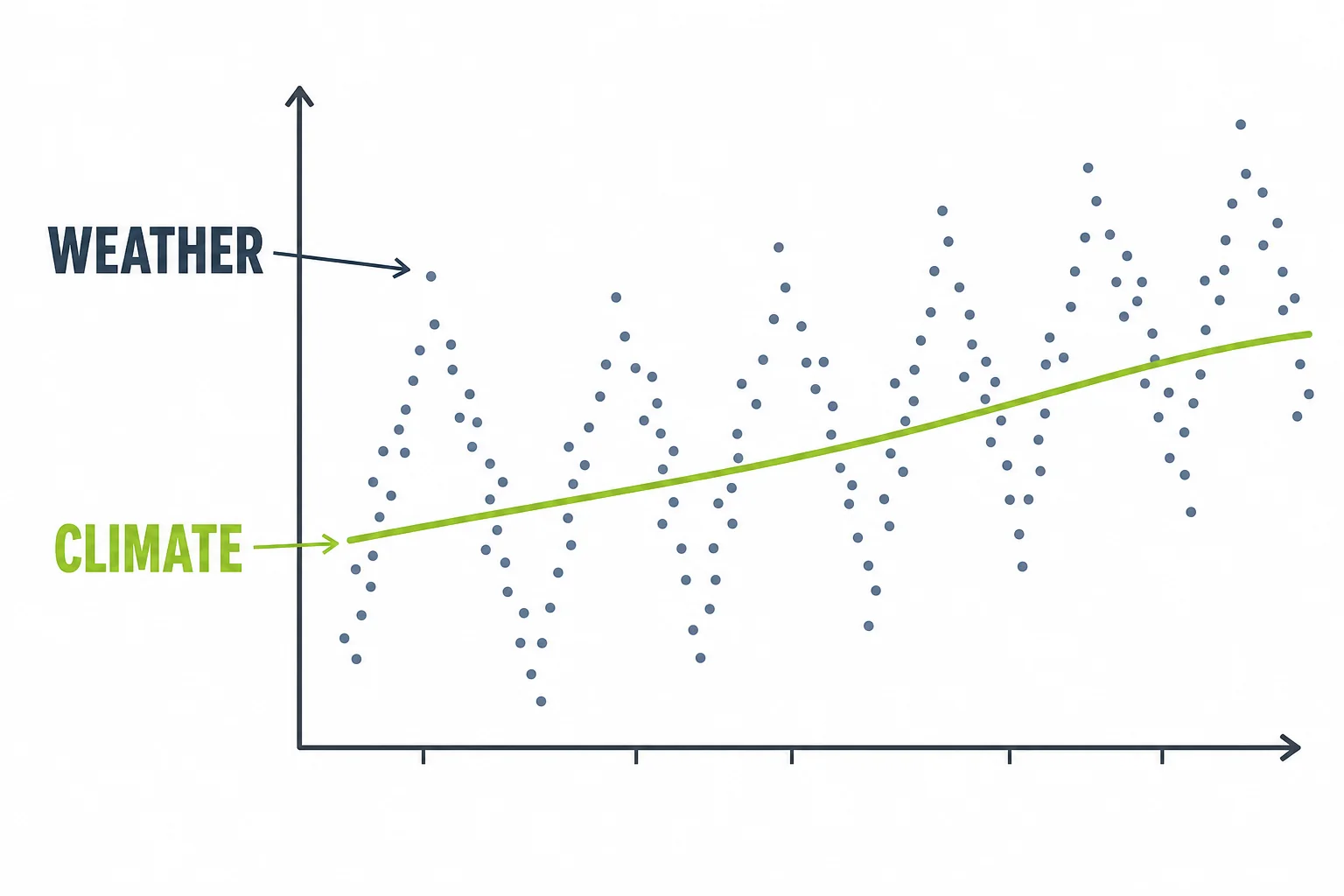
A graph-like illustration showing daily weather dots jumping up and down while a long-term climate trend line rises.
Weather jumps around. Climate is the long-term pattern.
A cold week does not disprove global warming. A hot day does not prove it by itself either. Weather is what happens over hours, days, or weeks. Climate is the long-term pattern across decades. To see climate change, scientists look at many measurements over a long time. They average temperatures from weather stations, ships, ocean floats, satellites, and other tools. Then they compare those averages with past averages. The result is like watching a slow moving line through noisy dots. The dots jump up and down because weather changes every day. The line shows the climate trend. Since the late 1800s, that line has moved upward. Some places warm faster than others. The Arctic has warmed especially fast. The important point is scale. Climate change is about the long-term energy balance of the whole Earth system.

Climate is the pattern that appears after many weather events are averaged.

Earth has an energy budget
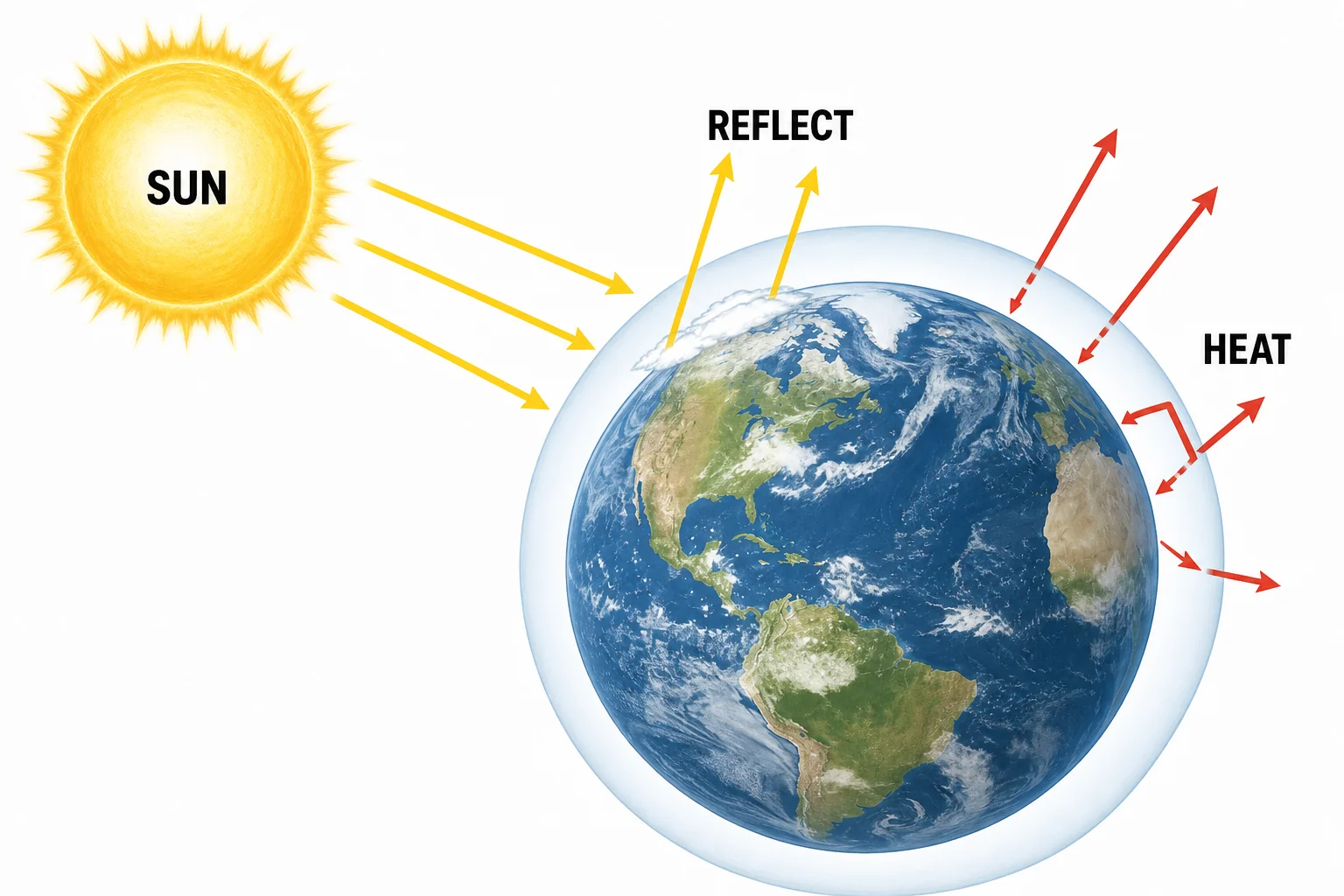
A simplified Earth energy budget showing sunlight entering, some light reflecting, infrared heat leaving, and some heat being retained.
Earth warms when energy in is greater than energy out.
Earth’s temperature depends on energy in and energy out. Sunlight brings energy to Earth. Some sunlight reflects off clouds, ice, snow, and bright land. The rest is absorbed by land, water, and air. Warm surfaces then give off energy as infrared radiation. You can think of infrared as heat energy moving away from Earth. If the same amount of energy leaves as enters, the average temperature stays fairly steady. If more energy enters than leaves, Earth warms. If more leaves than enters, Earth cools. Right now, measurements show that Earth is keeping a little more energy than it sends back to space. That extra energy may sound small when spread over the whole planet, but it adds up year after year. It warms oceans, melts ice, raises sea level, and shifts weather patterns.

A warming climate means Earth is storing extra energy.

Greenhouse gases absorb heat
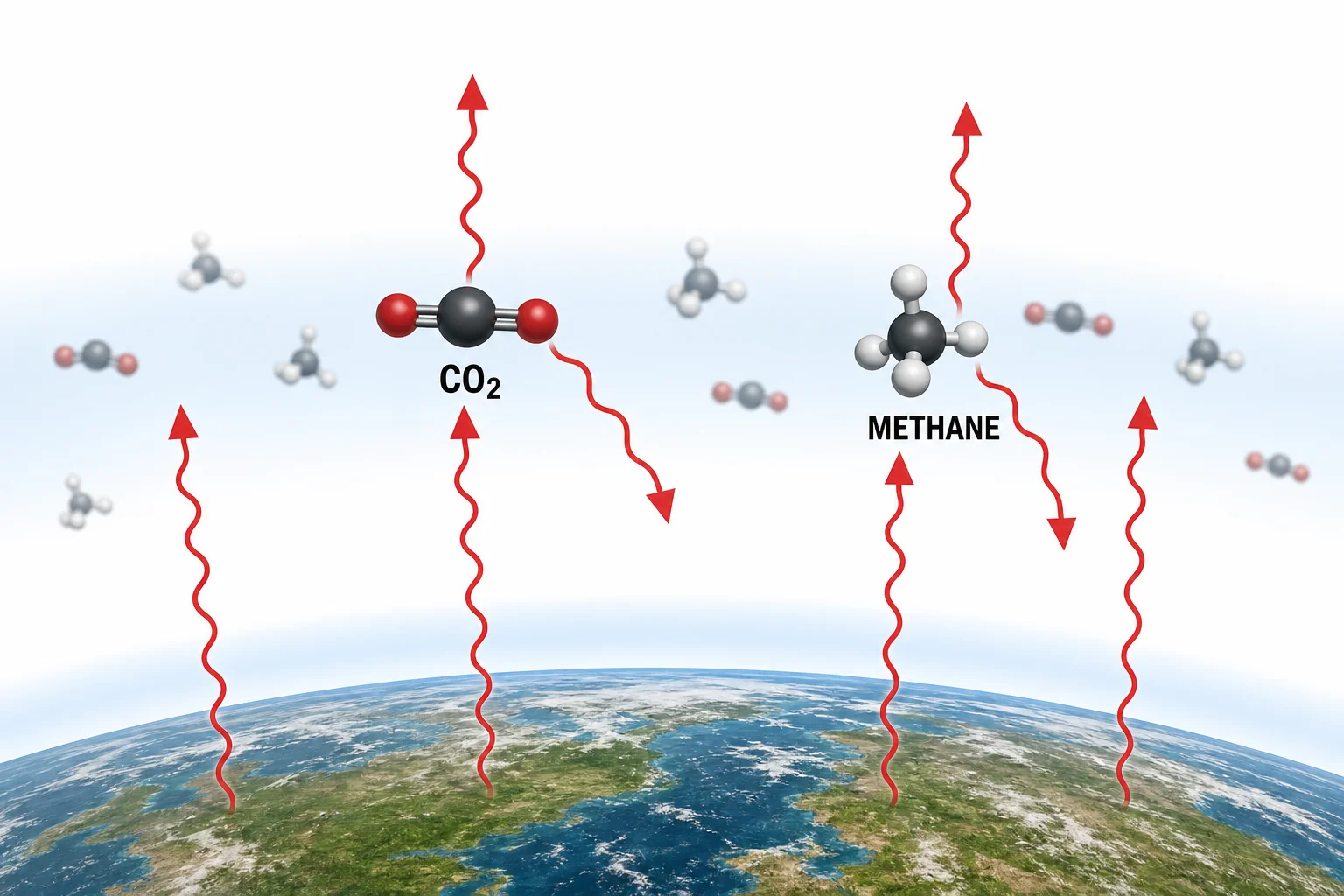
Carbon dioxide and methane molecules in the atmosphere absorbing red infrared arrows from Earth's surface.
CO2 and methane absorb parts of Earth's infrared radiation.
The greenhouse effect is natural and necessary. Without it, Earth would be much colder. The problem is that people have strengthened it. Greenhouse gases let most sunlight pass through the atmosphere. After the surface warms, Earth gives off infrared radiation. Molecules such as carbon dioxide and methane absorb some of that infrared radiation. Then they release energy in different directions, including back toward the surface and lower atmosphere. Different gases absorb different bands, or ranges, of infrared energy. Carbon dioxide absorbs strongly in one important range. Methane absorbs in other ranges. Adding more of these gases makes it harder for heat to escape straight to space. This is not like a glass greenhouse blocking air flow. It is about molecules interacting with radiation. The result is a warmer lower atmosphere and surface.

Extra greenhouse gases reduce how easily heat escapes to space.

People are adding the extra gases
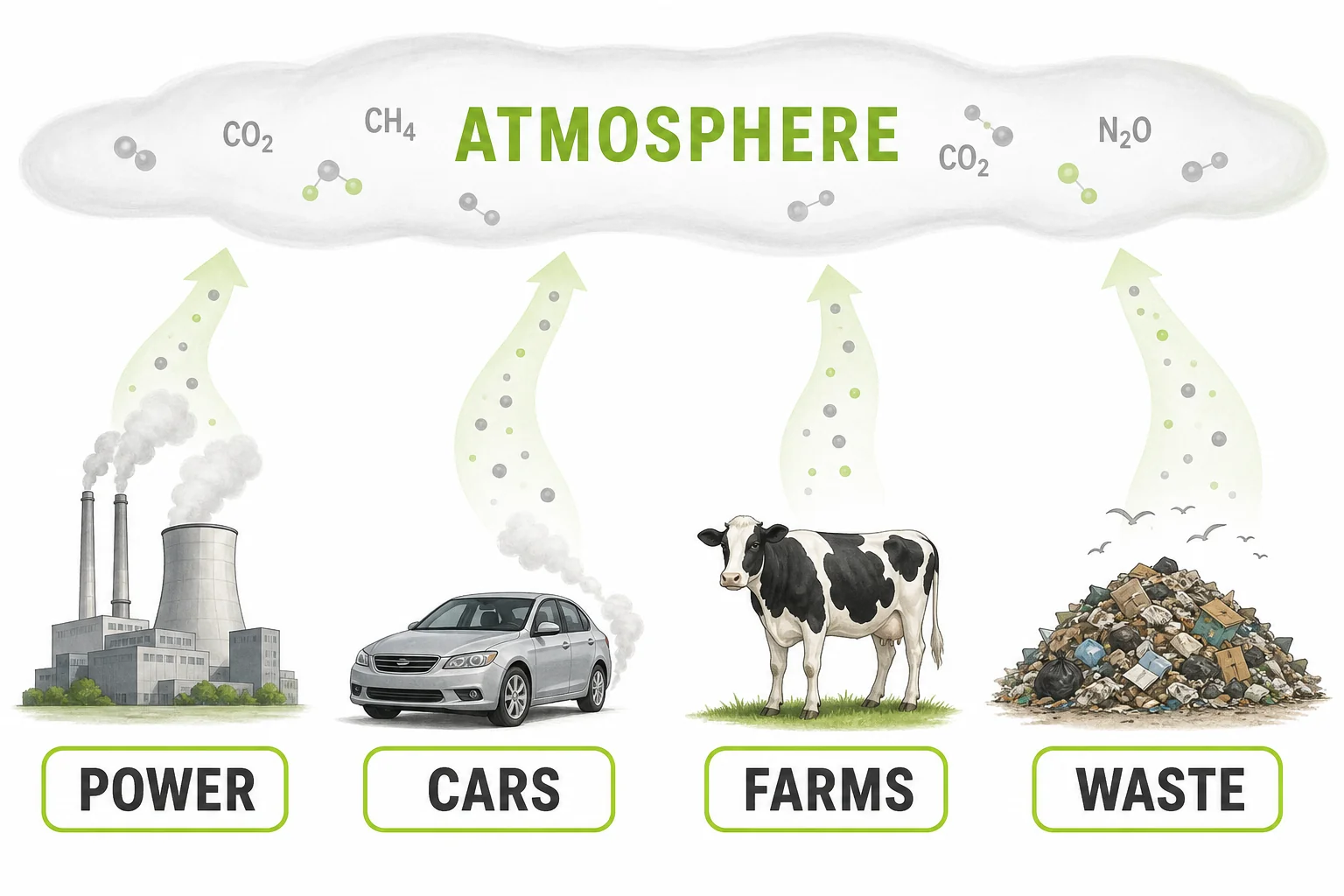
Human sources of greenhouse gases including a power plant, car, cattle, landfill, and cut forest connected to the atmosphere.
Most added greenhouse gases come from energy use, land use, farming, and waste.
Carbon dioxide has increased mainly because people burn fossil fuels. Coal, oil, and natural gas contain carbon from ancient living things. When they burn, carbon combines with oxygen and forms carbon dioxide. Cars, power plants, factories, heating systems, and cement making all add carbon dioxide. Deforestation adds more because trees store carbon. Methane comes from several sources. It leaks during oil and gas production. It is released by landfills, rice fields, and the digestion of cattle and other ruminant animals. Methane does not stay in the atmosphere as long as carbon dioxide, but it traps more heat molecule for molecule over shorter times. Scientists can track these gases by measuring air samples from stations, aircraft, and satellites. They can also use carbon clues to show that the extra carbon dioxide mostly comes from fossil fuels.

Human activities are the main cause of the recent rapid increase in heat-trapping gases.

Warming changes the whole system
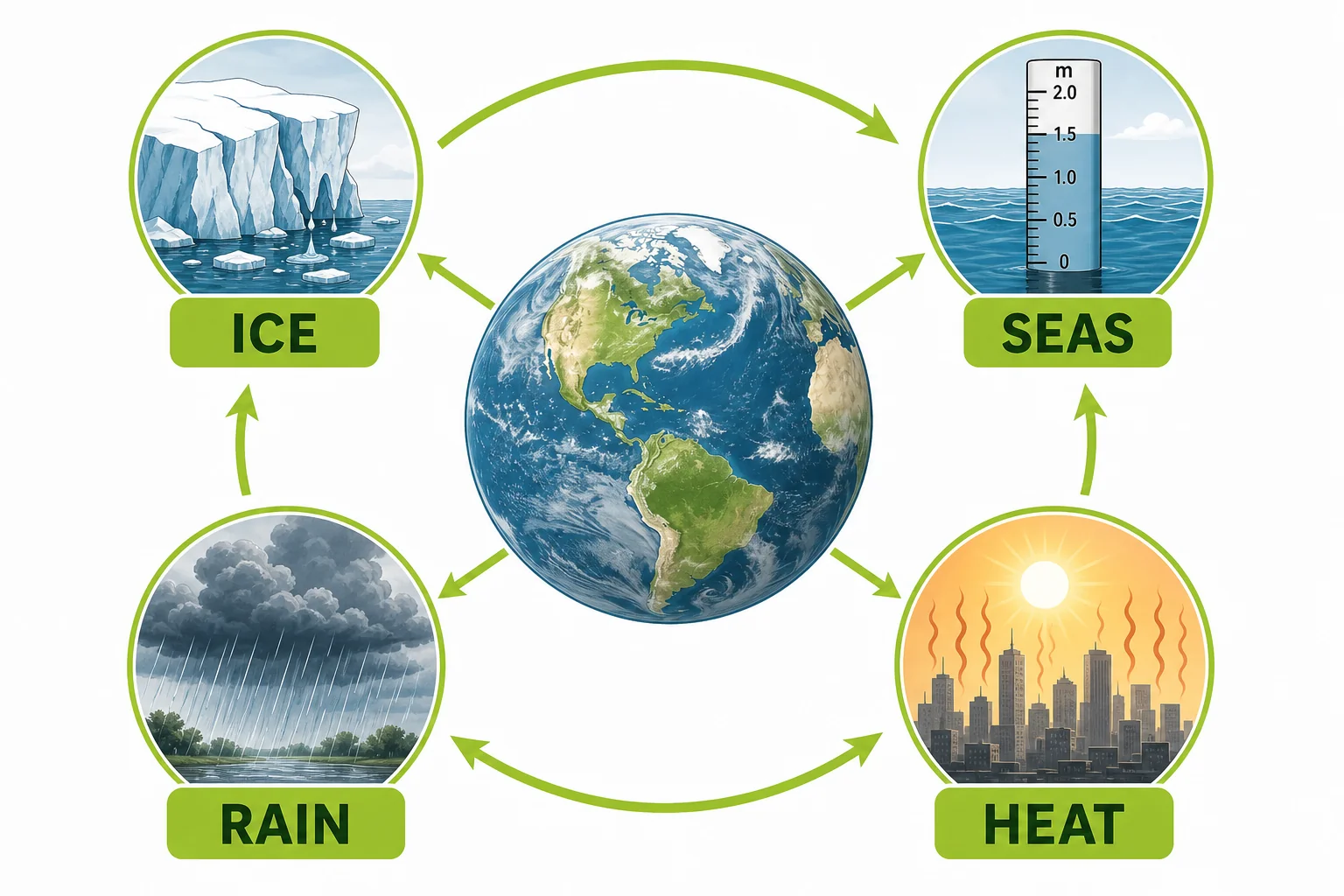
Connected climate effects showing melting ice, rising sea level, stronger heat waves, and heavier rain under a warmer atmosphere.
Warming changes ice, oceans, air, and weather patterns.
A hotter climate does not mean every place warms by the same amount. Land usually warms faster than oceans. Nights often warm faster than days. The Arctic warms faster than the global average because bright ice is replaced by darker ocean or land that absorbs more sunlight. Warmer air can also hold more water vapor, which can make heavy rain events stronger in some places. Heat waves become more likely and more intense. Sea level rises because warmer water expands and because land ice melts into the ocean. Some effects feed back into the system. Less ice means less reflection. More water vapor adds more greenhouse warming. Scientists study these changes with observations and computer models. The models are tested against real data. They help people understand risks and compare choices for reducing future warming.

Climate warming affects many parts of Earth at the same time.

Vocabulary

Climate
The long-term pattern of weather in a place or across Earth, usually measured over decades.
Weather
The short-term condition of the atmosphere, such as temperature, rain, wind, or clouds.
Greenhouse gas
A gas in the atmosphere that absorbs and releases infrared radiation, which helps trap heat near Earth.
Infrared radiation
Energy given off by warm objects. Earth sends much of its outgoing heat to space this way.
Energy budget
The balance between energy Earth receives from the Sun and energy Earth sends back to space.
Feedback
A process that can strengthen or weaken a change in a system, such as ice loss causing more sunlight to be absorbed.

In the Classroom

Weather dots and climate trend

25 minutes | Grades 6-8

Give students a table of daily or yearly temperature values with lots of ups and downs. Have them graph the points, draw a trend line, and explain the difference between short-term variation and a long-term pattern.

Model an energy budget

20 minutes | Grades 6-8

Students draw arrows for sunlight in, reflected light, and infrared heat out. Then they change the arrow sizes to show what happens when greenhouse gases reduce outgoing heat.

Greenhouse gas source sort

30 minutes | Grades 6-8

Students sort cards showing transportation, electricity, farming, landfills, forests, and industry. They identify which activities add carbon dioxide, which add methane, and which choices could lower emissions.

Key Takeaways

  • Weather is short term, while climate is the long-term pattern.
  • Earth warms when it keeps more energy than it sends back to space.
  • Carbon dioxide and methane absorb infrared radiation from Earth.
  • Human activities have increased greenhouse gases, mainly through fossil fuel use, farming, land use, and waste.
  • A hotter climate affects oceans, ice, sea level, rainfall, and heat waves.