Greenhouse Effect Energy Balance
Interactive Earth energy budget. Adjust CO2, albedo, solar irradiance, and greenhouse emissivity. Watch incoming and outgoing radiation balance shift Earth's temperature using the one-layer Stefan-Boltzmann model.
Scenarios
Results
Simplified one-layer atmosphere model (Stefan-Boltzmann)
Controls
Note, in nature, increasing CO2 raises ε. Here they are independent for pedagogical clarity.
Physics Equations
α, surface albedo (fraction of sunlight reflected)
S₀, solar irradiance at Earth's orbit (W/m²)
ε, effective emissivity (0 = perfect greenhouse, 1 = no greenhouse)
σ, Stefan-Boltzmann constant
The /4 factor accounts for averaging solar input over Earth's full spherical surface area (cross-section πR² vs surface 4πR²).
About the greenhouse effect
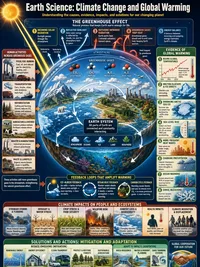
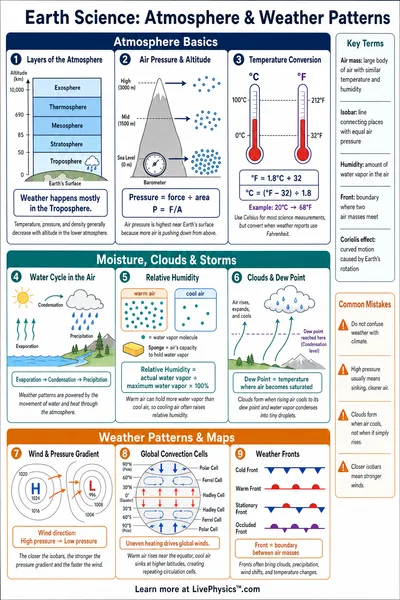
Greenhouse gases like carbon dioxide and water vapor absorb the long-wavelength infrared radiation that Earth emits as it warms. Some of that energy is re-radiated back toward the surface, raising the equilibrium temperature above what would be possible from sunlight alone. Without any greenhouse gases Earth's average surface temperature would be around minus 18 Celsius, well below the freezing point of water. The current value of about 15 Celsius is what the greenhouse effect provides.
Curriculum alignment
Supports NGSS HS-ESS3-1 (climate science) and HS-ESS3-5 (analyzing global climate trends), MS-ESS3-5, and AP Environmental Science energy and climate units. The tool uses the one-layer Stefan-Boltzmann model standard in intro climate physics. For the full lab workflow with data collection and conclusions, see the Greenhouse Effect Lab.
How to use this tool
- CO2 concentration - use the preset chips to jump to key milestones or drag the slider to any value between 200 and 1120 ppm.
- Albedo - surface reflectivity. Higher albedo (ice/snow) reflects more sunlight and cools the planet.
- Solar irradiance - the sun's output at Earth's distance. Increase it to simulate younger or more active stars.
- Emissivity - the effective trapping efficiency of the atmosphere. Lower values mean more heat is trapped.
Key scenarios explained
- Earth Today - current conditions, surface near 15°C. This is the reference point for comparing other scenarios.
- Pre-Industrial - CO2 at 280 ppm, slightly cooler. Shows how roughly 1°C of warming has occurred since 1750.
- Snowball Earth - high albedo from global glaciation combined with high emissivity produces a very cold, stable frozen planet.
- Venus-like - extreme solar input with low emissivity (runaway greenhouse) produces surface temperatures far above the boiling point of water.