Greenhouse Effect Lab
Investigate how CO₂ concentration affects Earth's equilibrium temperature. Vary greenhouse gas levels, record surface temperatures, plot the relationship, and document your findings in a structured lab report.
Hypothesis
Before running the experiment, predict what will happen. Consider, how will Earth's equilibrium surface temperature change as CO₂ concentration increases from 150 to 1000 ppm? Will the change be linear or follow a different pattern?
Controls
Reference Guide
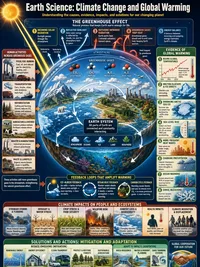
The Greenhouse Effect
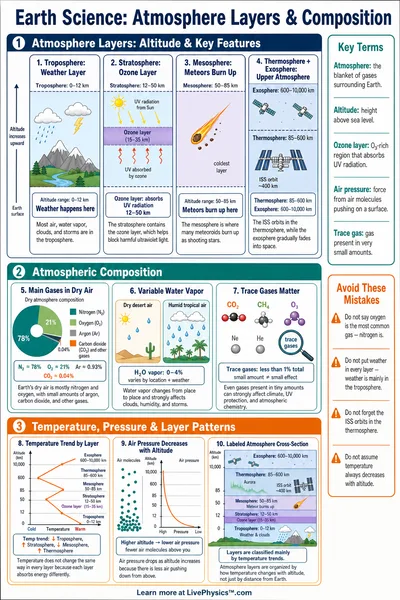
Sunlight passes through the atmosphere and warms Earth's surface. The surface then emits infrared (heat) radiation upward. Greenhouse gases - primarily water vapor, CO₂, methane, and nitrous oxide - absorb this outgoing infrared radiation and re-emit it in all directions, including back toward the surface.
This trapping effect raises Earth's surface temperature above what it would be with no atmosphere. Without any greenhouse gases, Earth's average temperature would be around -18°C. The natural greenhouse effect warms it to about 15°C, making life possible.
Human activities, primarily burning fossil fuels and deforestation, have raised CO₂ from pre-industrial levels of 280 ppm to over 420 ppm today, intensifying the greenhouse effect.
Stefan-Boltzmann Law
At equilibrium, the energy Earth absorbs from the Sun equals the energy Earth radiates back to space. The Stefan-Boltzmann law relates the equilibrium temperature to the energy balance
Here S is the solar constant (1361 W/m²), alpha is the planetary albedo (0.30), epsilon is the effective emissivity of the atmosphere, and sigma is the Stefan-Boltzmann constant (5.67 x 10⁻⁸ W m⁻² K⁻⁴).
Greenhouse gases reduce the effective emissivity. Lower emissivity means the planet must warm up more to emit enough radiation to balance the incoming energy.
Climate Projections
The IPCC uses Representative Concentration Pathways (RCPs) to describe possible future CO₂ trajectories based on different emissions scenarios.
- RCP 2.6 - Aggressive mitigation. CO₂ peaks before 2100 and declines.
- RCP 4.5 - Moderate mitigation. CO₂ stabilizes around 538 ppm by 2100.
- RCP 6.0 - Partial mitigation. CO₂ reaches approximately 670 ppm by 2100.
- RCP 8.5 - Business as usual, no significant climate policy. CO₂ approaches 936 ppm by 2100.
This lab uses a simplified energy-balance model. The actual climate system includes feedbacks (water vapor, ice-albedo, clouds) that amplify warming beyond the direct CO₂ effect.