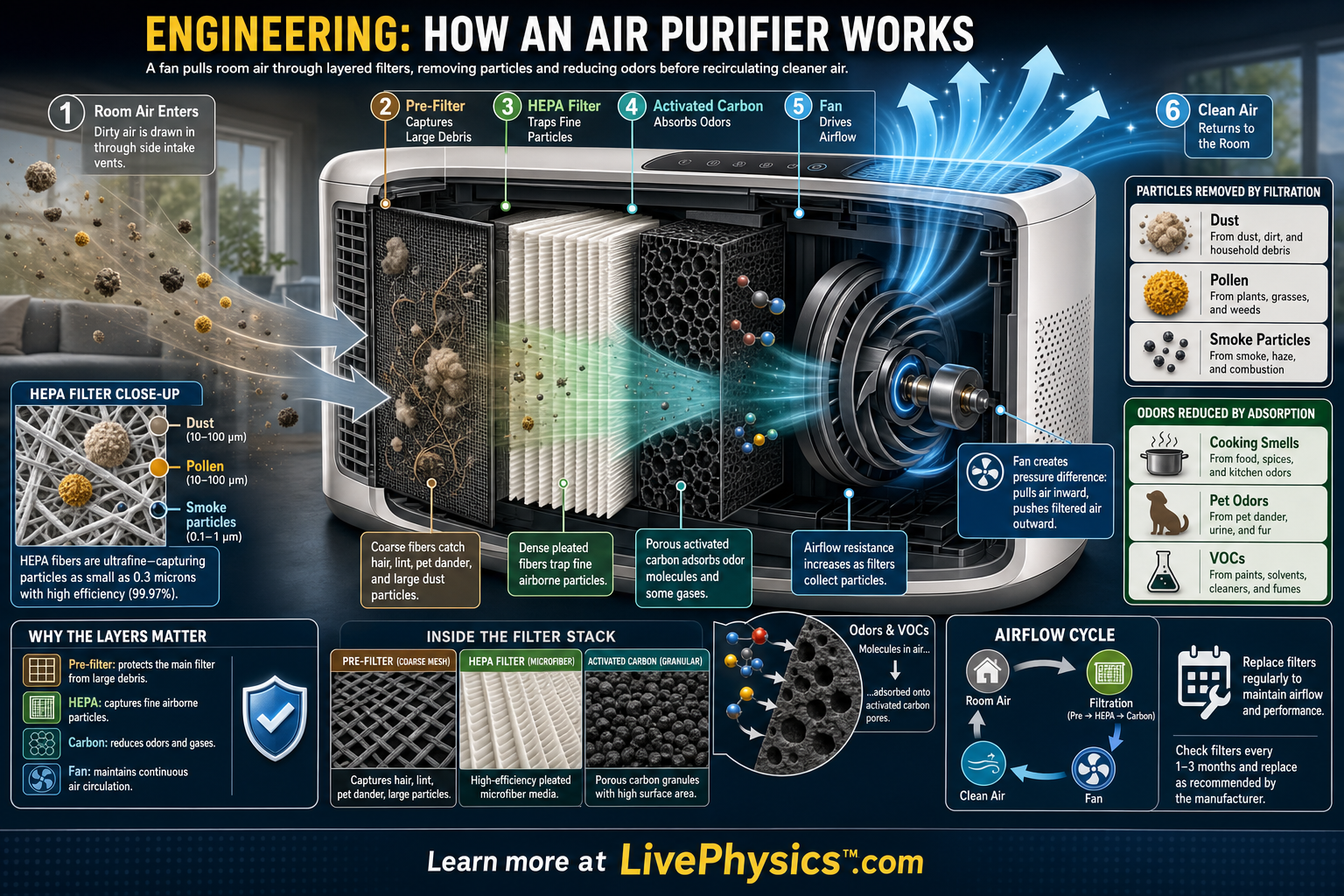
An air purifier is an engineered system that improves indoor air quality by moving room air through materials designed to remove contaminants. It can reduce airborne dust, pollen, smoke particles, pet dander, and some odor-causing gases. Its effectiveness depends on both the filters and the rate at which the device circulates air.
A purifier does not create oxygen or remove every pollutant, but it can lower the concentration of many indoor contaminants.
A fan creates a pressure difference that draws dirty room air into the intake. A pre-filter catches large lint, hair, and dust, protecting the finer filters behind it. A HEPA filter traps very small particles in a dense fiber network, while activated carbon adsorbs many odor molecules and volatile gases onto its porous surface.
The fan then pushes the filtered air out through the exhaust, where it mixes back into the room and gradually reduces pollutant levels.
Understanding Engineering, How an Air Purifier Works
HEPA filters do not work like simple sieves with identical holes. Their fibers form a tangled path that makes particles collide with or stick to the material. Larger particles can crash into fibers because their momentum carries them forward when the air stream bends.
Medium sized particles are often caught when they pass close enough to a fiber. Very tiny particles move in random zigzag paths after being hit by air molecules. This motion makes them more likely to touch a fiber.
The particles near zero point three micrometres are important in testing because they are among the hardest sizes to capture. Particles smaller or larger than this size can often be trapped more easily by different mechanisms.
A filter that captures particles well creates resistance to airflow. The fan must supply enough pressure to pull air through the fibers, carbon bed, grilles, and other internal parts. As dust builds up, the resistance rises.
Airflow can fall if the fan speed stays the same. Engineers balance removal efficiency, noise, electrical power, filter life, and cost. A very dense filter may clean each pass effectively but move too little air for a large room.
A fast fan can move more air but may be loud and use more electricity. The useful result depends on the amount of air cleaned over time, not just the filter label.
Room cleaning happens gradually because the outgoing air mixes with unfiltered air. The purifier repeatedly processes a portion of the room air. Its clean air delivery rate combines how much air it moves with how much particle material it removes in one pass.
For a bedroom, students can compare the purifier rating with the room size. A larger room needs more clean air delivery to reduce particle levels at a useful rate.
Open doors, open windows, people moving around, cooking, pets, and outdoor air entering through gaps can add new particles continuously. In those conditions, a purifier lowers the level but does not make the air perfectly clean.
Placement changes real performance. The intake and outlet need open space so air can circulate through the room. A unit pushed into a corner or blocked by furniture may mostly clean the air nearby.
It should not blow loose dust directly from a shelf or curtain into the room. Filters need regular checking because a clogged pre-filter reduces flow and a full carbon filter has fewer free surfaces for gas molecules. Carbon does not remove every gas equally, and standard particle filters do not remove carbon dioxide.
Students should separate particle problems from gas problems when judging a purifier. They should pay attention to room volume, airflow setting, noise, filter replacement dates, and the specific pollutant they want to reduce.
Key Facts
- Airflow pathway: room air in → pre-filter → HEPA filter → activated carbon → fan → clean air out.
- The fan creates a pressure difference, ΔP, that drives air through the purifier.
- Volumetric airflow rate is Q = V/t, where V is air volume moved in time t.
- CADR = airflow rate × single-pass particle removal efficiency.
- A HEPA filter is commonly rated to capture at least 99.97% of 0.3 μm test particles under its specified test conditions.
- Activated carbon removes many gases by adsorption, in which molecules stick to the large internal surface area of porous carbon.
Vocabulary
- Pre-filter
- A first-stage filter that captures large particles such as hair, lint, and visible dust before they reach finer filters.
- HEPA filter
- A high-efficiency fibrous filter designed to capture very small airborne particles through several physical trapping mechanisms.
- Activated carbon
- A highly porous form of carbon that adsorbs many odor molecules and gaseous pollutants onto its surface.
- CADR
- Clean Air Delivery Rate, a measure of how quickly an air purifier delivers cleaned air for a particular type of particle.
- Pressure difference
- The difference in air pressure between two locations that causes air to flow from higher pressure toward lower pressure.
Common Mistakes to Avoid
- Assuming a HEPA filter removes odors and gases, which is wrong because HEPA media is mainly designed for particles; activated carbon is the stage that adsorbs many gases and odors.
- Placing the purifier tightly against a wall or behind furniture, which is wrong because blocked intakes or exhausts reduce airflow and lower cleaning performance.
- Treating CADR as the same as fan airflow, which is wrong because CADR accounts for both airflow and how effectively the purifier removes particles in one pass.
- Never replacing a loaded filter, which is wrong because accumulated particles and saturated carbon increase resistance, reduce airflow, and can reduce pollutant removal.
Practice Questions
- 1 A purifier moves 180 m^3 of air in 30 minutes. Calculate its volumetric airflow rate in m^3/h.
- 2 A purifier has an airflow rate of 250 m^3/h and removes 80% of a certain particle type in one pass. Calculate its CADR for that particle type.
- 3 A purifier has a clean HEPA filter but no activated carbon layer. Explain why it may remove smoke particles well while a smoke odor can still remain in the room.