Pipe Network & Pump Operating Point Lab
This is the engineering pump-selection problem. Build a pipe network with segments in series or parallel, define a pump curve and a static lift, and find the operating point where the falling pump curve crosses the rising system curve. Darcy-Weisbach head loss drives the system curve, so a small change in pipe diameter moves the delivered flow a lot.
Guided ExperimentWhy does a bigger pipe move the operating point to higher flow?
Predict what happens to the operating-point flow when you keep the pump and static lift the same but widen the pipe. Will doubling the diameter give roughly double the flow, or much more?
Write your hypothesis in the Lab Report panel, then click Next.
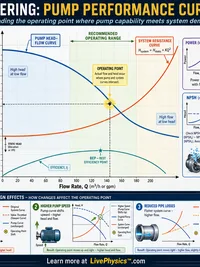
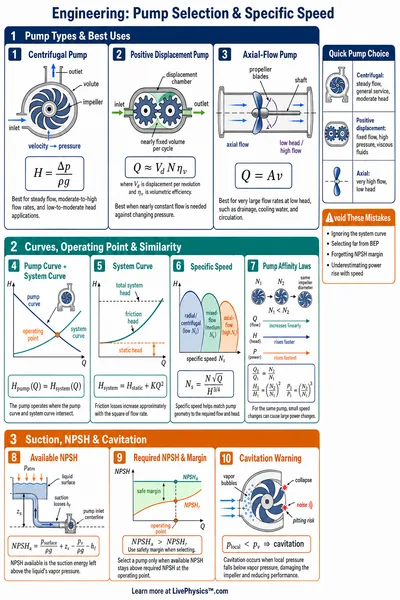
Pump curve, system curve, operating point
The teal curve is the pump, falling as flow rises. The amber curve is the system, rising from the static lift as flow squared. They cross at the red operating point, the only flow and head the pump and pipes both agree on.
Controls
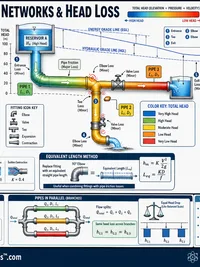
Series, the same flow runs through every pipe, so head losses add and resistance grows.
Diameter is the strongest lever. Head loss scales with diameter to the minus fifth power, so a small widening sharply cuts resistance.
A higher steepness a makes the pump curve fall faster, so the pump cannot hold its head as the flow rises.
The static lift is the height the water must rise. If it exceeds the shutoff head, the pump delivers no flow.
Operating point
| Pipe | D (mm) | Flow (L/s) | v (m/s) | h_f (m) |
|---|---|---|---|---|
| Pipe 1 | 100 | 23.98 | 3.05 | 2.85 |
| Pipe 2 | 100 | 23.98 | 3.05 | 1.90 |
| Diameter (mm) | K (s²/m⁵) | Operating flow (L/s) | Head (m) |
|---|---|---|---|
| 50 | 264,406 | 8.6 | 37.76 |
| 75 | 34,819 | 18.4 | 29.82 |
| 100 | 8,263 | 24.0 | 22.75 |
| 150 | 1,088 | 26.6 | 18.77 |
| 200 | 258 | 27.0 | 18.19 |
A bigger diameter sharply cuts head loss (D to the minus fifth power), so the system curve flattens and the operating point slides to a higher flow. Series adds resistance and lowers the flow, parallel reduces it and raises the flow.
Data Table
(0 rows)| # | Arrangement | Diameter (mm) | Pump H0 (m) | Static head (m) | Operating flow (L/s) | Operating head (m) |
|---|
Reference Guide
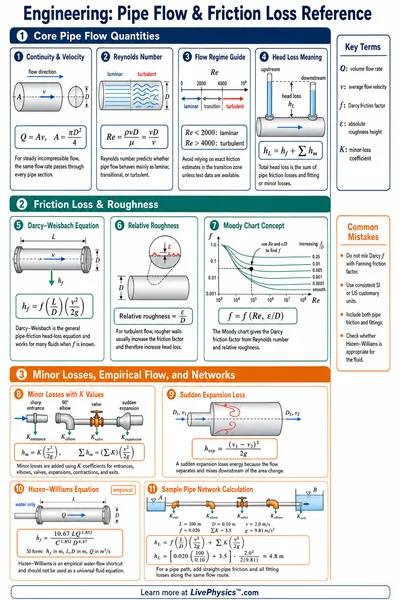
Head Loss and Why Diameter Matters
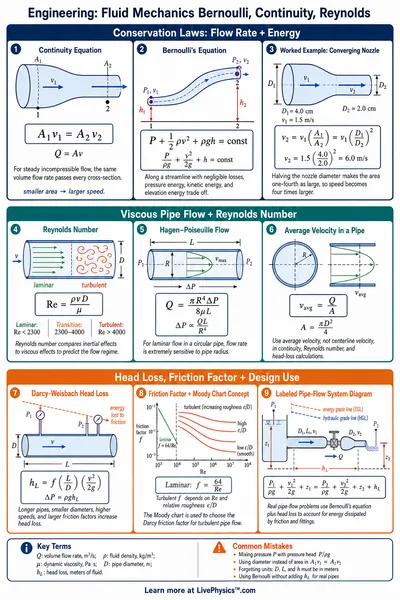
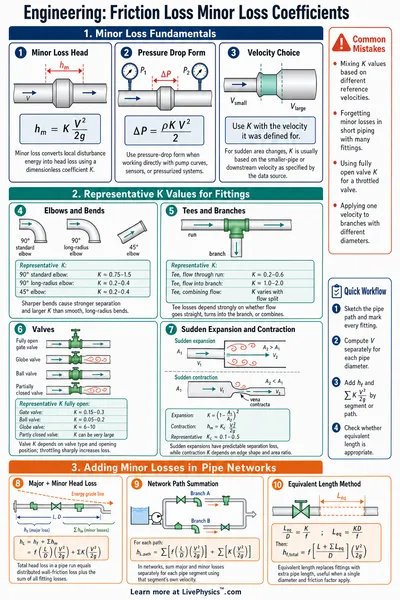
Darcy-Weisbach gives the head a flow loses to friction in a pipe. It rises with length and with the square of velocity, and it falls sharply as the pipe gets wider.
Writing the loss in terms of the flow rate Q gives a resistance K, where the head loss is K times Q squared. That K scales with diameter to the minus fifth power.
Halving the diameter multiplies the resistance by about 32. That is why widening a pipe is the strongest single way to move more flow.
The System Curve, Pump Curve, and Operating Point
The system curve is the head the pipes demand at each flow. It starts at the static lift, the height the water must rise, and climbs as the flow squared.
The pump curve is the head the pump can supply. It starts at the shutoff head H0 at zero flow and falls as the flow rises.
The operating point is the one flow where supply equals demand, where the two curves cross. If the shutoff head is below the static lift, the curves never cross at a positive flow and the pump delivers nothing.
Series and Parallel Networks
In a series network the same flow runs through every pipe, so the head losses add. The resistances add directly, and the network resistance is larger than any single pipe.
In a parallel network the pipes share the same head and their flows add. The resistance falls because each extra path gives the water another way through.
Two identical pipes in parallel cut the network resistance to a quarter, so the operating point moves to a higher flow. Series adds resistance and moves it lower.
Working Through the Lab
Start with a scenario, then change one thing at a time. Widen a pipe and watch the system curve flatten and the operating point slide to a higher flow. Switch between series and parallel and compare the network resistance.
The diameter comparison table shows the operating flow if the whole network used one diameter, so you can see the strong diameter effect at a glance. Record points to the data table and write up the tradeoffs in the lab report.
Try lowering the pump shutoff head below the static lift. The flow drops to zero, because a pump that cannot lift the water at all delivers nothing no matter how the pipes are arranged.