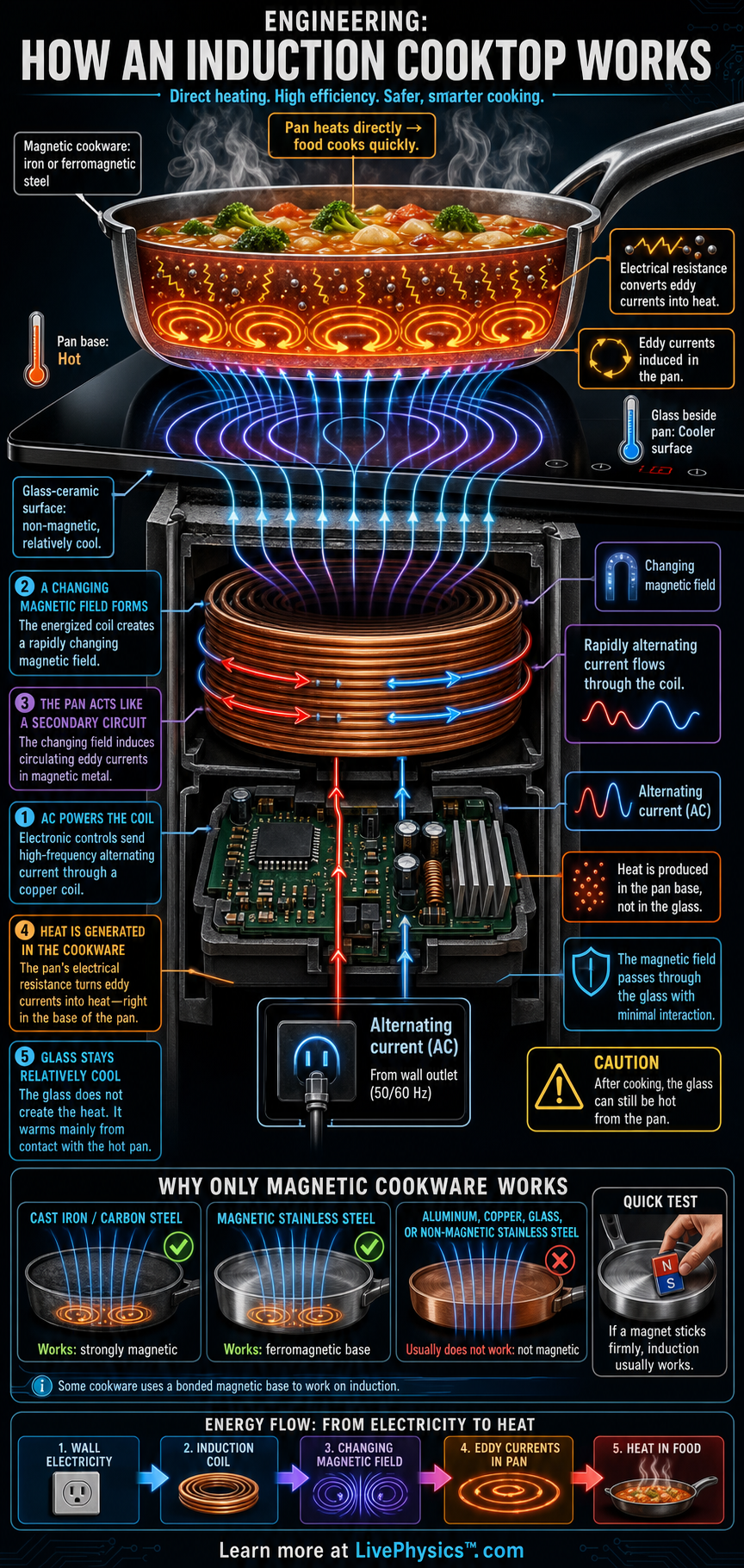
An induction cooktop heats a pan by transferring energy with a changing magnetic field instead of by heating a burner first. This makes cooking fast, efficient, and responsive because most of the energy is released inside the cookware. The glass-ceramic top stays relatively cool because it is not the main heat source.
It can still become hot from contact with the hot pan and spilled food.
Inside the cooktop, electronic controls send alternating current through a flat copper induction coil beneath the glass. The changing current creates a changing magnetic field that passes through the pan's base and induces circulating eddy currents in suitable cookware. Electrical resistance in the pan converts the energy of these currents into thermal energy, described by P = I²R.
Ferrous cookware works best because its magnetic properties strongly couple it to the changing field, concentrating energy in the pan.
Understanding Engineering, How an Induction Cooktop Works
The coil is driven by power electronics rather than directly from the wall outlet. First, the appliance changes the incoming electrical supply into a form that can be switched very quickly. Transistors then turn the current on and off thousands of times each second.
This high switching rate is useful because it produces a strong changing field without needing a huge coil. Many cooktops use a resonant circuit, where the coil works with capacitors. At the chosen frequency, energy moves efficiently back and forth between these parts.
The control system adjusts the switching to change the heating power. A low setting may send short bursts of energy, while a high setting sends energy for more of each second.
Cookware choice depends on more than whether a magnet sticks to it. The base must be magnetic enough to interact well with the field, but it must have a suitable electrical resistance too. Cast iron usually works well, though its rough base and slow response to temperature changes can affect cooking.
Magnetic stainless steel can work well when it has the right alloy and a flat base. Pure aluminium and copper conduct heat very well, but they are not normally magnetic. Some pans made from these metals have a magnetic steel layer bonded underneath.
The pan base should sit close to the glass and cover much of the coil area. A warped or very small pan receives energy less evenly.
The cooktop must detect whether a pan is present before it supplies significant power. It does this by observing electrical changes in the coil circuit. A suitable pan changes the way the circuit draws current and stores energy.
This lets the appliance stop when a pan is removed, which reduces wasted energy and limits hazards. Sensors inside the cooktop watch the temperature of electronic parts and the glass. They may reduce power if the system gets too hot.
These sensors do not always know the exact food temperature. Oil can become dangerously hot even when the appliance is operating normally, so cooking still needs attention.
This topic connects several school ideas in one device. Electricity supplies energy, magnetism transfers it across the glass, and thermal physics explains how that energy spreads through the pan and food. It is important to track where energy goes at every stage.
Some energy warms the coil, electronics, glass, air, and the handle, even though the pan base receives most of the useful energy. Heat then moves through the metal by conduction. Water in a saucepan gains energy until it boils, while a frying pan can become much hotter because little water is present.
When studying induction, separate the magnetic transfer step from the later heat transfer step. That distinction makes the engineering easier to understand.
Key Facts
- Alternating current in the induction coil produces a changing magnetic field.
- A changing magnetic field induces an emf, ε = -N dΦ/dt.
- The induced emf drives circulating eddy currents in the pan's base.
- Resistive heating in the pan follows P = I²R.
- The pan is the main heat source, while the glass heats mostly by conduction from the pan.
- Ferrous cookware, such as cast iron or magnetic stainless steel, couples strongly to the induction field.
Vocabulary
- Alternating current
- Electric current that repeatedly reverses direction, allowing the coil to create a changing magnetic field.
- Induction coil
- A flat coil of wire beneath the cooktop surface that creates the magnetic field used for heating.
- Magnetic flux
- A measure of how much magnetic field passes through a given area, such as the base of a pan.
- Eddy currents
- Circular electric currents induced within a conducting pan by a changing magnetic field.
- Ferrous
- Containing iron or having strong magnetic behavior that allows cookware to work effectively on an induction cooktop.
Common Mistakes to Avoid
- Thinking the magnetic field directly makes the pan hot. The changing field induces electric currents in the pan, and electrical resistance converts their energy into heat.
- Assuming any metal pan will work on induction. Aluminum and copper conduct electricity well but usually need a magnetic base because they do not couple strongly enough on their own.
- Believing the glass surface cannot become hot. The glass is heated secondarily by conduction from the hot pan, so it can remain hot after cooking.
- Confusing induction heating with a conventional electric radiant burner. A radiant burner first heats an element and then transfers heat to the pan, whereas induction primarily heats the pan itself.
Practice Questions
- 1 An induction cooktop delivers 1800 W to a pan for 4.0 minutes. How much energy is transferred to the pan in joules?
- 2 A region of a pan has an induced current of 12 A and an effective resistance of 0.50 Ω. Calculate the heating power using P = I²R.
- 3 A nonmagnetic aluminum pan and a cast-iron pan are placed on the same induction cooktop. Explain why the cast-iron pan heats much more effectively, even though aluminum is an excellent electrical conductor.