Thermal Resistance & Heat Exchanger Lab
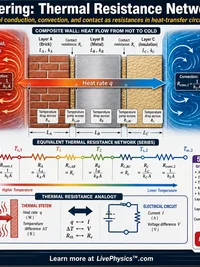
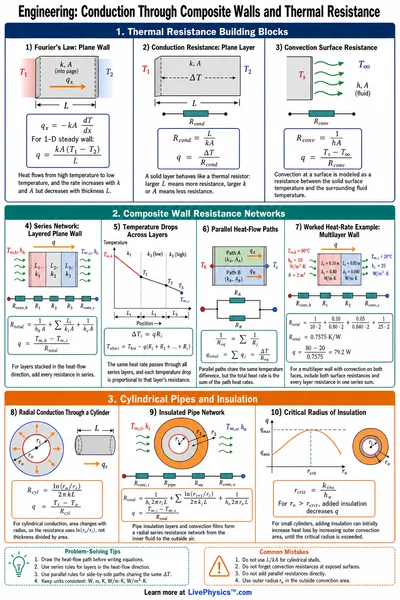
Treat a wall as a circuit. Each conduction layer and each air film is a thermal resistor. Stack them in series, add a window in parallel, and watch the total resistance, the U-value, and the steady-state heat-transfer rate Q change, then read the outlet temperature of a fluid stream that loses that heat.
Guided ExperimentWhich layer adds the most thermal resistance?
A wall has a thick brick layer and a thinner fiberglass layer. Predict which layer adds more thermal resistance, and what happens to the heat-transfer rate when you make the fiberglass thicker.
Write your hypothesis in the Lab Report panel, then click Next.
Thermal Resistance Circuit
Controls
- 1.Brickk 0.7 W/m·Kcm
- 2.Fiberglass insulationk 0.04 W/m·Kcm
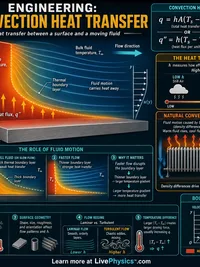
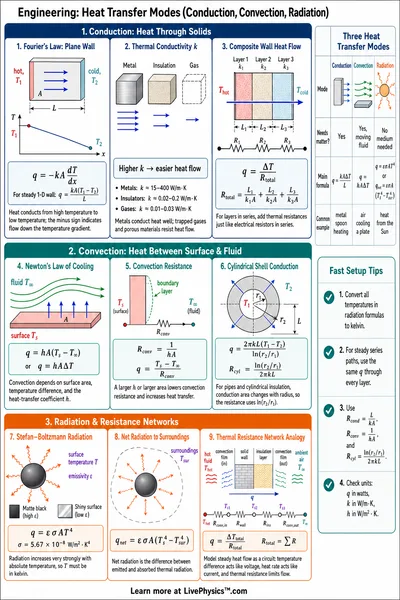
Still indoor air gives a low h around 8. Wind on the outside surface raises h toward 25 or more, lowering the film resistance.
The window covers part of the area and gives heat a second, easier path, in parallel with the wall.
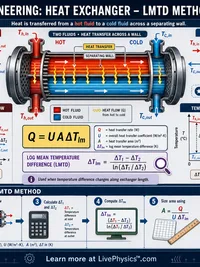
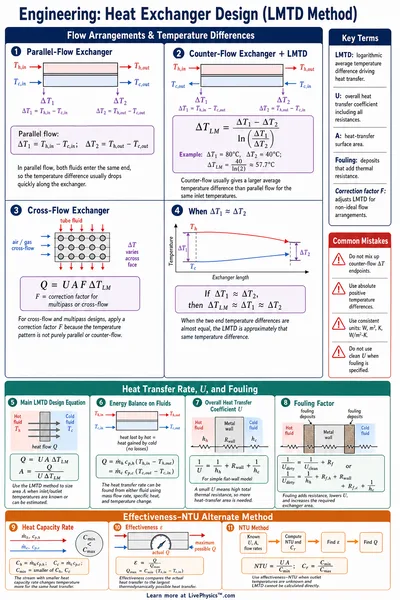
A warm stream at the inside temperature loses the wall heat rate Q and leaves a little cooler. A larger flow or a higher specific heat means a smaller drop.
Results
| Element | R (K/W) | Share | ΔT (°C) |
|---|---|---|---|
| Inside air film | 0.0125 | 5% | 1.4 |
| Brick 10 cm | 0.0143 | 6% | 1.5 |
| Fiberglass insulation 8 cm | 0.2000 | 87% | 21.7 |
| Outside air film | 0.0040 | 2% | 0.4 |
| Total | 0.2308 | 100% | 25.0 |
The temperature drop across each element is proportional to its resistance, just like voltage across resistors carrying the same current.
| Material | k | R (K/W) | U | Q (W) |
|---|---|---|---|---|
| Air gapbest insulator | 0.025 | 0.3508 | 0.285 | 71.3 |
| Fiberglass insulation | 0.04 | 0.2308 | 0.433 | 108.3 |
| Wood | 0.15 | 0.0841 | 1.189 | 297.2 |
| Brick | 0.7 | 0.0422 | 2.369 | 592.2 |
| Glass | 1 | 0.0388 | 2.578 | 644.6 |
| Concrete | 1.4 | 0.0365 | 2.740 | 684.9 |
| Steel | 50 | 0.0309 | 3.231 | 807.9 |
The lowest conductivity k gives the highest resistance and the smallest heat rate Q. A thin layer of a good insulator beats a thick layer of a conductor.
Data Table
(0 rows)| # | Wall makeup | Total R (K/W) | U-value (W/m²K) | Heat rate Q (W) | Outlet temp (°C) |
|---|
Reference Guide
Heat Flow as an Electrical Circuit
Steady heat flow through a wall maps directly onto Ohm's law. The temperature difference plays the role of voltage, the heat-transfer rate Q plays the role of current, and a thermal resistance R plays the role of electrical resistance.
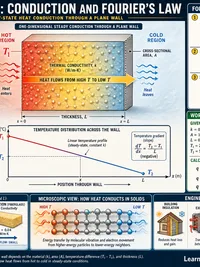
A conduction layer resists heat by R = L / (k A), where a low conductivity k or a large thickness L raises the resistance. A surface convection film resists by R = 1 / (h A). Build the wall and read each resistance in the results table.
Series and Parallel Resistance
Heat passes through the inside film, then each wall layer, then the outside film, one after another, so the resistances add in series. The same Q flows through every element, so the temperature drop across each one is proportional to its resistance.
A window gives heat a second path around the wall. Two branches in parallel always combine to a resistance lower than either one, which is why a window is the weak point of an otherwise well insulated wall.
U-value and Heat Rate
Engineers compare walls by the overall heat-transfer coefficient, the U-value. It rolls the whole resistance network into a single number per unit area, so the heat loss of any wall area follows directly from it.
A low U-value means a well insulated wall. Adding a thin layer of a good insulator, with its very low conductivity, lowers the U-value and the heat rate far more than a thick layer of brick or concrete.
The Fluid Stream Outlet
A warm fluid that flows past the wall loses the heat rate Q to the outside. How much its temperature falls depends on its heat-capacity rate, the mass flow times the specific heat.
Water has a high specific heat, so it carries a lot of heat with only a small temperature change. Air has a low specific heat, so the same heat loss cools it much more. This is the heart of how a heat exchanger transfers energy between streams.