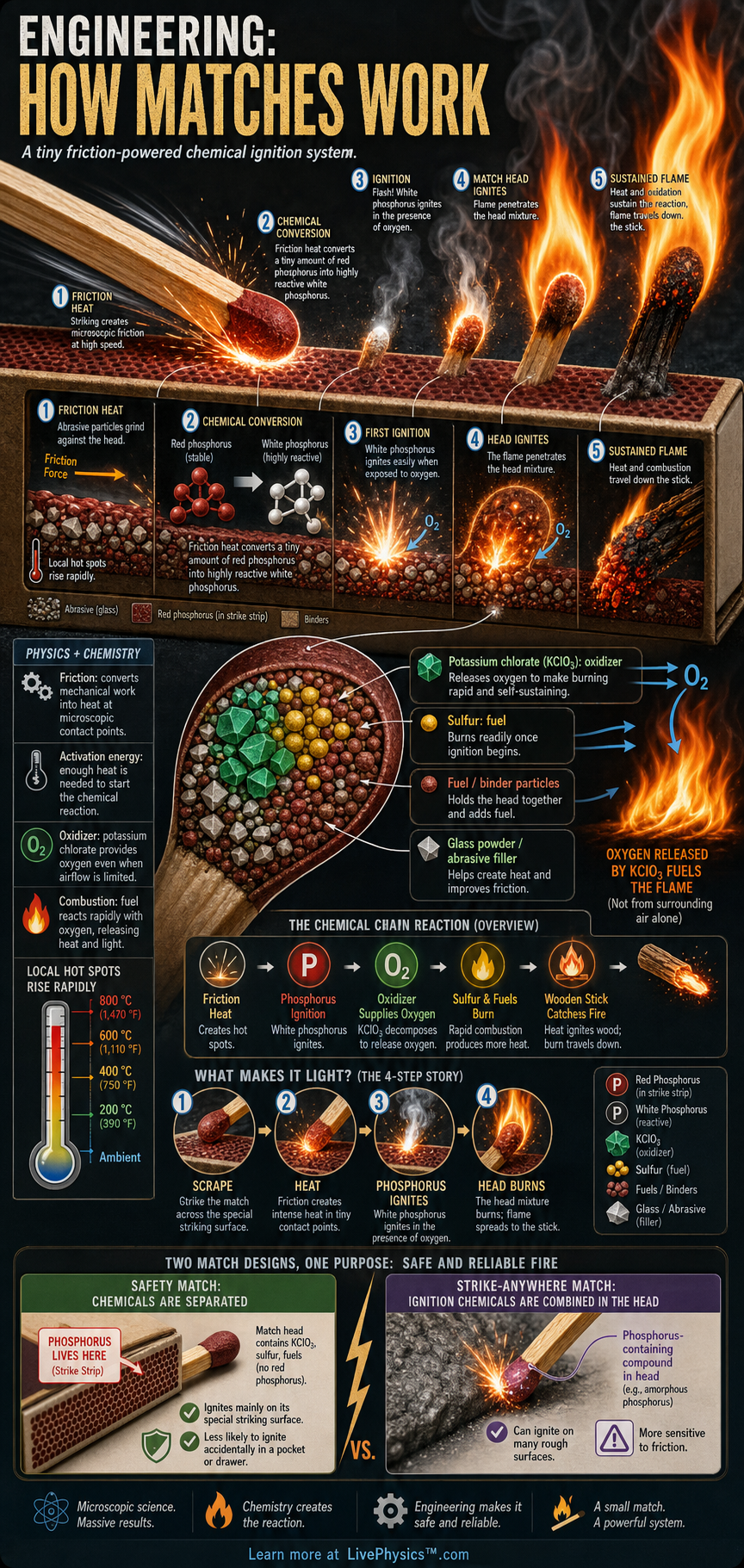
A safety match is a small engineered ignition system that turns mechanical motion into a controlled flame. Striking the match creates frictional heating at the rough strip, where special chemicals are kept separate until they are needed. This separation makes safety matches much less likely to ignite accidentally than older match designs.
The visible flame is the final stage of a rapid sequence involving heat, chemical reaction, and fuel.
The striker contains red phosphorus, abrasive particles, and a binder, while the match head commonly contains potassium chlorate, sulfur, fuel materials, and glue. Friction can convert a tiny amount of red phosphorus into a much more reactive phosphorus form that ignites in air. Its heat starts the decomposition of potassium chlorate, releasing oxygen that helps sulfur and other fuels burn even before enough outside air reaches the head.
The flame then heats the wooden stick or paper stem, allowing sustained combustion as long as fuel and oxygen remain available.
Understanding Engineering, How Matches Work
Ignition depends on reaching a threshold temperature in a very small region. The rough surface does more than resist motion. Its hard particles press into the match head and create tiny contact points.
Pressure at these points is much greater than the pressure from a finger alone. Heat is therefore concentrated instead of spread across the whole head.
A firmer, faster stroke usually transfers energy over a shorter time and can make the starting reaction more reliable. Too little pressure, a smooth worn strip, or a damp surface can prevent the temperature from reaching the needed level.
The head is designed as a mixture of particles with different jobs. Some materials provide fuel. Some provide oxygen through chemical change.
Others control how fast heat moves through the mixture. The glue holds the head together until ignition, but it must not stop the reaction once the head becomes hot. Particle size matters because smaller particles have more surface area available for reaction.
Close contact between fuel and oxidizer helps heat pass from one reacting particle to the next. This is why the flame can spread through the head quickly rather than burning only at the first hot spot.
A useful engineering idea here is controlled transfer. The early reaction must be energetic enough to light the head, yet the match should not react during ordinary handling. Keeping key ingredients on separate surfaces creates this balance.
The striker must remain rough and chemically active over many uses. The head must stay attached during transport, resist small bumps, and light with a predictable stroke. Humidity creates a real problem because water can absorb heat and can change how materials stick together.
Old or badly stored matches may crumble, fail to light, or burn weakly. The wooden stem or paper stem matters too because it carries the flame after the head has finished reacting.
Matches connect to several ideas students see beyond chemistry. Brake pads, tire grip, sanding, and drilling all use friction and surface roughness to manage energy. Fire safety uses the same idea of ignition temperature.
A material does not burn simply because it is fuel. It needs enough heat in the right place for long enough. Watching a match flame shows energy moving by conduction into the stem, convection into rising hot gases, and radiation from the glowing flame.
When learning this topic, pay attention to the difference between starting a reaction and sustaining it. The first stage is brief and localized. The later flame depends on continuing heat transfer and a steady supply of burnable material.
Key Facts
- Friction converts motion into thermal energy, Q ≈ fNd, where f is friction coefficient, N is normal force, and d is sliding distance.
- A safety-match striker contains red phosphorus, abrasives such as powdered glass, and a binder.
- Friction can create reactive phosphorus species from red phosphorus; these ignite and provide the first hot ignition source.
- Potassium chlorate is an oxidizer: 2KClO3 → 2KCl + 3O2.
- Released oxygen supports rapid burning of sulfur and fuel in the match head.
- Safety matches keep phosphorus on the striker, while strike-anywhere matches place a phosphorus compound in the match head.
Vocabulary
- Friction
- A force that resists sliding between surfaces and can convert mechanical energy into heat.
- Oxidizer
- A substance that supplies oxygen or another oxidizing chemical to help a fuel burn.
- Red phosphorus
- A relatively stable form of phosphorus used on safety-match striker surfaces.
- Potassium chlorate
- An oxygen-rich chemical in many match heads that decomposes when heated and acts as an oxidizer.
- Combustion
- A rapid chemical reaction between a fuel and an oxidizer that releases heat and often light.
Common Mistakes to Avoid
- Thinking friction alone keeps the match burning is wrong because friction mainly provides the initial heat needed to start chemical reactions. Sustained flame comes from combustion of the match-head and stem fuels.
- Saying that red phosphorus itself is the large fuel source in a safety-match head is wrong because it is mainly located on the separate striker. The head contains oxidizer, sulfur, and other combustible materials.
- Assuming potassium chlorate is a fuel is wrong because it is primarily an oxidizer. It helps other materials burn by releasing oxygen when heated.
- Treating safety matches and strike-anywhere matches as chemically identical is wrong because safety matches require the phosphorus-containing striker. Strike-anywhere designs include a reactive phosphorus compound in the head, making them easier to ignite accidentally.
Practice Questions
- 1 A match is struck with an average friction force of 3.0 N over a distance of 0.040 m. Estimate the thermal energy produced by friction using Q ≈ fNd.
- 2 A sample of potassium chlorate decomposes according to 2KClO3 → 2KCl + 3O2. If 4.0 mol of KClO3 decomposes completely, how many moles of O2 can be produced?
- 3 A safety match head is rubbed on smooth glass instead of its striker strip and does not light. Explain how the absence of the rough, red-phosphorus-containing striker affects the ignition sequence.